Wheat Straw Calculator
Estimate recoverable wheat straw, moisture-adjusted bale counts, nutrient removal, and practical bedding or mulch coverage from grain yield and field recovery assumptions.
Straw yield is estimated from wheat grain yield, a dry straw-to-grain ratio, and the portion actually recovered by the baler. Nutrients are calculated on dry tons, while bale counts use as-baled moisture weight.
Wheat Straw Results
Results separate dry matter from as-baled moisture so nutrient removal, bale counts, and coverage are not mixed together.
| Wheat stand condition | Dry straw-to-grain ratio | Dry straw per bushel | Field use note |
|---|---|---|---|
| Short-straw variety or high harvest index | 0.85 to 1.05 | 51 to 63 lb/bu | Use when heads are heavy and stems are short |
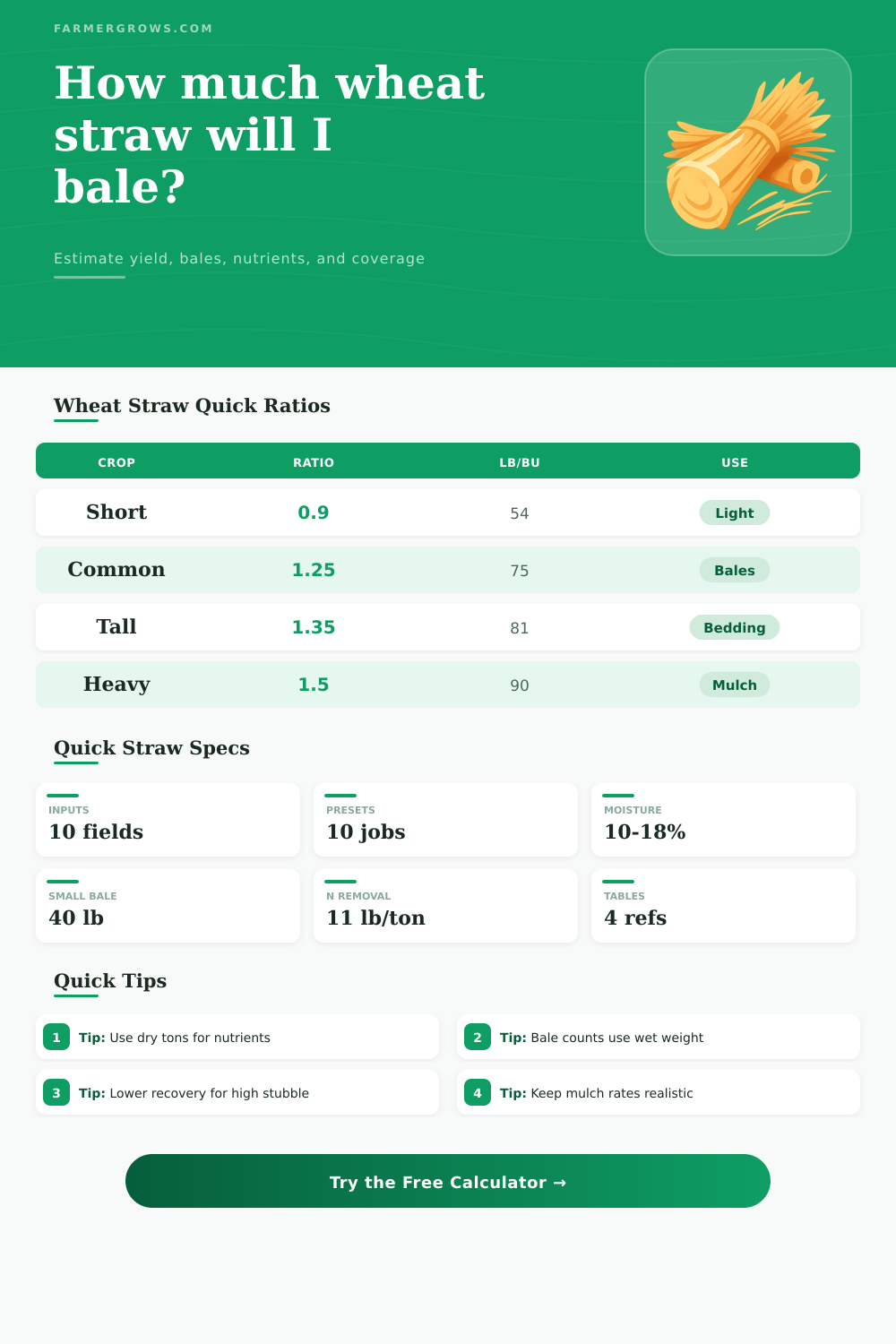
| Average winter wheat after normal cutting | 1.15 to 1.30 | 69 to 78 lb/bu | Good starting range for many baled fields |
| Tall conventional wheat with strong residue | 1.30 to 1.40 | 78 to 84 lb/bu | Close to common dry-matter research estimates |
| Heavy straw stand or high stubble capture | 1.40 to 1.55 | 84 to 93 lb/bu | Use only when field scouting supports heavy biomass |
| Known straw tonnage available | Back-calculate ratio | tons x 2000 / bushels | Use scale tickets or bale weights to refine future jobs |
| Bale format | Typical as-baled weight | Common moisture range | Approximate bales per wet ton |
|---|---|---|---|
| Small square, light | 35 lb | 10% to 16% | 57 bales/ton |
| Small square, dense | 40 to 50 lb | 10% to 16% | 40 to 50 bales/ton |
| Large square 3x3 | 700 to 900 lb | 10% to 15% | 2.2 to 2.9 bales/ton |
| Large square 3x4 | 1000 to 1300 lb | 10% to 15% | 1.5 to 2.0 bales/ton |
| Round 4x5 or 5x6 | 600 to 1100 lb | 10% to 18% | 1.8 to 3.3 bales/ton |
| Nutrient book value | N per dry ton | P2O5 per dry ton | K2O per dry ton | Removal emphasis |
|---|---|---|---|---|
| Ohio-style wheat straw | 11 lb | 3.7 lb | 29 lb | Balanced planning value for dry straw |
| Northern plains estimate | 12 lb | 1.5 lb | 30 lb | Potassium remains the major removed nutrient |
| Upper Midwest example | 14 lb | 3.3 lb | 24 lb | Often used with a 50 bu/ac, 2 ton straw example |
| Southern high-removal estimate | 20 lb | 3.3 lb | 45 lb | Matches high-yield straw removal examples |
| Use target | Dry straw rate | Coverage per 40 lb bale at 14% moisture | Coverage per dry ton | Planning note |
|---|---|---|---|---|
| Light seeded-area mulch | 6.9 lb/100 sq ft | 498 sq ft | 0.67 acre | Similar to 1.5 dry tons per acre |
| Standard seeded-area mulch | 9.2 lb/100 sq ft | 374 sq ft | 0.50 acre | Similar to 2.0 dry tons per acre |
| Garden mulch, settled layer | 12 lb/100 sq ft | 287 sq ft | 16,667 sq ft | Useful around vegetables and paths |
| Thicker vegetable bed mulch | 18 lb/100 sq ft | 191 sq ft | 11,111 sq ft | Better weed shading, less area covered |
| Deep bedding pack starter layer | 25 lb/100 sq ft | 138 sq ft | 8,000 sq ft | Use with stall cleaning frequency |
For nutrient planning: Use dry tons, not wet bale tons. Moisture changes scale weight, but it does not add nitrogen, phosphate, or potash to the straw dry matter.
For bale counts: Replace the default bale weight with scale weights from your own field. Straw density changes with bale chamber tension, chop length, moisture, and handling.
To estimate the value of wheat straw that will be sold, it is first necesary to determine the amount of wheat straw that is growing in each field. The amount of wheat straw that is present in a field isnt always easy to determine. For instance, field may appear to contain a great deal of wheat straw.
However, the actual amount of wheat straw that is growing in the field is dependent upon factors such as the height of the stubble that remains after the wheat is harvested, the amount of straw that becomes lost during the baling of the straw, and the moisture content of the straw bales themselves. Each of these factors must be accounted for in determining the value of the straw that the fields will produce. The calculation of the value of the wheat straw begins with the grain yield that each field produces.
How to Calculate the Value of Wheat Straw
As with the amount of wheat straw that is grown in each field, the yield of the fields is a number that the farmers who manage those fields already know. However, in addition to determining the amount of dry wheat straw that is produced relative to the grain yield, it is also necessary to determine how much of that wheat straw the hay baler collects. As with the amount of straw that is produced, the amount of straw that is collected is influenced by factors such as the variety of wheat that is planted in each field, and the weather conditions during the growth of the wheat.
For instance, wheat varieties that have short growing periods will produce less straw then those with taller plants. A calculator that is programmed to determine these values relative to the wheat straw that was observed in each field can perform these calculations. The moisture content of the wheat straw is another factor that must be accounted for when calculating the value that the farmers will place upon the straw that is produced by their fields.
The weight of the straw bales can be measured when they contain moisture from the straw. However, calculations regarding the nutrients that the straw removes is based upon the dry weight of that straw. For instance, the dry weight of straw bales that contain 14% moisture will be less than the dry weight of bales of dry wheat straw.
Furthermore, the value of straw can be based upon its weight when used as bedding for animals. Thus, the calculator allows farmers to separate these calculations, determining the dry tons of straw that the fields produce, as well as the total number of bales that is produced. Another factor in determining the value of wheat straw is the percentage of the straw that the baler collects.
Factors such as raking of the straw may allow farmers to collect most of the straw that grows from the fields. However, some straw will always remain in the stubble fields. Additionally, straw bales that are piled in windrows may experience a loss of straw if rain or wind destroys some of the straw.
A percentage of 78% is often used to estimate straw recovery. However, straw may be lost if the cutterbar of the hay baler is set high to ground the fields, or if the fields are uneven. A calculator can help farmers to determine the value of straw bales if different percentages of straw recovery are tested.
The nutrient content of straw is another calculation that can be performed with the calculator. Straw contains very little nitrogen, but contains significant amounts of potassium. Because many fields has low levels of potassium, the removal of this nutrient from fields is one of the reasons to calculate the amount of straw that is grown by each field.
Furthermore, if the land is leased to another farmer, the potassium will be removed from the soil that is leased, and the next tenant will need to replenish that amount of potassium. Therefore, each field should have a nutrient profile that is established for that region of the country. Thus, farmers will be able to determine how much potassium the growing of wheat removes from each field each year.
Other calculations that will help farmers to determine the value of wheat straw includes determining how much area that the straw will cover if it is used as mulch, or how many animal-day can be covered by each ton of straw if it is used for bedding for farm animals. For mulching applications, straw may be used in thin layers to prevent soil erosion, or in thick layers to mulch garden plots. Each dry ton of wheat straw will include both the number of acres that it will cover as mulch, as well as the number of animal-days that one ton of straw will cover.
Tables are provided with the calculator that may assist in each of these calculations. Tables can show the different ratios of wheat straw to grain based off the height of the wheat plants, as well as the different weights of different types of wheat straw bales. These tables dont need to be memorized, but may be scanned to ensure that the assumptions made about straw production are accurate.
The use of each of these calculations will allow each farmer to ensure that the straw that is harvested from their fields meets their own needs. Farmers need to know how much straw is required to cover their acres with mulch, or how much is required to provide bedding for their farm animals. Furthermore, farmers need to ensure that the nutrients that leave their fields are those that are acceptable to the soil in which the wheat was grown.
Thus, by calculating these different values, farmers will be able to avoid any potential problems with their fields in the spring. They should of checked the straws moisture before selling. It is actualy a lot of work to get it right.