Hay Calculator for Cattle
Estimate cattle hay needs from body weight, dry matter intake, forage share, hay moisture, feeding waste, bale weight, and winter feeding days.
Use tested hay dry matter and realistic feeder waste when possible. This planner estimates hay inventory, not a complete ration, so mineral, protein, energy, water, and veterinary needs still require local herd management.
Hay Feeding Estimate
Results convert dry matter demand into as-fed hay, then add feeding waste and reserve inventory.
| Cattle class | Typical body weight | DMI range | Hay share guidance | Feeding note |
|---|---|---|---|---|
| Dry beef cow, mid gestation | 1,000 to 1,400 lb | 1.8% to 2.2% BW | 90% to 100% hay DM | Works for average body condition in mild weather with adequate hay quality. |
| Beef cow, late gestation | 1,050 to 1,450 lb | 2.0% to 2.4% BW | 85% to 100% hay DM | Intake and nutrient need rise as calving approaches, especially in cold weather. |
| Lactating beef cow | 1,100 to 1,500 lb | 2.4% to 3.0% BW | 75% to 95% hay DM | Milk production increases both intake and forage quality requirements. |
| First-calf heifer | 850 to 1,150 lb | 2.3% to 2.8% BW | 75% to 95% hay DM | Still growing while gestating or lactating, so do not understate demand. |
| Growing stocker calf | 450 to 800 lb | 2.6% to 3.2% BW | 60% to 90% hay DM | Higher quality hay improves gain when concentrates are limited. |
| Mature bull | 1,600 to 2,200 lb | 1.6% to 2.1% BW | 85% to 100% hay DM | Adjust upward before breeding season or during cold exposure. |
| Dry dairy cow | 1,300 to 1,700 lb | 1.8% to 2.3% BW | 45% to 80% hay DM | Ration balance matters more than hay volume alone near freshening. |
| Lactating dairy cow | 1,300 to 1,700 lb | 3.0% to 4.2% BW | 25% to 60% hay DM | Hay is usually only part of total ration dry matter. |
| Body weight class | 2.0% DMI | 2.5% DMI | 3.0% DMI | Useful cattle examples |
|---|---|---|---|---|
| 500 lb calf | 10 lb DM/day | 12.5 lb DM/day | 15 lb DM/day | Light stocker, weaned calf, replacement calf |
| 700 lb calf | 14 lb DM/day | 17.5 lb DM/day | 21 lb DM/day | Growing stocker or backgrounder |
| 900 lb heifer | 18 lb DM/day | 22.5 lb DM/day | 27 lb DM/day | Replacement heifer or first-calf heifer |
| 1,100 lb cow | 22 lb DM/day | 27.5 lb DM/day | 33 lb DM/day | Smaller beef cow or young mature cow |
| 1,300 lb cow | 26 lb DM/day | 32.5 lb DM/day | 39 lb DM/day | Mature beef cow or dry dairy cow |
| 1,500 lb cow | 30 lb DM/day | 37.5 lb DM/day | 45 lb DM/day | Large beef cow or dairy cow |
| 1,900 lb bull | 38 lb DM/day | 47.5 lb DM/day | 57 lb DM/day | Mature breeding bull |
| Hay condition | Moisture | Dry matter | As-fed hay for 30 lb DM | Planning note |
|---|---|---|---|---|
| Very dry hay | 8% to 10% | 90% to 92% | 32.6 to 33.3 lb | Usually stores well if protected from ground and weather. |
| Well-cured hay | 11% to 13% | 87% to 89% | 33.7 to 34.5 lb | Good default for dry hay planning when no test is available. |
| Typical dry hay | 14% to 16% | 84% to 86% | 34.9 to 35.7 lb | Common planning range for many grass and mixed hays. |
| High-moisture hay | 17% to 20% | 80% to 83% | 36.1 to 37.5 lb | Needs more as-fed weight to supply the same dry matter. |
| Damp or risky hay | 21% to 25% | 75% to 79% | 38.0 to 40.0 lb | Watch heating, mold, refusals, and storage losses carefully. |
| Feeding method or storage | Typical waste | Why waste changes | Calculator setting |
|---|---|---|---|
| Covered storage plus bunk or well-managed feeder | 5% to 10% | Less weathering, less trampling, and tighter access. | Use 5% to 10% |
| Round bale feeder on firm pad | 10% to 20% | Some leaf loss, sorting, dropped hay, and edge weathering. | Use 15% default |
| Ring feeder moved through pasture | 15% to 25% | Mud, bale exposure, and manure contamination raise refusal. | Use 20% to 25% |
| Unrolled hay or loose ground feeding | 20% to 35% | Cattle walk on hay and waste rises when supply exceeds cleanup. | Use 25% to 35% |
| Outdoor bale storage without cover | 10% to 30% extra | Outer layers weather, especially on soil contact and old bales. | Add reserve or waste |
| Bale type | Common dimensions | Typical as-fed weight | DM at 88% hay | Handling note |
|---|---|---|---|---|
| Small square bale | 14 x 18 x 36 in | 40 to 70 lb | 35 to 62 lb DM | Easy to hand feed but more labor per ton. |
| Large square bale | 3 x 3 x 8 ft | 700 to 1,000 lb | 616 to 880 lb DM | Stacks efficiently and feeds well in bunks. |
| Large square bale | 3 x 4 x 8 ft | 900 to 1,400 lb | 792 to 1,232 lb DM | High tonnage per bale; check loader capacity. |
| Round bale | 4 x 5 ft | 700 to 950 lb | 616 to 836 lb DM | Common for smaller herds and lighter equipment. |
| Round bale | 5 x 5 ft | 900 to 1,200 lb | 792 to 1,056 lb DM | Useful default when actual weights are unknown. |
| Round bale | 5 x 6 ft | 1,200 to 1,800 lb | 1,056 to 1,584 lb DM | Large inventory units; weighing matters a lot. |
| Production stage | Demand direction | Hay quality focus | Practical adjustment |
|---|---|---|---|
| Mid gestation beef cow | Lower | Moderate grass hay can work if body condition is good. | Watch thin cows and separate them when possible. |
| Last 60 days before calving | Rising | Better energy and protein support fetal growth. | Raise intake estimate or improve hay quality. |
| Early lactation beef cow | High | Palatable, higher quality hay helps milk and rebreeding. | Reduce waste and avoid long gaps between feedings. |
| Growing replacement heifer | Moderate to high | Protein and digestibility influence target gain. | Use a higher DMI percent than mature dry cows. |
| Lactating dairy cow | Very high | Forage test and ration balance are essential. | Use hay share only for the hay portion of the ration. |
Use dry matter first: Cattle eat nutrients, not water. A 1,100 lb bale at 88% dry matter supplies about 968 lb of hay dry matter before feeder waste.
Separate high-need cattle: Thin cows, first-calf heifers, lactating cows, and growing calves may need better hay or a different ration than dry mature cows.
Planning for the winter months for a herd of cattle require a determination of how much hay the herd will consume when the grass stops growing. The total amount of hay that are required for the cattle herd can be calculated with a hay calculator by entering information regarding the body weight of the herd, the stage of production of the herd, and the quality of the forage that the cattle consume. Additionally, the hay calculator will ask for information regarding how much hay the cattle consume each day, as well as how much of the total daily intake come from hay versus other sources of feed for the cattle herd.
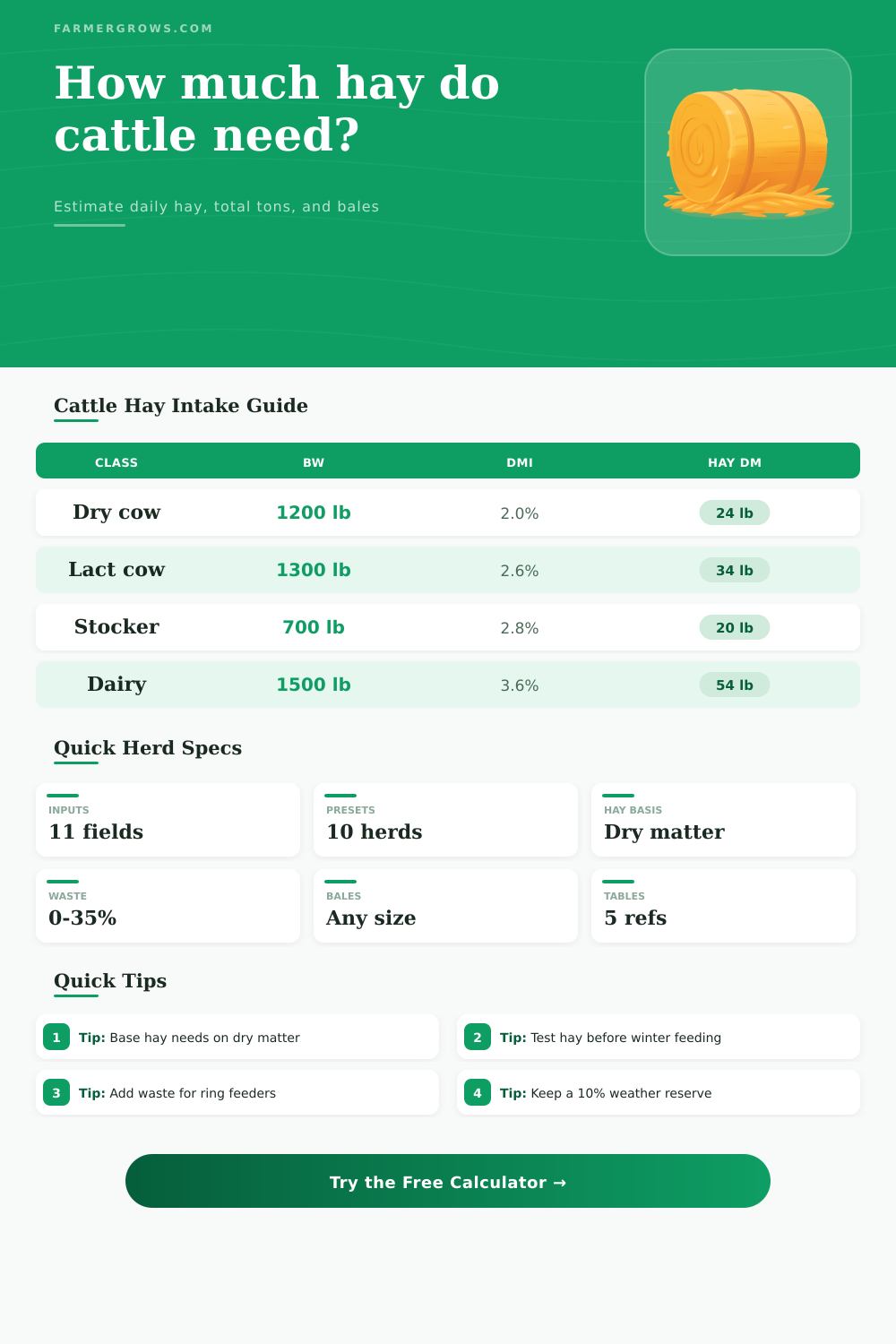
The hay calculator uses the body weights of the cattle as a baseline measurement. However, the percentage of the body weights that the cattle consume each day will depend upon the stage of production of each individual cow. For instance, dry mature cow may consume 2% of there body weight in feed each day, but milking dairy cows may consume over 3.5% of their body weight in feed each day.
Plan Winter Hay for Cattle
The hay calculator will allow for the entry of these percentages into the hay calculator to determine the amount of hay that is needed to meet the requirements of each individual herd of cattle. Furthermore, the hay calculator will also ask for the percentage of the total feed ration that will come from hay. If other sources of feed is provided to the herd, the amount of hay that is required will decrease, and the hay calculator will provide an updated calculation of the amount of hay that should be purchased for the winter months.
The amount of hay that the cows consume may not be equal to the amount of hay that is delivered to the bunk. For example, hay will contain some percentage of moisture; the hay calculator will ask for the percentage of dry matter contain in the hay, which will allow for calculations of the amount of hay that is needed to provide the amount of dry matter that is required by the herd. Furthermore, hay that is delivered to the feeding area may be lost due to various reason.
For example, if hay is fed through ring feeders to ground that is firm and dry, the cattle may lose 15% or more of the hay that is delivered to the feeding area due to the cattle trampling of the hay. Similarly, hay that is stored outdoors and fed to the cattle may lose additional portion of that hay due to weathering of the hay stacks. The hay calculator will ask for the percentage of hay that will be lost due to these feeding and storage issue, which will allow for adjustments in the amount of hay that should be purchased for the winter months.
After establishing the amount of hay that is required to be provided each day, the hay calculator can calculate the total amount of hay that is required to last the winter; such an estimation take into account the length of the winter months as well as the amount of hay that is to be stored in case of extreme cold weather that may occur during the winter months. After the hay calculator establishes the total amount of hay (in tons), it will ask for the size of hay bale that are to be used within the cattle farm; the hay calculator will calculate the total number of hay bales that will be required for the winter months. Finally, the hay calculator will ask about the quality of hay that will be purchased; while not a calculation by itself, the decision about hay quality can be made based off the information provided within the hay calculator.
Reference tables are included on the hay calculator page; these tables include information about the dry matter intake of different class of cows, and the weights of hay bales of different sizes. These reference tables can help to ensure that the numbers that are entered into the hay calculator are within the range of typical hay consumption. Furthermore, these reference tables can help the farmer to decide, for instance, whether it is better to provide higher quality hay to first-calf heifers or whether it is better to feed lower quality hay to the entire herd.
The hay calculator is most useful when compared to the amount of hay that is actualy use on the ground within the feeding area. For instance, you can weigh bales of hay at the beginning of the winter months. When the winter months are over, those same bales can be weighed again to determine the percentage of hay that was lost to feeding and storage.
These percentages can be entered into the hay calculator for the following winter months to establish an estimate of the amount hay that should be purchased for the following winter months. Thus, the hay calculator has the ability to become a record of the amount of hay that the herd of cows actualy consumes. When used over several winter months, the hay calculator will allow a farmer to establish a pattern of hay consumption, indicating that hay purchases will become a calculated decision rather than a guess.
Thus, hay planning itself is a process of matching hay supply to hay needs, and the hay calculator establish such a matching between hay supply and hay needs.