Straw Bale Calculator
Estimate straw bales for garden mulch, whole-bale beds, erosion cover, and livestock bedding using bale size, settled depth, shake-out volume, waste, and delivery limits.
Use settled coverage depth for mulch or bedding, then choose a bale type that matches what is actually being delivered. Straw bale weights vary with moisture, crop, and baler density, so the calculator reports both average weight and a practical range.
Straw Bale Estimate
Results use area x settled depth for loose straw volume, bale dimensions x shake-out factor for usable volume per bale, then add the selected waste allowance.
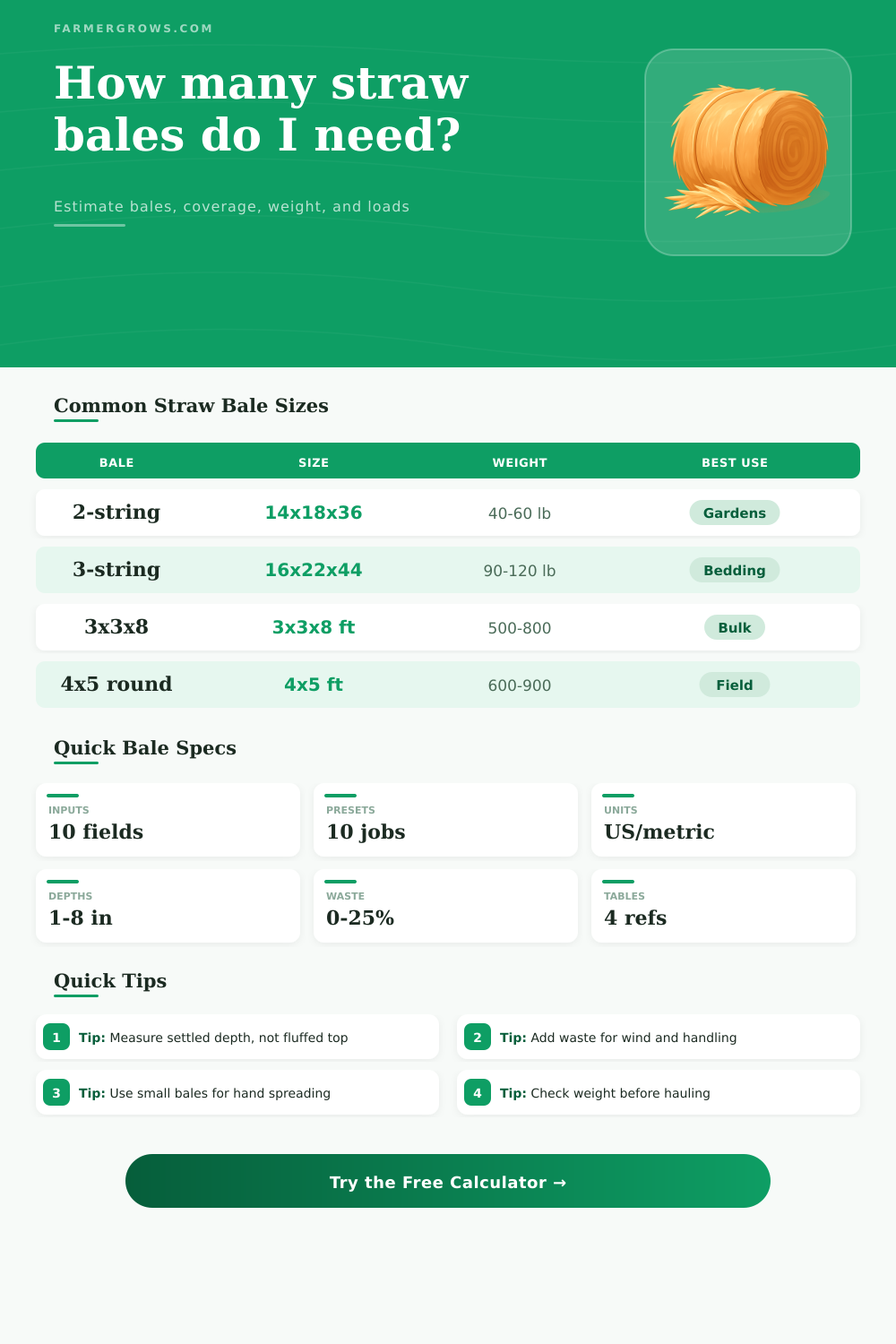
| Bale type | Typical dimensions | Compressed volume | Typical straw weight | Handling note |
|---|---|---|---|---|
| 2-string small square | 14 x 18 x 36 in | 5.25 cu ft | 40 to 60 lb | Most common hand-stacked garden and bedding bale |
| Garden rectangular bale | 18 x 24 x 36 in | 9.0 cu ft | 50 to 75 lb | Common size for straw bale gardening layouts |
| 3-string square | 16 x 22 x 44 in | 9.96 cu ft | 90 to 120 lb | More volume per bale, harder to lift by hand |
| Large square | 3 x 3 x 8 ft | 72 cu ft | 500 to 800 lb | Needs loader, spear, or forks |
| Large square | 3 x 4 x 8 ft | 96 cu ft | 800 to 1200 lb | Bulk bedding delivery and barn storage |
| Round bale | 4 ft wide x 4 ft diameter | 50.3 cu ft | 400 to 600 lb | Smaller round bale for compact equipment |
| Round bale | 4 ft wide x 5 ft diameter | 78.5 cu ft | 600 to 900 lb | Common field bale; actual density varies widely |
| Round bale | 5 ft wide x 5 ft diameter | 98.2 cu ft | 800 to 1200 lb | High-volume bale for machinery handling |
| Settled depth | Loose straw per 100 sq ft | Area per loose cu yd | 2-string bale coverage at 2.1x | Typical use |
|---|---|---|---|---|
| 1 in | 8.3 cu ft | 324 sq ft | 132 sq ft | Light seed cover or soil splash guard |
| 2 in | 16.7 cu ft | 162 sq ft | 66 sq ft | Light vegetable bed mulch |
| 3 in | 25.0 cu ft | 108 sq ft | 44 sq ft | General garden mulch and paths |
| 4 in | 33.3 cu ft | 81 sq ft | 33 sq ft | Heavy tomato, potato, or garlic mulch |
| 6 in | 50.0 cu ft | 54 sq ft | 22 sq ft | Deep litter bedding or winter protection |
| 8 in | 66.7 cu ft | 40.5 sq ft | 16.5 sq ft | Fresh bedding pack startup |
| Project | Common depth | Waste factor | Planning shortcut | Field note |
|---|---|---|---|---|
| Vegetable bed mulch | 2 to 4 in | 5% to 15% | One 2-string bale covers about 33 to 66 sq ft | Pull straw away from crowns and small stems |
| Garlic or winter cover | 3 to 5 in | 10% to 15% | Plan extra for settling after rain | Fluff again if crusting forms |
| Chicken deep litter | 4 to 8 in | 10% to 20% | Multiply by refresh count for the season | Dry storage keeps absorbency useful |
| Horse or calf bedding | 3 to 6 in | 10% to 20% | Use stall count as the application multiplier | Heavy urine areas need spot bedding |
| Seeded slope cover | 1 to 2 in | 15% to 25% | Thin enough for light and seedlings | Anchor on windy or steep ground |
| Delivery setup | Usual payload range | Typical 2-string bales | Large bale fit | Planning note |
|---|---|---|---|---|
| Small pickup bed | 800 to 1200 lb | 12 to 24 bales | Not practical | Weight and stack height both matter |
| Full-size pickup | 1200 to 2000 lb | 24 to 40 bales | One small round only if loaded safely | Check axle, tires, and tiedown limits |
| Utility trailer | 1500 to 3500 lb | 30 to 70 bales | Small rounds or one large square | Deck space often limits square bales first |
| Flatbed or hay wagon | 4000 lb and up | 80 plus bales | Multiple large squares or rounds | Plan unloading path before stacking |
| Barn handling allowance | Use 10% extra time | Applies to hand stacking | Applies to loader moves | Broken strings and loose flakes add waste |
For garden mulch: Calculate from the depth you want after rain and foot traffic. Freshly shaken straw looks taller than the settled layer that actually suppresses weeds.
For bedding: Keep bale count, weight, and handling separate. A large square may be efficient on paper, but only if machinery can place it where the bedding is used.
Straw bale projects is often more complex in person than straw bale projects are on paper. While a person may measure the garden bed or the stall floors, and even picture the finished layer of straw, a person will encounter new questions in the field. These questions may include how much the straw will expand when shake loose, how much weight a truck can carries, and how much straw will be lost to the wind or mud before it can be spread.
The straw bale calculator will provides mathematical results for each question once you enter the area of your projects, the settled depth of the straw bale project, and the type of bale of straw you will use. Such a calculator will eliminate guesswork in determining factor like how much straw will expand, how much straw will be lost to shake-out, and how much straw will be lost due to waste. Each factor has a direct impact upon the results of the straw bale calculator.
How to Use a Straw Bale Calculator
For instance, using the height of the fluffy straw bales rather then the settled depth will result in ordering too much straw for the project. The type of bale of straw can impact how much work you will have to do with the straw bales. Small two-string bales are easy to lift and split into flake, but you must move more individual piece of straw.
Large square and round bales requires less moving, but you may require the use of a loader to move the bales to the project. The calculator allows changing the type of bale to see its impact upon the number of trip to move the straw bales or the amount of physical work to be done with the straw bales. The waste allowance for a straw bale project are an important input for the project, but one that many straw bale project enthusiasts will consider to be an optional input.
The waste allowance is the extra straw bales that must be ordered to account for straw lost to wind, mud, and waste during the project. It is helpful to order an extra ten or fifteen percent of straw bales to account for waste during the project, rather than needing to recalculate the amount of straw needed upon delivery of the order. Another important factor in straw bale projects is the shake-out factor.
Compressed straw take up less space than straw shaken to loosen the flakes of straw. A shake-out factor can account for the shaking of the straw flakes apart by hand versus with a straw blower or straw chopper. Using the wrong shake-out factor will result in not having enough straw bales for the project.
In addition to the straw bale calculator, it is also important to consider the limits in which the straw bales will be delivered. The payload limit of a truck may not agree with the limits of the flat deck of the truck. You should use the lower of the two limits in the calculation to determine how many straw bale will be delivered in a trip.
The straw bale calculator considers both limits to avoid overloading the axle of the truck or trailer with the straw bales. Finally, straw bale projects have many shape that are not perfect rectangles. The limits of the areas to be covered in a project may involve tree ring, slopes, stalls with feeders in the corners of the stalls, and more.
These features will require adjustment of the amount of straw bales calculated by the straw bale calculator. While the straw bale calculator provides an estimated amount of straw bales needed for the project, a person will need to use they’re own judgement to determine if there is the need for additional straw bales for these odd corners or shapes in the project. It is also helpful to run the straw bale calculator for the first choice of size of bale, and then to run the straw bale calculator for a different size of bale.
Such calculations will allow you to compare the results of each kind of bale, which will allow you to make a decision as to which bale size is better for your project, whether smaller bales for ease of movement, or large bales that allow for the rental of a loader to deliver the bales to the project. Seeing the result of both kind of straw bales will allow you to make a plan for your straw bale project instead of guessing at the proper number of bale to order.