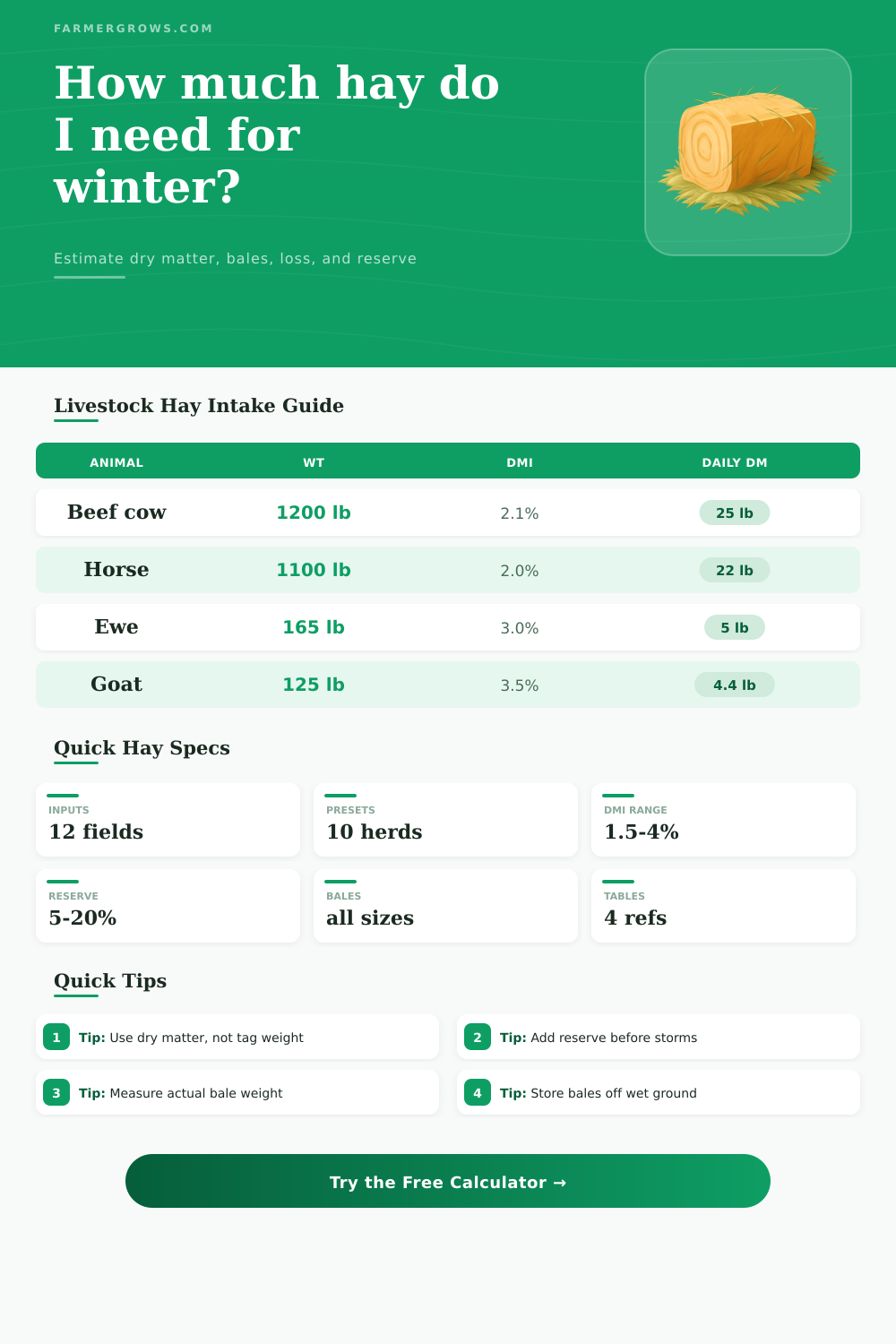
Winter Hay Calculator
Estimate winter forage needs from livestock dry matter intake, hay moisture, bale weight, feeding waste, storage loss, and reserve days before cold weather locks in.
Use actual bale weights and a forage test when available. This calculator estimates hay quantity, not a complete ration, mineral program, or veterinary nutrition plan.
Winter Hay Estimate
Results convert animal dry matter demand into as-fed hay, then account for quality adjustment, storage loss, feeding loss, and reserve.
| Livestock class | Typical body weight | Dry matter intake range | Example daily DM | Planning note |
|---|---|---|---|---|
| Dry mature beef cow | 1,100 to 1,400 lb | 2.0% to 2.2% BW | 24 to 29 lb at 1,300 lb | Use higher end during cold stress or late gestation. |
| Lactating beef cow | 1,100 to 1,400 lb | 2.5% to 3.0% BW | 31 to 38 lb at 1,250 lb | Nursing calves and cold weather raise forage demand. |
| Growing calves or stockers | 500 to 800 lb | 2.3% to 2.8% BW | 15 to 18 lb at 650 lb | Performance goals may require grain or higher quality forage. |
| Dairy cow forage base | 1,200 to 1,500 lb | 3.0% to 4.0% BW total DMI | 42 to 56 lb at 1,400 lb | Total ration should be balanced; hay may be only part of DMI. |
| Mature horse | 900 to 1,200 lb | 1.5% to 2.5% BW | 17 to 22 lb at 1,100 lb | Many horse plans target at least 1.5% BW forage DM. |
| Ewe or sheep | 130 to 190 lb | 2.5% to 3.5% BW | 4 to 6 lb at 165 lb | Late gestation and lactation increase both intake and quality needs. |
| Meat or dairy goat | 90 to 160 lb | 3.0% to 4.0% BW | 4 to 5 lb at 125 lb | Sorting waste is often higher with stemmy hay. |
| Alpaca or llama | 120 to 350 lb | 1.5% to 2.0% BW | 2.7 to 3.0 lb at 150 lb | Body condition scoring matters because intake percentage is modest. |
| Bale type | Common weight range | Typical calculator weight | Hay DM at 88% | Handling note |
|---|---|---|---|---|
| Small square bale | 40 to 70 lb | 55 lb | 48 lb DM | Easy to ration by flake, but actual flakes vary widely. |
| Three-string square | 90 to 130 lb | 110 lb | 97 lb DM | Common in western hay markets and horse barns. |
| Round bale 4 x 5 ft | 800 to 1,100 lb | 900 lb | 792 lb DM | Density, forage species, and baler pressure change weight fast. |
| Round bale 5 x 5 ft | 1,000 to 1,400 lb | 1,200 lb | 1,056 lb DM | A practical beef cow planning size in many regions. |
| Round bale 5 x 6 ft | 1,300 to 1,800 lb | 1,500 lb | 1,320 lb DM | Heavy enough that storage site and loader capacity matter. |
| Large square 3 x 3 x 8 ft | 700 to 1,100 lb | 900 lb | 792 lb DM | Stacks efficiently under cover and feeds well in TMR systems. |
| Large square 3 x 4 x 8 ft | 1,100 to 1,700 lb | 1,400 lb | 1,232 lb DM | Strong choice for high-volume farms with proper equipment. |
| Loss source | Typical range | Use this when | Calculator effect | Field note |
|---|---|---|---|---|
| Indoor storage | 2% to 5% | Barn, shed, or well ventilated covered stack | Raises hay inventory slightly | Keep airflow so bales do not heat or mold. |
| Covered outside storage | 5% to 10% | Tarped, wrapped, or roofed bales with drainage | Moderate inventory increase | Keep bales off soil and shed water away from ends. |
| Uncovered outside storage | 10% to 25% | Bales exposed to rain, snow, and sun | Large inventory increase | Round bale outer layers can carry much of the loss. |
| Ground contact or poor drainage | 15% to 30% | Bales sit on wet soil or in low spots | Very large inventory increase | Bottom spoilage can quietly erase usable feed. |
| Ring or rack feeding | 5% to 15% | Hay is confined and moved before mud builds | Divides by usable feeding fraction | Good feeders reduce trampling and bedding contamination. |
| Unrolled or ground feeding | 15% to 35% | Hay is spread on snow, mud, or sod | Substantially raises hay needed | Works best only when daily placement and clean ground are managed. |
| Planning factor | Typical value | When to use it | Reserve guidance | Forage quality note |
|---|---|---|---|---|
| Mild winter or long grazing season | 90 to 120 days | Pasture or crop residue often carries part of winter | 5% to 10% | Good hay can stay near the base intake estimate. |
| Moderate winter feeding season | 120 to 150 days | Common full hay season for many cattle and horse farms | 10% to 15% | Fair hay may need extra inventory for sorting. |
| Long northern winter | 150 to 180 days | Snow cover, frozen lots, or late spring green-up | 15% to 20% | Test protein and energy before relying on mature hay. |
| Drought or pasture failure buffer | 30 to 60 extra days | Use when fall pasture or spring growth is uncertain | 20% or more | Low TDN hay may fill animals before nutrient needs are met. |
| Premium legume or mixed hay | Little added refusal | Leafy, tested, clean, and palatable forage | Base reserve may be enough | Watch richness for easy keepers and horses. |
| Weathered or stemmy hay | 6% to 12% adjustment | Animals sort stems or leave coarse material behind | Add buffer and monitor bunks | Quantity cannot fully fix poor protein or energy. |
Use dry matter math first: A 1,000 lb bale at 88% dry matter contains about 880 lb of feed dry matter before storage, feeding, and refusal losses.
Check the first month: Weigh a few bales, track how long they last, and compare real disappearance against this estimate while there is still time to adjust inventory.
A winter hay calculator is a tool that will help a person to determine the amount of hay that there livestock will consume during the winter months. A winter hay calculator is used to make it so that a person dont have to guess at the amount of hay that their livestock will consume. A winter hay calculator requires that a person enters certain data regarding the livestock and hay to recieve an estimate of the amount of hay that is needed.
The first of the factors that a winter hay calculator must consider is the amount of dry matter that is contain within the hay. Hay does contain moisture, meaning that hay is not one hundred percent feed. The dry matter percentage of the hay must be entered into the calculator.
How to Use a Winter Hay Calculator
It is impossible to assume that every pound of hay in a bale of one thousand pounds of hay will be usable feed for the livestocks. The dry matter percentage of the hay will allow for the calculator to determine the amount of dry matter that the livestock requires to consume for feed. The dry matter requirement can then be multiplied by the number of livestock and the number of days that the livestock will require hay to calculate the total amount of hay (excluding waste and loss).
Beyond the dry matter percentage of the hay, a winter hay calculator must also factor in the percentage of hay that may be lost during storage and during the feeding of the hay to the livestock. Hay may be lost during storage if hay is stored on wet ground or is exposed to the weather. Additionally, hay may be lost during feeding if the livestock trample some of the hay or refuses to eat some of the hay within the bales.
These percentage of hay loss can also be entered into the calculator to allow for the hay requirement to account for these losses. By changing the percentages of hay loss within the hay calculator, the calculator will change the total amount of hay that is calculated as being required to be stored. Another factor that is required within the winter hay calculator is a percentage of reserve hay that must be available to store beyond the amount of hay that is calculated.
The length of the winter months may change, and hay may need to be fed for longer periods of time. Additional hay can be entered as a reserve percentage of the total amount of hay that the winter hay calculator calculates. This hay will ensure that hay is available if the winter lasts longer than calculated.
The hay calculator may then convert that total amount of hay to the number of bale of hay that are required. The amount of hay that each species of livestock will consume is not the same from animal to animal. For instance, a beef cow will consume a different amount of hay then a goat that is used for meat.
Lactating dairy cows will consume more hay than dry dairy cows. These animals can be entered into the calculator, as well as the amount of hay that each type of livestock will consume. An incorrect amount of hay may be entered for each type of livestock, leading to an incorrect total amount of hay that is calculated.
Additionally, the livestock may consume hay of poor quality. The livestock may push some of the hay aside, as it is coarse and difficultly to eat. In this case, the hay calculator calculates an incorrect amount of hay.
A percentage can be entered for hay quality to account for this possibility. Using a hay calculator will allow a farmer or hay producer to determine which factors has the most impact on the total amount of hay that will be required for the winter season. The length of winter, the total number of animals that will consume hay, and the total weight of hay bales that are available may impact the total amount of hay that is consumed by livestock more significant than by the percentage of dry matter within the hay.
The hay calculator may be run using the actual weights of the hay bales. The hay calculator may also be run using conservative estimates regarding hay loss. Based off the hay calculator and the hay estimates that are made, a farmer can determine whether hay should of been purchased when hay prices are low, or if hay conservation techniques should be implemented.
By comparing the amount of hay that is actualy consume during the winter months to the amount of hay calculated by the hay calculator, a farmer can determine if hay should be purchased or if hay conservation measures should be taken.