Silage Calculator
Estimate harvested tons, dry matter inventory, storage volume, shrink-adjusted feed days, and daily face removal for corn silage, haylage, sorghum, earlage, and other ensiled crops.
Use field yield and crop dry matter to size storage from packed dry matter density. The calculator separates harvested inventory from usable feed after fermentation, spoilage, and feedout loss.
Silage Estimate
Results use harvested dry matter, packed dry matter density, selected storage shape, and planned daily feedout.
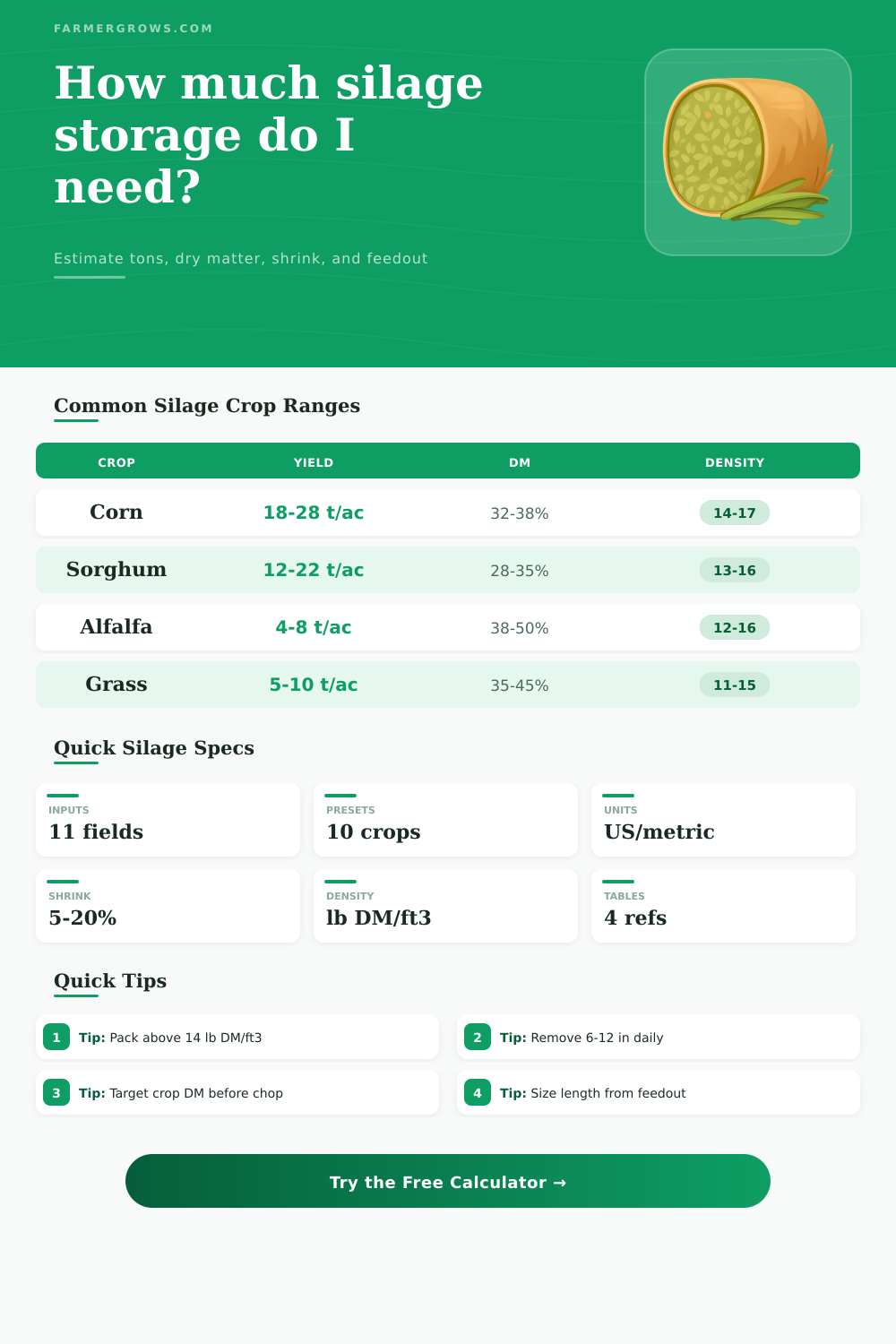
| Crop | Common as-fed yield | Target dry matter | Typical storage | Planning note |
|---|---|---|---|---|
| Whole-plant corn silage | 18 to 28 tons/ac | 32% to 38% | Bunker, pile, bag | Harvest around half to two-thirds milk line, then confirm by moisture test. |
| Forage sorghum silage | 12 to 22 tons/ac | 28% to 35% | Bag, bunker, pile | Often wetter than corn; wilt or delay chop if seepage risk is high. |
| Alfalfa haylage | 4 to 8 tons/ac per cutting | 38% to 50% | Bunker, bag, wrapped bale | Higher dry matter requires tight packing and fast covering. |
| Grass haylage | 5 to 10 tons/ac per cutting | 35% to 45% | Pile, bunker, bag | Watch wet stems and ash contamination during chopping. |
| Small grain silage | 6 to 14 tons/ac | 30% to 40% | Bag, pile, bunker | Boot to soft dough harvest changes fiber and starch sharply. |
| Earlage or snaplage | 6 to 12 tons/ac | 35% to 40% | Bunker, bag | Dense grain-and-cob feeds need careful processor setting. |
| Storage type | Useful density range | Shape factor | Common loss range | Dimension check |
|---|---|---|---|---|
| Bunker silo | 14 to 18 lb DM/ft³ | 85% to 95% | 8% to 14% | Inside width times average height times filled length. |
| Drive-over pile | 12 to 16 lb DM/ft³ | 55% to 75% | 10% to 18% | Use a lower factor for wide sloping shoulders. |
| Silage bag | 12 to 15 lb DM/ft³ | 100% cylinder | 6% to 12% | Diameter controls face area and feedout speed. |
| Upright tower | 14 to 18 lb DM/ft³ | 100% cylinder | 6% to 12% | Diameter and settled fill height set capacity. |
| Wrapped baleage | 8 to 12 lb DM/ft³ | Bale volume | 6% to 14% | Use bale count and bale weight when storage is not continuous. |
| Daily removal goal | Cool weather | Warm weather | Why it matters |
|---|---|---|---|
| Bunker or pile face | 4 to 6 in/day | 6 to 12 in/day | Faster face movement reduces oxygen exposure and heating. |
| Silage bag face | 6 to 9 in/day | 9 to 18 in/day | Small face area helps, but loose plastic and rough faces still heat. |
| High-moisture corn | 3 to 5 in/day | 4 to 8 in/day | Dense grain ferments well but can spoil when oxygen enters slowly. |
| Haylage face | 4 to 8 in/day | 8 to 12 in/day | High dry matter haylage is more prone to air pockets. |
| Fermentation target | Corn silage | Haylage | Planning interpretation |
|---|---|---|---|
| Final pH | 3.7 to 4.2 | 4.3 to 5.0 | Lower pH normally reflects faster acid preservation at proper moisture. |
| Lactic acid | 4% to 7% of DM | 3% to 6% of DM | More lactic acid usually indicates efficient fermentation. |
| Acetic acid | 1% to 3% of DM | 1% to 4% of DM | Moderate acetic acid can improve aerobic stability. |
| Butyric acid | Less than 0.1% | Less than 0.5% | High values suggest clostridial fermentation, often from wet forage. |
| Ammonia-N | Less than 10% of total N | Less than 12% of total N | High ammonia points to protein breakdown or slow fermentation. |
Density check: If packed density falls below 14 lb DM/ft³ in a bunker, add tractor weight, pack in thinner layers, slow delivery, or shorten the pile before adding more crop.
Feedout check: If the calculated face removal is below your target, narrow the bunker, split crop into a bag, or reduce exposed face area for the group being fed.
The silage calculator are a tool that will allow you to calculate the amounts of silage that you will have for your livestock. You input data regarding the type of crop that you grew, the size of the field in which you grew that crop, the dry matter percentage of the silage, the number of tons of silage that you will feed daily to your livestock, and the dimensions of the storage structure for that silage. The silage calculator will allow you to see if the pile of silage that you will create will last until the next harvest, and it will prevent you from having to guess at the amount of silage that you will have or the rate at which you can remove the silage from that pile.
The silage calculator help you to determine how many tons of silage will be available for your livestock after the silage is fermented. When silage is harvested from field, the tons of silage include a higher percentage of water than the silage that can be fed to livestock. Because water dont provide nutritional value to livestock, the percentage of water in the silage will impact the amount of silage that you have to store and use for your herd.
How to Use the Silage Calculator
If the percentage of dry matter in your silage is less than that which you had planned when you plant your fields, the silage calculator will automatically adjust for that and allow you to decide whether you will need to plant more acre of silage or change the length of time that you feed your livestock. The shape of the silage storage area and the density of the silage will determine how much oxygen is exposed to the silage after it is harvested from the fields. If silage is stored in a bunker that have straight walls, such as those that heavy tractors pack, the silage can reach densities of 15 or 16 pounds of dry matter per cubic foot.
If silage is stored in a drive over pile, where the silage is stored in a hill shaped area, the density of silage will be less at around 13 pounds of dry matter per cubic foot. Because silage with less density will contain more air pockets within the silage, those silage piles will heat at a faster rate and will have more greater total shrink. The silage calculator can determine whether your storage area can handle the density of silage that your fields will create.
The silage calculator determine the rate at which you can remove silage from the silage storage structure. Because silage that is removed from a wide bunker face will move at a slower rate than silage that is removed at a narrow face, spoilage may occur on the exposed silage face. The spoilage of silage can lead to the loss of the density that was created when silage was first loaded into the storage structure.
The silage calculator allows you to determine whether you will need to narrow the silage storage structure to achieve a desired rate at which silage is remove, such as six to twelve inches per day. The tables located on the calculator will provide information about the yield of silage by type of crop and storage structure. These values will help you to begin to calculate the amount of silage that you will have available to your livestock.
However, factor in the environment can alter the yields of silage; for instance, silage may be grown in areas with high amount of water during the spring months. The silage calculator allows you to adjust the percentage of loss of silage and the density of silage in relation to the information in the tables. Many livestock farm will use different types of silage in different storage structures.
For instance, a dairy farm may use silage and haylage in different storage structures. Each type of silage will have different rate at which the faces of the silage piles are removed from the silage storage structures. By using the silage calculator, each farm can determine which type of silage will empty at a faster rate than the other.
The silage programs at the farm will change based off these variable of silage. By using the silage calculator, farmers can test the variables of silage. For instance, if the density of silage is adjusted, the number of day that the silage will last can be seen.
If the percentage of silage loss is adjusted in the silage calculator, the length of the silage storage structure requirements can be seen. By adjusting these and other variables within the silage calculator, farmers can make better decision regarding silage storage and silage management.