Bedding Plant Calculator
Estimate annual flower plant counts, tray or pack quantities, soil amendment volume, fertilizer, and weekly irrigation from actual bed shape and spacing.
Use the mature spacing from plant tags when available. This calculator uses center-to-center spacing and converts all metric entries to imperial internally for consistent plant, volume, and water formulas.
Bedding Plant Estimate
Your plant, tray, compost, fertilizer, and water numbers will appear here.
| Bedding plant | Typical spacing | Plants per sq ft | Light fit | Best use |
|---|---|---|---|---|
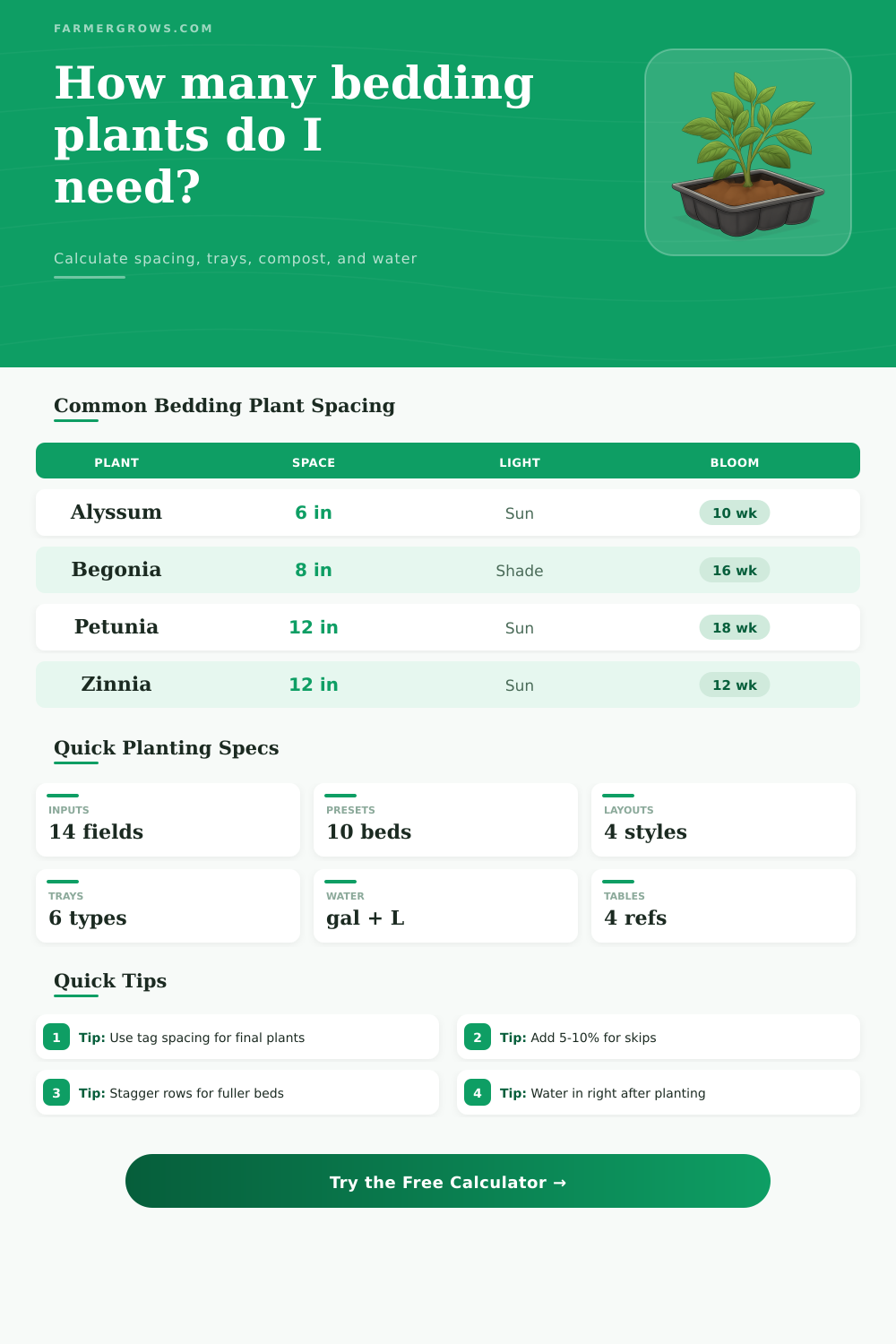
| Sweet alyssum | 6 in | 4.00 square / 4.62 staggered | Sun to part shade | Low edging, gaps, front borders |
| Wax begonia | 8 in | 2.25 square / 2.60 staggered | Part shade | Formal edging and tidy mass beds |
| Pansy or viola | 8 in | 2.25 square / 2.60 staggered | Cool sun | Fall, winter, and spring color |
| Dwarf marigold | 10 in | 1.44 square / 1.66 staggered | Full sun | Pollinator strips and hot borders |
| Impatiens | 10 in | 1.44 square / 1.66 staggered | Shade | Moist shade mass planting |
| Petunia | 12 in | 1.00 square / 1.15 staggered | Full sun | Color beds, containers, mounds |
| Dwarf zinnia | 12 in | 1.00 square / 1.15 staggered | Full sun | Heat-tolerant flower blocks |
| Coleus | 14 in | 0.73 square / 0.85 staggered | Part shade | Foliage ribbons and mixed beds |
| Annual vinca | 12 in | 1.00 square / 1.15 staggered | Hot sun | Dry, sunny summer beds |
| Blue salvia | 12 in | 1.00 square / 1.15 staggered | Full sun | Upright bedding color and bees |
| Tray or pack | Plants per unit | Units for 96 plants | Best use | Counting note |
|---|---|---|---|---|
| Six-pack | 6 | 16 packs | Small beds and mixed colors | Flexible but more handling |
| 12-cell color pack tray | 12 | 8 trays | Porch beds and small islands | Good for split color recipes |
| 18-pack market flat | 18 | 6 flats | Medium home plantings | Last flat has 12 unused cells |
| 36-cell landscape flat | 36 | 3 flats | Commercial edging strips | Last flat has 12 unused cells |
| 48-cell standard flat | 48 | 2 flats | Mass annual color beds | Common full-flat planning size |
| 72-cell plug tray | 72 | 2 trays | Grower plugs and tight staging | Second tray has 48 unused cells |
| Example bed | Area | 12 in square grid | 12 in staggered grid | Compost at 1 in |
|---|---|---|---|---|
| 2 x 10 ft edging | 20 sq ft | 20 plants | 24 plants | 1.7 cu ft |
| 4 x 12 ft border | 48 sq ft | 48 plants | 56 plants | 4.0 cu ft |
| 6 x 10 ft shade bed | 60 sq ft | 60 plants | 70 plants | 5.0 cu ft |
| 8 x 20 ft display row | 160 sq ft | 160 plants | 185 plants | 13.3 cu ft |
| 12 x 12 ft island | 144 sq ft | 144 plants | 167 plants | 12.0 cu ft |
| 6 ft diameter tree ring | 28.3 sq ft | 29 plants | 33 plants | 2.4 cu ft |
| Item | Planning value | Metric equivalent | Use in calculator | Field note |
|---|---|---|---|---|
| Weekly water | 1 in per week | 25.4 mm per week | gal = area x inches x 0.623 | Raise during heat or wind |
| Compost topdress | 0.5 to 1 in | 1.3 to 2.5 cm | cu ft = area x depth / 12 | Avoid burying crowns |
| Starter fertilizer | 0.5 to 1.5 lb per 100 sq ft | 0.24 to 0.73 kg per 100 sq m | lb = area x rate / 100 | Follow soil test when available |
| Cool-season bloom | 10 to 16 weeks | Same timing | Shown by variety | Pansy and alyssum prefer cool weather |
| Warm-season bloom | 14 to 22 weeks | Same timing | Shown by variety | Petunia, vinca, zinnia, and salvia |
| Install buffer | 5 to 15 percent | Same percent | plants x buffer | Covers weak plugs and layout changes |
Spacing tip: A staggered triangular layout increases plant density by about 15 percent compared with a square grid at the same center spacing, so it fills faster without changing the plant tag distance.
Watering tip: The first week after transplanting is not a normal maintenance week. Water the root balls in thoroughly, then use the weekly water estimate as the regular bed target.
A bedding plant calculator is a helpful tool that allows you to calculate the number of plants, the amount of compost, and the amount of water that you will need to fill your garden bed with bedding plants. The calculator makes it easy for you to determine how many plants you need to buy by using your measurements. This information is helpful because any changes you make to the parameter of the bedding plant calculator will change the number of plants that you have to purchase.
If you change the spacing of the plants in your garden bed, for example, the calculator will change the amount of compost and the amount of water that will be needed to take care of your plants throughout the growing season. The first time that you use a bedding plant calculator, you will be asked to provide the dimension of the garden bed that you would like to fill with bedding plants. You will have to provide the length and the width of the garden bed.
How to Use a Bedding Plant Calculator
The area of the garden bed is a critical measurement because this number will inform you of the amount of plants, compost, and water that is required for the bed. You must also provide the spacing in which you would like to grow your bedding plants. The spacing is the distance from the center of one plant to the center of the next plant.
If you want to grow your plants more close together in your bed, you will require more water to wet the roots of all of your plants. A bedding plant calculator can automatically convert between inches and centimeters for you. Many people tend to ignore the layout of the garden bed that they are preparing for planting.
A triangular layout for the plants allows for more plants to be placed into the same area of the garden bed than a layout that arranges the plants in a square grid. When using a bedding plant calculator, you can also account for any buffer percentage. Buffer percentage accounts for any plants that may die when they are transplanted into your garden bed or if some of them get replaced during the planting process.
Ten percent is a common buffer percentage for people who design there own garden beds. When a bedding plant calculator presents a total number of plants that it calculated for your garden bed, you will have to determine what type of tray of bedding plants that you would like to purchase. If you buy six-pack trays, you will have more flexibility in choosing the color of your bedding plants.
However, six-pack trays take more handling to move from the nursery to your garden bed. A 48-cell flat tray allows for fewer trips from the car to the garden bed, but there may be unused cells within the tray if the total number of plants that you calculated is not divisible by 48. The bedding plant calculator will show the total number of units of bedding plants that you will buy and the number of open cell.
Based on this information, you can decide whether you would like to purchase an extra tray of bedding plants. You can calculate the amount of compost that will be needed for the garden bed based on the total area of the bed and the depth of the compost that will be added to the bed. Adding an inch of compost will improve the moisture that retains in the soil, as well as make it easier for the roots of the plants to grow into the ground during it’s first full month of growth.
Calculations related to the amount of water that is needed for the garden bed are another function that many people overlook when they prepare to plant their bedding plants. Many people make mistakes when they try to calculate the amount of water for their garden bed in relation to the amount of time that it will take to water the plants in minutes. Instead, you can enter the amount of water in inches into a bedding plant calculator, which will present the amount of gallons or liters of water that will be needed to water the garden bed.
This information will help you to set the timer on your irrigation system correctly. Dense, staggered plantings may require different watering schedules then drift plantings. The tables that are included with bedding plant calculators is used to provide information to people about how many bedding plants of a certain type are required per square foot of garden bed.
For instance, alyssum plants will require four plants per square foot of garden bed if the spacing between the plants is to be six inches. Coleus plants, on the other hand, will require less than one plant per square foot of garden bed if the spacing between the plants is to be fourteen inches. These reference tables will allow you to sketch out your garden bed prior to purchasing bedding plants of the colors and types that you would like to include in your garden.
When you begin to plant your bedding plants into your garden bed, you will use the number that is presented from the bedding plant calculator as your target number of plants. In the event that some of your plants look weaker than others or that certain colors do not match what you saw in the nursery, you may have to adjust the number of plants that you begin to plant. However, the bedding plant calculator will allow you to avoid guessing how many bedding plants will be required for your garden bed.
Not only will using this type of calculator ensure that your garden bed will be filled with plants in the time that you have scheduled for it to be filled, but it will ensure that the garden bed itself is healthy due to the fact that it will have the correct amount of plants, compost, and water. You should of used a calculator to avoid mistakes.