Manure Pit Volume Calculator
Estimate usable liquid storage, manure loading, rainfall capture, freeboard, sludge allowance, reserve volume, and practical storage days for farm manure pits and tanks.
Use the calculator for planning estimates before engineering review. Enter inside dimensions, not outside wall dimensions, and measure liquid depth below the overflow or top-of-wall control point.
Manure Storage Results
Results use inside pit geometry, 7.48052 gallons per cubic foot, manure production values, rainfall volume, freeboard depth, sludge depth, and selected reserve percentage.
| Storage geometry | Volume formula | Gallons formula | Use this for |
|---|---|---|---|
| Rectangular pit or lagoon | length x width x liquid depth | cubic feet x 7.48052 | Under-barn pits, scrape tanks, runoff cells, and straight-walled lagoons |
| Round tank or circular pit | 3.14159 x radius x radius x liquid depth | cubic feet x 7.48052 | Steel tanks, concrete slurry stores, round reception pits, and pump-out tanks |
| Freeboard volume | surface area x freeboard depth | freeboard cubic feet x 7.48052 | Top space held out of usable storage for splash, wind, waves, and management margin |
| Sludge volume | surface area x sludge depth | sludge cubic feet x 7.48052 | Bottom volume reserved for settled solids that reduce pumpable liquid capacity |
| Rainfall volume | rain inches / 12 x exposed area | rain cubic feet x 7.48052 | Open tanks, lagoons, runoff basins, and uncovered reception pits |
| Allowance item | Typical planning range | How the calculator uses it | Field note |
|---|---|---|---|
| Covered concrete pit freeboard | 6 to 12 inches | Subtracts from total depth before usable volume | Local plans may require a fixed minimum below slats or overflow elevations |
| Open tank freeboard | 12 to 24 inches | Subtracts from liquid depth and appears as reserved top volume | Wind, agitation, rainfall, and pump timing make open storage less forgiving |
| Earthen lagoon freeboard | 18 to 36 inches | Subtracts from operating storage depth | Embankment settlement, wave action, and storm reserve may require separate engineering checks |
| Sludge allowance | 4 to 18 inches | Subtracts from bottom depth before usable liquid volume | Higher bedding, sand, grit, and long cleanout intervals need more bottom space |
| Management reserve | 5% to 25% | Adds to required storage after manure, washwater, dilution, and rainfall | Use a larger reserve where spreading windows are short or weather access is uncertain |
| Livestock group | Manure liquid equivalent | Practical storage note | Common adjustment |
|---|---|---|---|
| Lactating dairy cow | 18 gal/head/day | High water content manure and urine before parlor washwater | Add 1 to 5 gal/head/day for parlor water where it drains to storage |
| Dry cow or large heifer | 11 gal/head/day | Lower production than milking cows but still meaningful in winter storage | Add scrape alley water or bedding dilution separately |
| Beef cattle feedlot animal | 8.5 gal/head/day | Liquid equivalent varies with diet, weight, and exposed lot runoff | Rainfall on open lots can exceed manure liquid volume during wet periods |
| Finishing pig | 1.2 gal/head/day | Works for typical deep-pit liquid manure planning | Adjust for waterer leakage and washdown |
| Sow or gestation unit | 3.0 gal/head/day | Larger animals and farrowing washdown need more storage | Use custom rate for farrow-to-finish systems |
| Layer hen liquid equivalent | 0.035 gal/bird/day | Only for liquid leachate or washwater planning, not dry litter stacks | Use separate solids storage calculations for litter |
| Rainfall, dilution, or reserve item | Planning value | Formula or impact | When it matters most |
|---|---|---|---|
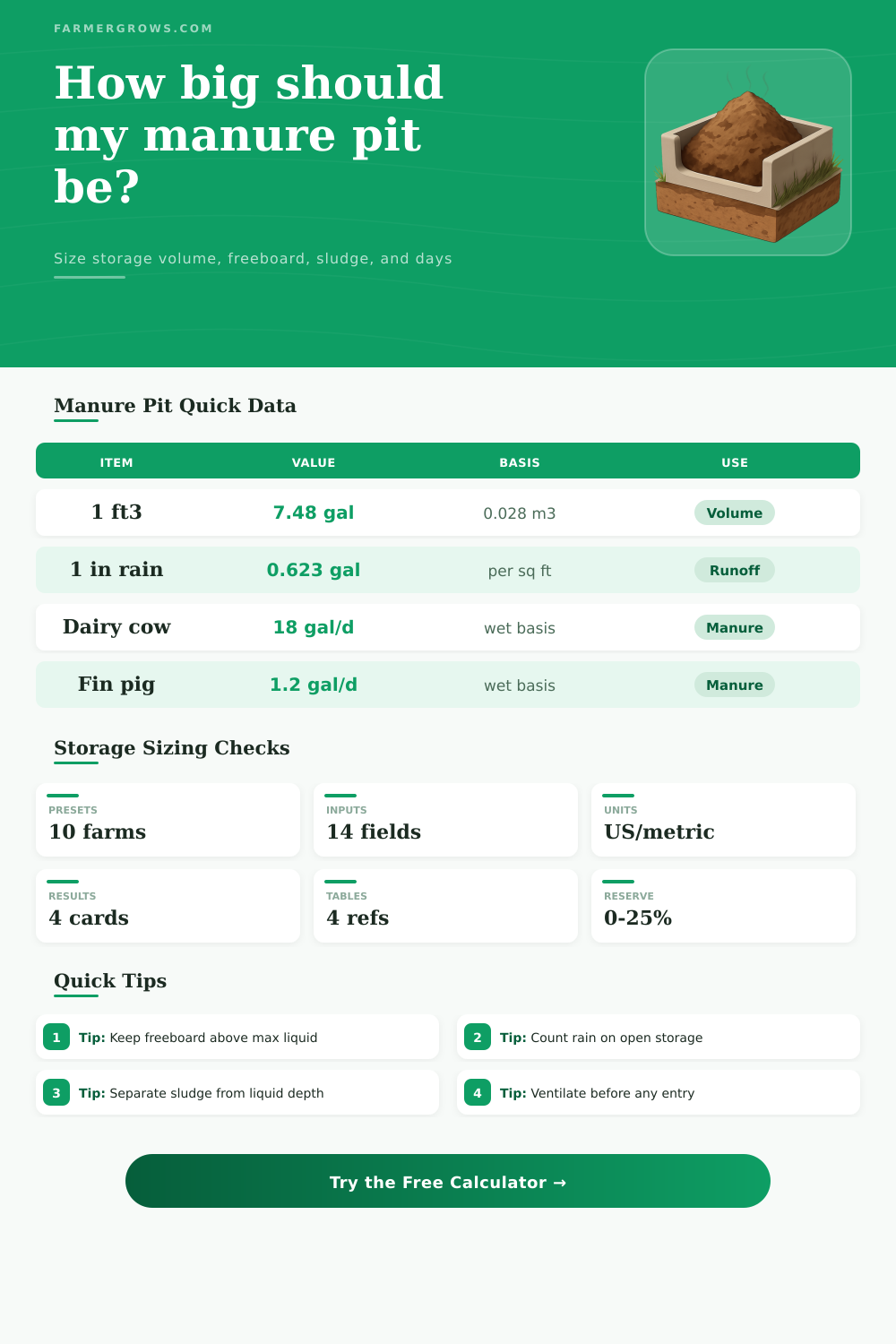
| Rain on open storage | 0.623 gal per sq ft per inch | rain inches x exposed sq ft x 0.623 | Open lagoons, reception pits, and feedlot runoff basins |
| Milking center washwater | 2 to 6 gal per cow per day | add directly to daily liquid load | Dairy systems where parlor water drains to the manure store |
| Waterer leakage or flush water | 0.1 to 1.0 gal per head per day | extra dilution per animal x head count | Swine pits, flush alleys, and automatic waterer systems |
| Storage period | 90 to 270 days | daily liquid load x target days | Cold climates, wet soils, crop nutrient timing, and restricted spreading windows |
| Safety reserve | 10% to 20% common | required volume x reserve percentage | When weather, herd size, or manure consistency is uncertain |
Measure usable depth separately: A pit that is 12 ft deep is not a 12 ft storage volume once freeboard, settled sludge, pump intake limits, and agitation needs are held back.
Count every liquid source: Manure, urine, washwater, waterer leakage, flush water, rainfall, and runoff all compete for the same storage capacity.
The heart of any working farm: The manure storage facility (a.k.a. The holding tank is where all the waste waits until weather allows for spreading. What’s the danger? You can have a pit that is too large, wasting money on extra material that will never be used. Or, you can have one that is too small, which lead to overflowing and hauling by hand at the wrong time. To avoid either extreme, know your numbers first. Measure accuratley; then build.
When you input the internal dimensions, daily load of animals, and additional water sources, the calculator calculate the necessary volume for you. It take into account sludge and freeboard. It won’t count unusable space as storage. It also accounts for a management reserve that represent realistic operating conditions, not an ideal scenario. We take into account the freeboard (the liquid surface rises with wind or agitation) and the fact that sludge settles on bottom, which reduces usable depth. However, these factors is not offset. They are considered separately subtracted from total volume by the calculator.
How to Calculate Manure Storage Size
Operators also tend to forget how much water they put in their open storages through rainfall. A thousand-square-foot area gets more than six-hundred gallons from an inch of rain. They has to store this water and apply it to land at some point. In a short spreading window, or during a long winter, that additional volume can tip a marginal pit into the red. The calculator adjusts for this variable based off exposed area (without forcing you to do any conversions).
Depending on housing system, animal size, and diet, there can be differences in daily output. For example, a dry cow produce about half as much milk as a lactating cow, and wash water from parlors adds more to total flow. Custom-rate lets you measure your own data; preset buttons offers starting points for typical operations.
This puts two key outputs on one page: Required volume and usable gallons. What does that mean? If your usable gallons exceed your required volume after reserve, you have a positive margin. This means you will be able to handle extra hauling delays or wet springs without running out of space in the pit. A negative margin mean you’re going to have to either increase physical pit size or reduce amount of time needed for storage. That’s why having these numbers side by side makes the decision more clearer.
Because we know weather and herd size don’t always stick to an exact timetable, you would of wanted some kind of safety margin when you do your storage planning. You’ll find this margin clearly displayed in the calculator. It turns guesswork into exact data, allowing you to make smart decisions regarding timing and capacity.