PVC Pipe Expansion Calculator
Estimate thermal movement, expansion-loop leg length, anchor count, and guide allowance for PVC and CPVC pipe runs exposed to seasonal or operating temperature changes.
The calculator uses the real thermal expansion formula, then estimates the flexible leg needed to keep bending stress within your chosen limit. Use manufacturer data for final support spacing and code-critical piping.
Thermal Expansion Results
Movement is calculated directly from coefficient x length x temperature change. Loop size is an engineering estimate for early planning.
| Formula | Expression | Units | Use in this calculator |
|---|---|---|---|
| Linear expansion | Delta L = alpha x L x Delta T | in, ft, mm, m | Computes total pipe movement from length and temperature change |
| Metric expansion | Delta L mm = alpha metric x L m x Delta T C | mm | Uses equivalent micrometer-per-meter coefficient |
| Flexible leg | L = sqrt(3 x E x OD x movement / stress) | inches | Estimates loop or offset leg to limit bending stress |
| Guide count | ceil(run length / guide spacing) + 1 | points | Estimates guide or hanger locations along the straight run |
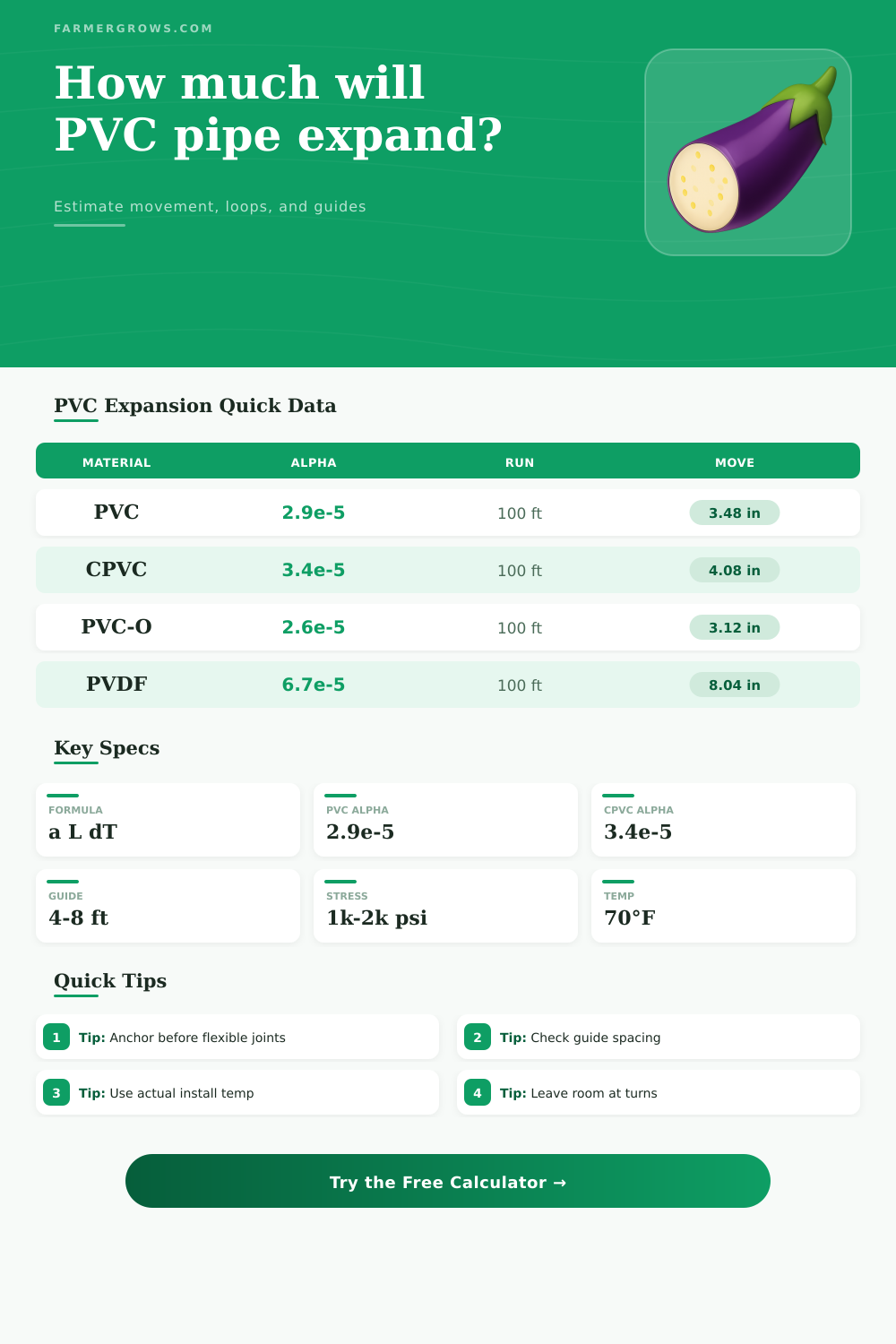
| Material | Alpha in/in/°F | Alpha mm/m/°C | Planning note |
|---|---|---|---|
| PVC Schedule 40 | 0.000029 | 52.2 | Common irrigation and farm water planning value |
| PVC Schedule 80 | 0.000028 | 50.4 | Slightly lower coefficient, larger wall thickness |
| CPVC Schedule 40 | 0.000034 | 61.2 | Higher movement in warm or hot water service |
| CPVC Schedule 80 | 0.000032 | 57.6 | Use manufacturer data for pressure derating |
| PVC-O | 0.000026 | 46.8 | Use only if the selected pipe is actually oriented PVC |
| PVDF comparison | 0.000067 | 120.6 | Included to show why material selection matters |
| Nominal size | Outside diameter | Typical exposed guide range | Loop sizing effect |
|---|---|---|---|
| 1/2 in | 0.840 in | 3 to 5 ft | Small OD gives shorter flexible legs |
| 1 in | 1.315 in | 4 to 6 ft | Common greenhouse and irrigation header size |
| 2 in | 2.375 in | 5 to 7 ft | Larger OD increases loop leg estimate |
| 4 in | 4.500 in | 6 to 8 ft | Longer legs or engineered joints are often needed |
| 6 in | 6.625 in | 7 to 10 ft | Check supports, thrust restraint, and manufacturer limits |
| Installation condition | Temperature range to test | Preferred movement detail | Field check |
|---|---|---|---|
| Outdoor irrigation main | Install temperature to hottest pipe surface | U-loop or guided offset near turns | Confirm pipe can slide through supports |
| Greenhouse overhead pipe | Cool morning to sunny afternoon pipe temp | Small repeated offsets with close guides | Watch sprinkler alignment and sag |
| CPVC hot wash line | Room temperature to operating hot water | Flexible branch or manufactured loop | Use CPVC-rated hangers and transition fittings |
| Buried run with exposed riser | Soil temperature to exposed riser temperature | Movement space at riser or valve manifold | Keep rigid anchors away from brittle fittings |
Before setting anchors: Decide where movement is allowed to happen. Anchor the fixed points, then guide the run toward the loop, offset, or swing joint.
Before final glue-up: Use the pipe temperature at installation, not only air temperature. Sunlit PVC can be much warmer than a shaded thermometer.
PVC pipe will expands when the temperature increases, but PVC pipe will contract if the temperature decreases. If the PVC pipe expansion or contraction are not allowed due to the PVC pipe run not having enough space to accommodate such movement, then the PVC pipe fitting will break or deform due to the movement of the PVC pipe. Therefore, it is important for an individual to calculate how much room the PVC pipe will need and where that room should be placed along the proposed runs.
The first factor in calculating the movement of the PVC pipe is the coefficient that is associated with the PVC pipe expansion. The coefficient will vary according to the type of PVC pipe that is being use; standard PVC pipe, CPVC pipe, or molecularly oriented PVC pipe will each has different coefficients of expansion. Therefore, the coefficient that is used in the calculation should match the type of PVC pipe that is to be used in the installation.
How to Allow PVC Pipe to Move
The second factor that contributes to the movement of the PVC pipe is the change in the temperature of the waters that passes through the PVC pipe. The difference between the initial installation temperature and the highest or lowest temperature that the PVC pipe will reach will contribute to the movement of the PVC pipe. Additionally, the temperature of the air isnt necessarily the same as the temperature of the PVC pipe; the PVC pipe that is exposed to the sun will reach higher temperature than the PVC pipe that is shaded from the sun.
Therefore, the temperature difference should be that of the actual temperatures of the PVC pipe. The third factor that should be considered is the length of the PVC pipe. The longer the length of the PVC pipe, the more that the PVC pipe will move.
For instance, a 40-foot section of PVC pipe will move differently than a 200-foot section of PVC pipe. The length that is used in the PVC pipe movement calculator is the length of the PVC pipe that is restrained by the anchors or the changes in the direction of the PVC pipe. The fourth factor is the movement that can be allowed within the PVC pipe installation.
For instance, one installation method may use a U-shaped loop to allow for the movement of the PVC pipe, while another installation method may use a single offset or swing joint to allow for the movement of that PVC pipe. Each of these methods will require the installation of the PVC pipe to have different size leg joints to permit for the movement of that PVC pipe. Additionally, guides and anchors will be necessary to install along the PVC pipe.
Guides will allow for the movement of the PVC pipe but will prevent it from buckling, while the anchors will allow for the PVC pipe to be restricted to certain points along that run. If the guides and anchors is spaced too far apart from one another, the PVC pipe may sag between those anchors. However, if the guides and anchors are too closely spaced along the PVC pipe, then an excessive amount of hardware will be required to install along that pipe.
While the mathematical formula may work in the plans room for the installation of the PVC pipe, there are other factor that may exist in the real world. For instance, soil may restrict the movement of buried sections of PVC pipe, yet allow other sections of aboveground PVC pipe to move as they wish. Additionally, the temperature cycles of the exposed risers may differ from the buried sections of PVC pipe.
Finally, the installation of valves or other fitting along the PVC pipe will restrict the movement of that PVC pipe. Despite the mathematical calculation of the movement of the PVC pipe, it is recommended that the installer actually walks the line where the PVC pipe will be installed. Due to the ability of PVC pipe to expand and contract with the change in temperature, the installer may need to make adjustment to the placement of PVC pipe supports.
Many installers make mistake when installing PVC pipe. For instance, PVC pipe often gets installed with the anchors placed first, and then the offset or loop is installed into the remaining portion of the PVC pipe layout. This often leads to the installation of PVC pipe that has bend that are too tight for that portion of the pipe to make.
Additionally, many installers use the same spacing between guides and anchors for all size of PVC pipe; however, larger diameter PVC pipe will have more sagging issue than smaller diameter PVC pipe. Another mistake that many installer make is to not consider the allowable movement at the loop or joint where the PVC pipe may move. If the available movement at the joint or loop is smaller than the calculated movement of the PVC pipe, the PVC pipe may damage that joint or fitting.
Therefore, it is important to consider these difference; the calculated movement of the PVC pipe should be compared to the available movement at the joint. PVC pipe is often exposed to seasonal temperature changes; however, greenhouses may experience much larger changes in temperature within a single day. These temperature changes within the greenhouse that are not experienced outside of those buildings may lead to the joints of PVC pipe in those greenhouses failing faster then those in other location.
Therefore, the coefficient of friction between the PVC joints may need to be increased to account for these different temperature changes. Another installation scenario is that of buried PVC pipe with risers that are exposed to the air. The buried portion of the PVC pipe will not move due to soil restriction, yet the risers will expand and contract with the air and sun exposure.
Any movement at the point where the buried PVC pipe meets the riser will have to be accounted for; placing clamps on those risers too close to the buried pipe may restrict the movement of the risers. In order to manage the movement of the PVC pipe correctly, the individual should measure the actual movement of the PVC pipe’s temperature, choose the correct coefficient for the type of PVC pipe being used, and determine where movement is to be allowed within that installation. Once these three pieces of information are determined, the calculator may assist the installer in performing the calculation for that PVC pipe installation.