Privacy Fence Calculator
Estimate wood privacy fence boards, posts, rails, gate deductions, screws or nails, concrete bags, stain surface, and waste for straight, segmented, and sloped yard runs.
Enter the total fence line or list separate runs. Gate openings are removed from board runs, while gate leaf boards, extra posts, rails, fasteners, concrete, and coating surface are still included.
Privacy Fence Material Estimate
The estimate will update after calculation.
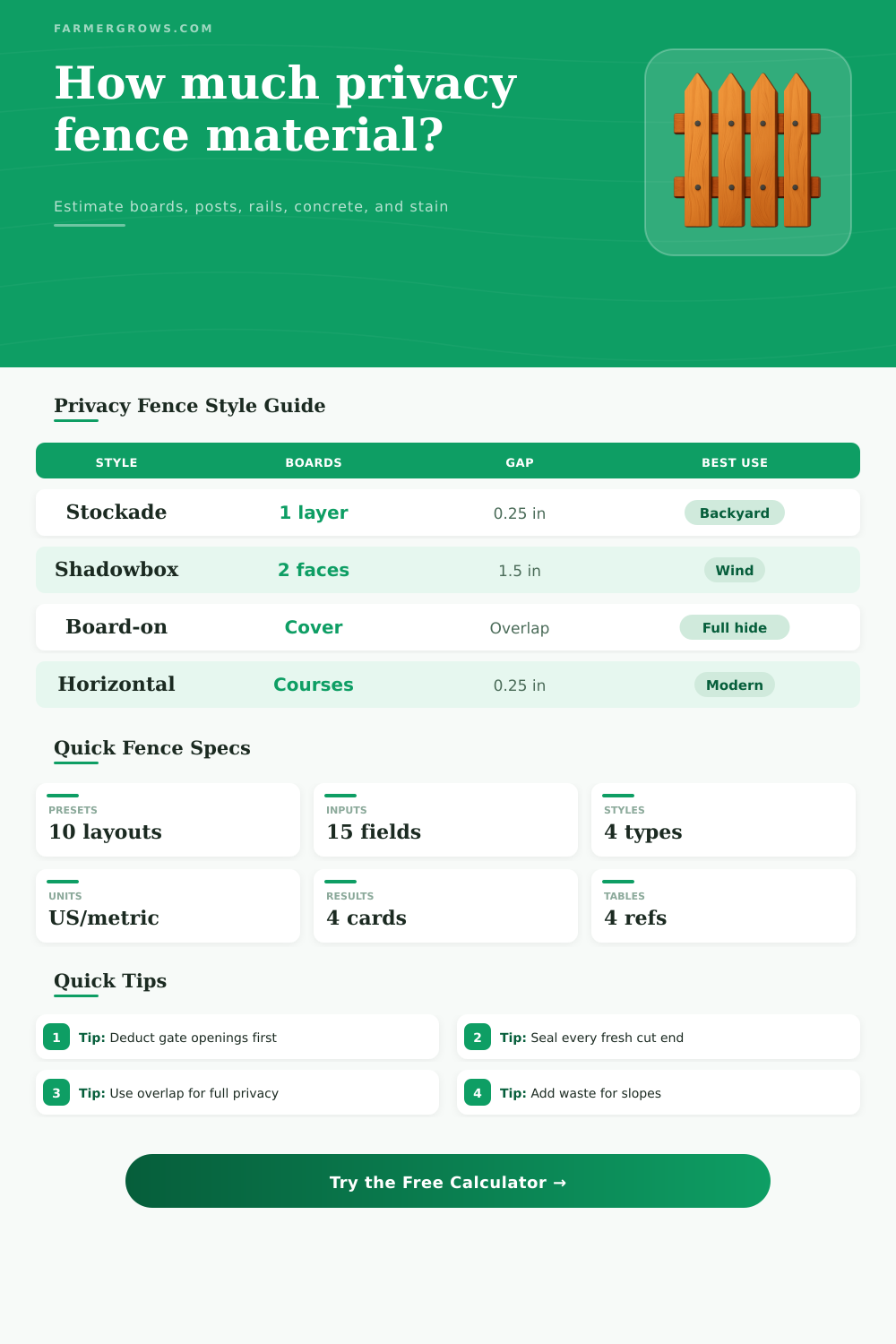
| Privacy style | Board count method | Typical gap or overlap | Best estimating note |
|---|---|---|---|
| Stockade vertical | Run length divided by board width plus visible gap | 0 to 0.5 in gap | Fastest count, but small gaps can appear as boards dry. |
| Board-on-board | Base layer plus cover boards over the gaps | 1 to 2 in overlap | Use for strongest privacy and add extra waste for trimming. |
| Shadowbox | Alternating boards on both sides of the rail line | 1.25 to 2 in gap | Needs more boards but handles airflow better than solid faces. |
| Horizontal | Fence height divided into stacked board courses | 0.125 to 0.5 in gap | Short sections reduce sag, so posts often drive the count. |
| Fence height | Common rail count | Post spacing guide | Post note |
|---|---|---|---|
| 4 ft privacy screen | 2 rails | 6 to 8 ft | Good for patios, bins, and short garden screens. |
| 5 to 6 ft fence | 3 rails | 6 to 8 ft | Most backyard privacy fences use a top, middle, and bottom rail. |
| 7 to 8 ft fence | 4 rails | 5 to 7 ft | Check local height rules and increase post embedment. |
| Horizontal boards | Rails may be hidden or doubled | 4 to 6 ft | Closer posts reduce board sag and keep sight lines straight. |
| Hole class | Line post hole | Gate or end hole | Use when |
|---|---|---|---|
| Light screen | 8 in diameter x 24 in deep | 10 in diameter x 30 in deep | Short screens, sheltered patios, or light decorative runs. |
| Standard privacy | 10 in diameter x 30 in deep | 12 in diameter x 36 in deep | Typical 5 to 6 ft wood privacy fence in average soil. |
| Heavy privacy | 12 in diameter x 36 in deep | 14 in diameter x 42 in deep | Taller fences, wider gates, or softer ground conditions. |
| Windy solid face | 14 in diameter x 42 in deep | 16 in diameter x 48 in deep | Long solid board runs with meaningful wind exposure. |
| Finish or fastener item | Typical input | Calculator use | Planning note |
|---|---|---|---|
| Transparent oil stain | 150 to 250 sq ft per gallon | Lower coverage means more gallons | Rough cedar and dry pine absorb more on the first coat. |
| Semi-transparent stain | 175 to 300 sq ft per gallon | Multiply by selected coats | Common privacy fence finish when grain should remain visible. |
| Solid stain or paint | 200 to 350 sq ft per gallon | Uses total board, rail, and post surface | Prime raw end grain and add touch-up allowance. |
| Fasteners | 1 to 3 per board crossing | Boards x rails x pattern, plus rails and gates | Use exterior-rated screws or nails compatible with the lumber. |
Before ordering boards: Mark gate openings, corners, end posts, and any jogs first. Privacy boards belong only on the boarded run, but gates and posts still need their own material.
Before staining: Count both faces, edges, rails, gate boards, and exposed posts. Fresh cut ends often drink more stain than the flat board faces.
Building a privacy fence require that you determine the amount of lumber that you will need to complete the fence. The amount of lumber that is required for building the fence will depend upon several factors, such as the style of fence that you would like to build, the height of the fence, and how the fence will be expose to the elements (such as wind and sun). By using a privacy fence calculator, you can create an organized list of all of the lumber and finishing supplies that will be required to build the fence.
By creating such an organized list, you ensure that you will not purchase too much lumber for the project, nor will you purchase insufficient lumber for the fences construction. Privacy fence styles will differ in the number of fence boards that is required to build the fence. For instance, a stockade fence will require fewer boards than a fence that includes two layer of boards (also known as a board-on-board fence).
How to Calculate Wood Needed for a Privacy Fence
The reason that a stockade fence will require fewer boards is that there will be gaps between the fence boards due to the drying of the wood. A board-on-board fence add a second layer of fence boards to the fence to ensure that there are no gaps between the boards. A shadowbox fence include fence boards on both sides of the fence rail, but allows for more airflow through the fence.
Finally, a horizontal fence includes fence boards that are stacked in the same manner as siding on a house, but requires that the fence include closer spacing between fence posts to ensure that the fence does not sag in the middle. The privacy fence calculator can calculate each of these fence styles, as the calculator is able to consider the various heights and lengths of the fence to determine how many fence boards the calculator will require for each fence style. In addition to calculating the number of fence boards that are required for the fence, the privacy fence calculator will also account for the openings that will be made in the fence for the gates.
The width of the gate openings will be subtracted from the total length of the fence to calculate the number of fence boards that will