Planter Box Soil Calculator
Estimate deep planter box fill after false bottoms, drainage layers, settling allowance, overage, and soil blend parts so raised boxes match the crops you want to grow.
This tool is built for rectangular planter boxes, stock-tank conversions, trough planters, balcony boxes, and raised boxes with a built-in reservoir or false bottom. Measure the inside dimensions of the box, not the outside boards.
Soil Blend Components
Planter Box Soil Estimate
Your box fill estimate will appear here.
| Inside box | Gross volume | Typical crops | Planner note |
|---|---|---|---|
| 2 x 3 ft x 16 in | 8.0 cu ft | Herbs, greens, flowers | Good balcony size; avoid heavy wet loam on weak decks. |
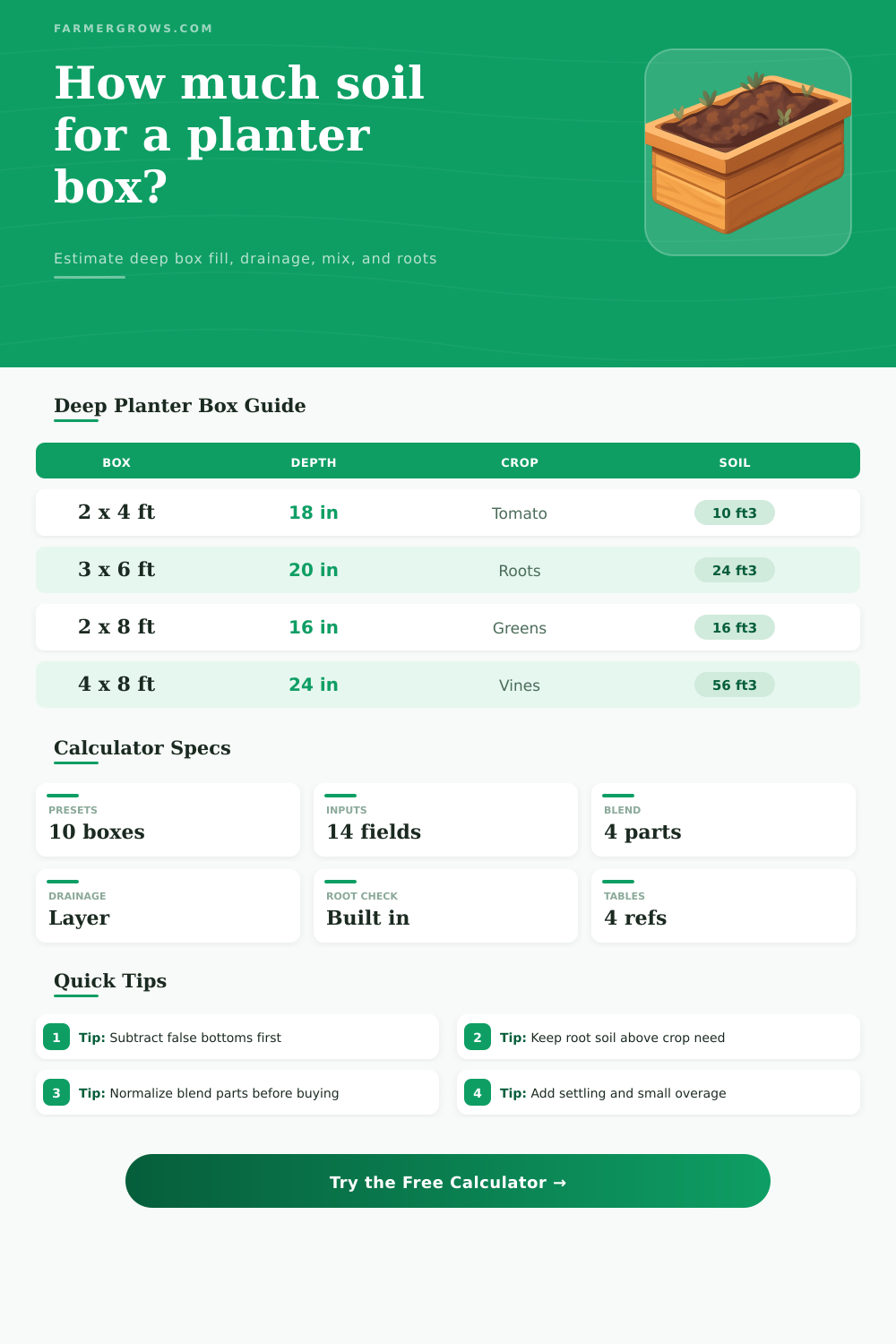
| 2 x 4 ft x 18 in | 12.0 cu ft | Peppers, dwarf tomatoes | Enough depth for fruiting crops when drainage is modest. |
| 2 x 8 ft x 16 in | 21.3 cu ft | Greens, beans, herbs | Long boxes dry unevenly; water from multiple points. |
| 3 x 6 ft x 20 in | 30.0 cu ft | Carrots, beets, tomatoes | Subtract any reservoir or false floor before buying soil. |
| 4 x 8 ft x 24 in | 64.0 cu ft | Deep roots, vines, mixed crops | Bulk mix is usually easier than small bags at this size. |
| Recipe | Parts by volume | Best for | Adjustment note |
|---|---|---|---|
| Balanced vegetables | 5 base, 3 compost, 2 aeration, 1 mineral | Tomatoes, peppers, greens | Keep compost moderate in deep boxes to reduce settling. |
| Leafy green box | 5 base, 4 compost, 2 aeration, 0.5 mineral | Lettuce, spinach, chard | More compost holds moisture but still needs open pore space. |
| Root crop trough | 6 base, 2 compost, 3 aeration, 0.5 mineral | Carrots, radish, beets | Screen clumps and avoid dense clay pockets. |
| Self-watering box | 6 base, 2 compost, 3 aeration, 1 mineral | SIP planters, wicking tubs | Higher aeration keeps the root zone from staying saturated. |
| Berry planter | 5 acidic base, 2 compost, 3 bark or pumice, 0.5 mineral | Blueberries and acid lovers | Use crop-specific pH planning before planting berries. |
| Crop group | Minimum rootable soil | Preferred deep box depth | Box planning note |
|---|---|---|---|
| Herbs and annual flowers | 6 to 8 in | 10 to 12 in | Fine for shallow rails if drainage does not steal too much depth. |
| Leafy greens | 8 to 10 in | 12 to 14 in | Even moisture matters more than extreme depth. |
| Peppers and eggplant | 12 to 14 in | 16 to 18 in | Use a stable box because mature plants become top-heavy. |
| Tomatoes | 14 to 18 in | 18 to 24 in | Deep root volume helps buffer watering swings. |
| Carrots and beets | 12 to 16 in | 16 to 20 in | Loose, stone-free soil prevents forking and misshapen roots. |
| Cucumbers and vines | 14 to 18 in | 20 to 24 in | Match root volume with trellis wind load. |
| Box footprint | 1 in layer | 2 in layer | Why it matters |
|---|---|---|---|
| 2 x 3 ft | 0.50 cu ft | 1.00 cu ft | Small boxes lose root depth quickly. |
| 2 x 4 ft | 0.67 cu ft | 1.33 cu ft | Drainage aggregate adds weight fast. |
| 2 x 8 ft | 1.33 cu ft | 2.67 cu ft | Long boxes need consistent outlet spacing. |
| 3 x 6 ft | 1.50 cu ft | 3.00 cu ft | A false bottom may be lighter than stone. |
| 4 x 8 ft | 2.67 cu ft | 5.33 cu ft | Check deck load before adding heavy media. |
False bottoms change the whole order of operations: subtract the reservoir or shelf height first, then subtract drainage media, then compare only the remaining soil depth with crop root needs.
Deep boxes settle more than small pots: fluffy container mixes compress after watering. Buy enough for settling and keep a little matching blend for mid-season top-offs.
Getting it right with raised planter boxes is important, as it’s one of the factors that can make the difference between thriving tomatoes and malformed carrots. Root space, drainage, and even depth are key. A bag of soil purchased at the store isn’t always the answer; there are considerations such as a false bottom, a drainage layer, and compaction once watered.
With your reservoir/fake bottom height and your internal dimensions entered into the calculator at top, it’ll crunch the numbers for you. Why? You lose usable growing area because of both things which is easy to forget. If your box is 20 inches deep but has a fake bottom four inches thick, that cuts down on how much room there is for rootable soil… And how many plant can get grown. It subtracts the drain layer. It accounts for how much settling there may be. It also leaves a little extra to make sure you don’t wind up running dry after the medium settles.
Why Measuring Is Important for Planter Boxes
Then there’s the addition of soil mixes. With the four-part inputs, you get to choose your ingredients (base, compost, aeration, mineral material) rather than guessing when purchasing a premade bag. Parts is converted into real volumes, so you can save money by balancing your parts and avoid buying too little or too much of any single item.
If you have your boxes resting on a deck, the weight estimate will help as moist soil and drainage stone add up quicker then most think.
The depth you plan to grow things also depends on which crop you choose. Vines and tomatoes wants about 20 inches from the top of their growing medium. You should of added another few inches for the roots, since they don’t like sitting in the bottom inch or two where the drain layer is. Shallower-growing herbs will do fine in just ten inches of soil. To see quickly if your box is just deep enough or plenty deep, compare it to the preferred and minimum root depths for various crops:
Settling is underestimated by most builders. With highly aerated, fluffier mixes, expect an initial 8-12% compression within the first month of watering. When the water level drops and root zone gets exposed…you’ll be short if you bought only what you calculated. Without thinking too hard about it, use the overage selector to add some buffer.
So what is the main point? Simple: Determine your actual inside dimensions. Determine how much of that interior space you’d like to use for a reservoir and drainage. Match the rest with amount of soil depth that will support whatever you actually wish to grow. After that, everything else, soil blend ratios and total volume, isn’t too complicated. It’s moddern and naturaly easy if you use these tool.