
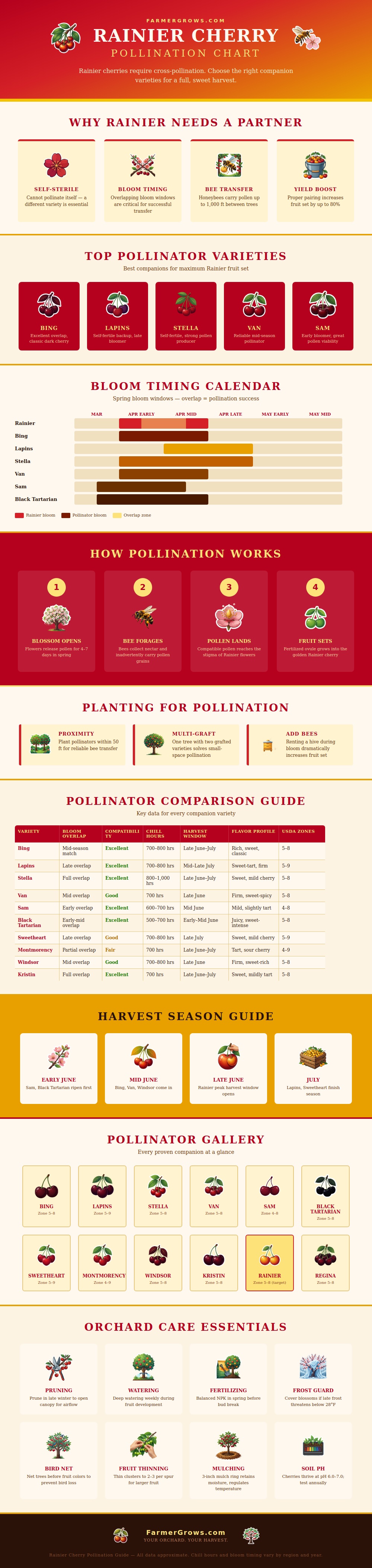
When you plant A RAINIER cherry tree, you’re hoping for the delicacy of its flavor, its subtle sweetness and its most noticeable feature: the soft golden blush on every fruit. They is sweet right off the tree, so no sugar or anything else are needed. Yet when many people who have planted trees learn of this little problem, it’s too late. You’ve purchased an apparently healthy tree, dug hole, positioned it carefuly in good soil and waited for harvest. Each spring, the tree bloom, but it rarely produces any fruit.
Not your bad luck. It is biology. While many varieties of cherries is self-fruitful, meaning that they can pollinated by their own flowers, Rainiers are not. If you hope to ever taste any cherry from one of them, then a second tree must be present to provide pollen.
How to Get Cherries from Your Tree
Variety is key but so are proximity and timing: The bees aren’t carrying pollen very far. Usually they stays within a hundred feet of their hive. So if you have a compatible variety partner who’s two blocks away from your lone Rainier tree, forget it, pollination won’t happen (unless you get lucky). To make things work, plant companion varieties within fifty feet of each other so the bees can shuttles back and forth among them.
And remember: Both trees also needs to be flowering at the same time. The only thing that matters is that they bloom at the same time. The key is to match bloom times when selecting a partner. Bing is popular, since its timing align most closely with Rainier’s. Other good choices are Stella, which is a reliable pollen producer, and Lapins, which is self-fertile and great in small yards. Because it is self-fruitful, Lapins can set some fruit by itself, too, though yields is higher if you have one nearby a Rainier tree.
The partner should of be blooming during the receptive phase of the Rainier’s cycle; meaning that you want their peak pollen release timed to coincide with yours. A partner that flowers two weeks before or after won’t do any good in terms of pollination. This also all depends a lot off the weather. If you get a late frost, it will ruin the blossom before they can be pollinated. The blossom can be covered with row covers during cold snaps to prevent damage.
If your plants does successfully pollinate, then remove some of the young fruit from each cluster so that what remains has room to ripen bigger and sweeter. Otherwise there will be too many left on the branch and the fruit will be smaller and not as good. That is a bummer for all that careful planning.
Another aspect of growing a healthy tree is what is under it. Trees like cherries thrives in soil that is not too alkaline or too acidic (neutral-to-slightly-acidic soil has a pH of 6-7). You can test yours each year. Trees needs nutrients to grow well, but deficiencies may shows no obvious symptoms. To help stabilize the root-zone environment, mulch around the trunk to keep roots warm in winter and cool in summer.
Late-winter pruning helps open the canopy and allow light into inner branches. Better light equals better-flavored fruit come harvest. That’s the kind of attention to detail that pays off.
Isolated trees bears far fewer fruit, and they are not as good, properly pollinated ones yield larger cherries with a milder sweetness and improved texture. It’s not just about one tree; it’s about creating an ecosystem that works together to support fruit production. It’s a team effort in the orchard.
When you have compatible varieties blooming at the same time in spring, free-range bees can shuttle back and forth between them. Nature takes care of the rest, leaving you with full branches instead of empty ones. This shows that good advice about planting trees as companions realy does work.