Pond Liner Calculator
Estimate liner cut size, underlayment, and pond volume from shape, depth, slope, and overlap settings. Use the presets for common ponds or tune the fields for a custom fit.
Pick a real pond form to seed the fields. Each preset sets shape, span, depth, slope, overlap, underlayment, buffer, and liner material so you can jump straight to a result.
Pond Liner Output
Calculated from the current pond shape, slope, and allowance settings.
| Shape | Area factor | Liner input | Volume note |
|---|---|---|---|
| Rectangle | 1.00 | Length and width | Most direct fit |
| Circle | 0.79 | Diameter only | Same span both ways |
| Oval | 0.79 | Long and short | Ellipse style |
| Kidney | 0.72 | Long and short | Curve friendly |
| Freeform | 0.68 | Longest spans | Irregular outline |
| Material | Thickness | Flex | Best use |
|---|---|---|---|
| EPDM rubber | 45-60 mil | Very high | Curved ponds |
| PVC liner | 20-30 mil | Medium | Small ponds |
| RPE liner | 30-40 mil | Medium | Large shapes |
| HDPE liner | 30-60 mil | Low | Straight basins |
| Allowance | Typical amount | Effect | Note |
|---|---|---|---|
| Rim overhang | 10-12 in | Edge slack | Helps anchor liner |
| Fold allowance | 4-8 in | Corner room | Useful on curves |
| Underlayment overlap | 8-12 in | Protects edge | Keep it wider |
| Safety buffer | 5-10% | Extra margin | Covers layout error |
| Pond size | Depth | Liner cut | Approx volume |
|---|---|---|---|
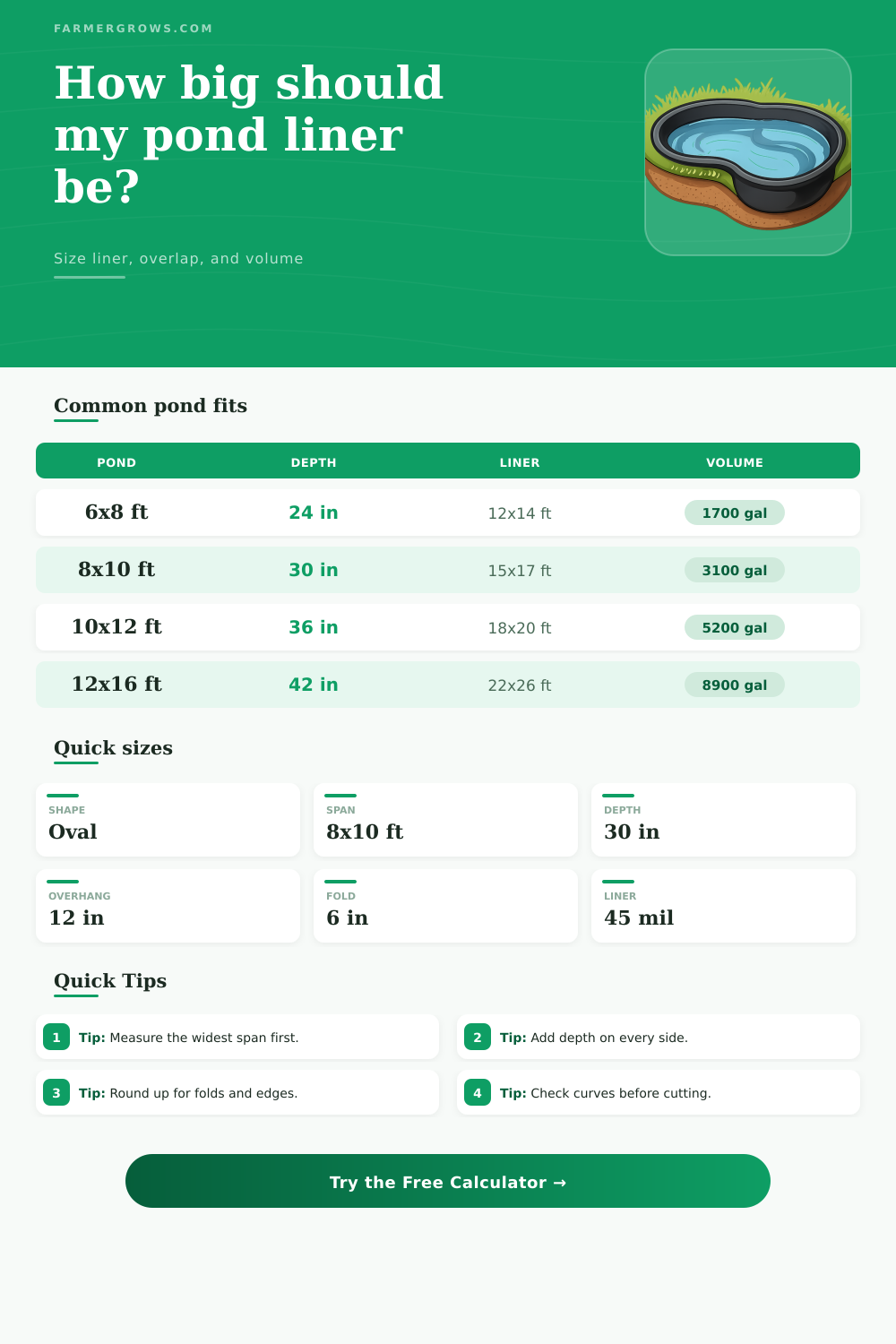
| 6x8 ft | 24 in | 12x14 ft | 1,700 gal |
| 8x10 ft | 30 in | 15x17 ft | 3,100 gal |
| 10x12 ft | 36 in | 18x20 ft | 5,200 gal |
| 12x16 ft | 42 in | 22x26 ft | 8,900 gal |
To fit an pond liner correctly to a pond, you must account for the pond’s shape, depth, and slope. A pond liner must be large enough to cover the pond’s bottom, the sloping sides of the pond, and the pond’s rim. Should the liner be too small, it will fail to cover the edge of the pond.
Furthermore, you must measure the widest part of the pond at its rim because this is the widest part of the pond. The slope of the pond walls affect how much liner you will need for your pond. The slope is the angle of the pond walls from the pond’s rim to the pond’s bottom.
How to Measure and Fit a Pond Liner
Most pond owner use a 1.5-to-1 slope for their koi ponds. This means that the depth of the pond is 1.5 times the depth of the pond’s walls. You must account for the length of the slope in your liner measurements for your pond.
Ponds with steeper slopes use less pond liner. However, these ponds also provide less space for plant to grow and for fish to hide from other fish in the pond. Ponds with gentler slopes requires more pond liner but allow for more room for plants and for the fish to hide.
The shape of the pond will also determine the amount of pond liner you will need. Rectangular ponds are easier to measure than oval or kidney shaped ponds. These ponds have curves that require more pond liner than ponds with straight sides.
A pond owner must use a shape factor to account for the curves in the pond. For instance, a pond in the shape of a circle will require eighty percent of the liner that would be used for a rectangular pond. A pond liner in the shape of a freeform pond may only have sixty-eight percent efficiency in how it lay.
Extra liner will have to be provided to account for the curves in the pond. The different material for pond liners will also affect how the liner fits into the pond. EPDM rubber is a flexible liner and is best for ponds with shelf and streams because the rubber will not crack when bent.
PVC liner is a lighter material and best for small ponds. RPE and HDPE liner are more rigid and used for larger pond. The flexibility of pond liner materials will change the amount of liner that will be needed for the pond.
A buffer has to be provided for pond liner creases. The buffer for creases should be four to eight inch. This buffer will prevent the pond liner seams from becoming exposed and pulled apart.
Underlayment will also have to be used for pond liners. The pond liner must also overlay the underlayment by twelve inches to protect the pond liner from rocks or other pointed objects in the pond. The depth of the pond will determine the volume of the water that will fill the pond.
The depth of the pond is the distance from the pond’s rim to the deepest part of the pond. However, pond owners use the average depth of the pond to calculate how much water the pond will hold. The average depth of a pond with sloped walls is less than the depth of the pond walls.
In addition to the depth of the pond, pond owners should also provide a rim overhang of ten to twelve inches. This overhang will help to anchor the pond liner to the ground. Furthermore, it will allow pond owners to tuck the pond liner under flat rocks along the edge of the pond.
A ten percent margin will also have to be provided to the measurements. This safety margin will account for potential error in the measurement of the pond and unexpected ledges in the pond soil. The type of soil in which the pond will be dug also affects the behavior of the pond and the placement of the pond liner into the soil.
Sandy loam soils will shift under the weight of the water in the pond. Clay soils will hold firm in their placement. If pond owners do not test their soil, they may find that there are air pocket under the pond liner.
Rocks can be used at the rim of the pond liner to hide the edges of the pond liner. However, if rocks will be used to cover the pond liner, six inches of extra liner should be provided. The temperature and weather for the area in which the pond will be built will also affect the pond and the pond liner.
EPDM rubber pond liners will handle ice better than PVC pond liners. Thin PVC pond liners may become brittle in cold weather temperatures. Large ponds will hold more water than small ponds.
Additionally, the water in large ponds will have more even temperatures throughout the pond than small ponds. If the pond contains fish, pond owners will have to use pond aerators to ensure that the water has enough oxygen in it when it freeze on the surface of the pond. To prepare the pond liner for the pond, there are specific step that will have to be followed.
The measurements for the pond liner should not include the waterline. By measuring the waterline, the pond liner will be too small for the pond. The underlayment must be overlaid with the pond liner by twelve inches.
If this is forgotten, the pond liner will be exposed to the soil and may be damaged. The measurements should be rounded up to the nearest inch. A buffer for creases should be added to the pond liner measurements.
This buffer will prevent the seams in the pond liner from being pulled apart. Finally, you must test the pond liner for fit while the liner is dry. Testing the pond liner while it is dry will allow pond owners to inspect the pond liner for proper folds and slack in the liner.