Raised Bed Soil Calculator
Estimate the soil you need for one bed or a whole garden block. The calculator handles bed footprint, number of beds, settling, waste allowance, bag counts, bulk yardage, and blend ratios for a practical order.
Pick a real garden layout to seed the fields. Each preset sets dimensions, bed count, depth, bag size, settle allowance, waste allowance, density, and blend recipe.
Raised Bed Soil Output
Calculated from the bed footprint, chosen blend, and purchase allowances above.
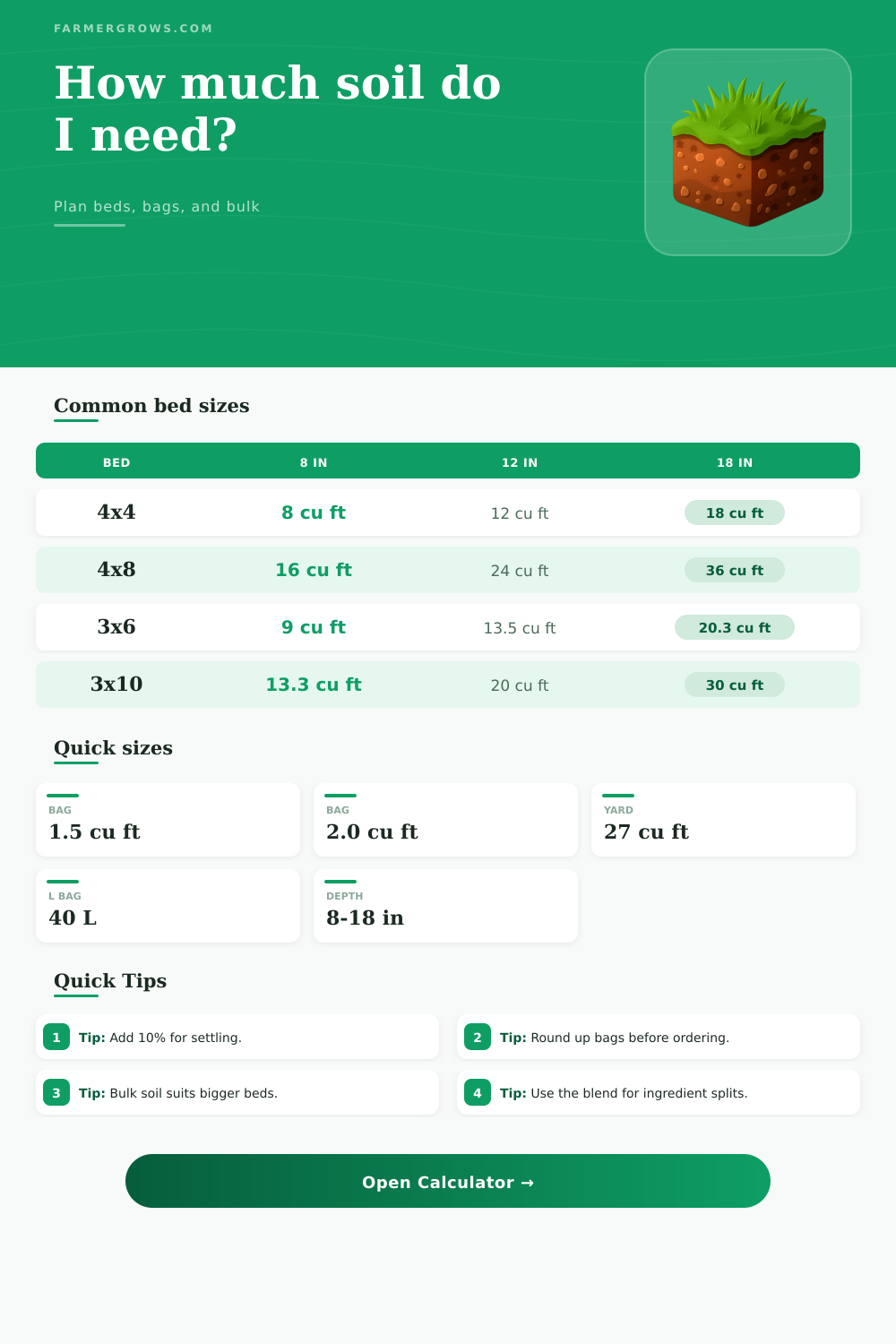
| Bed | 8 in | 12 in | 18 in | Notes |
|---|---|---|---|---|
| 2x4 | 4.00 ft3 | 6.00 ft3 | 9.00 ft3 | Small herb box |
| 3x6 | 9.00 ft3 | 13.50 ft3 | 20.25 ft3 | Handy narrow bed |
| 4x4 | 8.00 ft3 | 12.00 ft3 | 18.00 ft3 | Square planter |
| 4x8 | 16.00 ft3 | 24.00 ft3 | 36.00 ft3 | Standard layout |
| 3x10 | 13.33 ft3 | 20.00 ft3 | 30.00 ft3 | Long kitchen row |
| 4x12 | 24.00 ft3 | 36.00 ft3 | 54.00 ft3 | Large market bed |
| Bag size | 6 in depth | 8 in depth | 12 in depth | Use note |
|---|---|---|---|---|
| 0.75 cu ft | 1.50 sq ft | 1.13 sq ft | 0.75 sq ft | Top-off only |
| 1.50 cu ft | 3.00 sq ft | 2.25 sq ft | 1.50 sq ft | Small beds |
| 2.00 cu ft | 4.00 sq ft | 3.00 sq ft | 2.00 sq ft | Common bag |
| 3.00 cu ft | 6.00 sq ft | 4.50 sq ft | 3.00 sq ft | Heavy duty |
| 40 L | 1.41 cu ft | 1.06 cu ft | 0.71 cu ft | Metric bag |
| 1000 L | 35.3 cu ft | 26.5 cu ft | 17.7 cu ft | Bulk tote |
| Crop type | Depth | Root note | Bed fit |
|---|---|---|---|
| Lettuce | 6-8 in | Shallow roots | Quick turnover |
| Herbs | 6-8 in | Compact root zone | Great edge rows |
| Strawberries | 8-10 in | Even moisture | Low profile |
| Beans | 10-12 in | Moderate roots | Easy fit |
| Tomatoes | 12-18 in | Deep feeder | Stakes help |
| Root crops | 12-16 in | Loose soil | Choose fine mix |
| Squash | 12-18 in | Wide feeder | Needs room |
| Asparagus | 18-24 in | Long-lived crowns | Deep bed only |
| Blend | Topsoil | Compost | Coir | Aeration | Use note |
|---|---|---|---|---|---|
| All-purpose | 50% | 30% | 15% | 5% | Balanced fill |
| Veg boost | 40% | 40% | 10% | 10% | Feeding beds |
| Tomato rich | 35% | 45% | 10% | 10% | Heavy feeders |
| Berry light | 45% | 30% | 15% | 10% | Moist but airy |
| Seed start | 30% | 35% | 25% | 10% | Soft texture |
| Dry climate | 50% | 20% | 20% | 10% | Drains fast |
| Waterwise | 55% | 20% | 15% | 10% | Retains more |
| Loamy deep | 45% | 35% | 10% | 10% | Strong structure |
Calculating how much soil is needed for an raised bed is a necessary task that every gardener should perform. If you buy too much soil for your raised bed, you will have an excess of soil. However, if you purchase too little soil for your raised bed, you will experience a shortage of soil.
To ensure that you fill your raised bed with the correct amount of soil, you must calculate the volume of the raised bed. To calculate the volume, you must use the following formula: length multiplied by width multiplied by depth. However, you must also account for settling and waste when you calculate the amount of soil required to fill the raised bed.
How Much Soil Do You Need for a Raised Bed
When you first add soil to the raised bed, it settle into the raised bed after the first watering. Additionally, some of the soil may spill out of the raised bed when you fills it. The composition of good raised bed soil requires a balance of different components.
Topsoil provide structure for the soil, whereas compost contribute nutrients to the soil for the plants growing in the raised bed. Coir hold the soil together to retain moisture, and aeration materials prevents the soil from becoming too dense. You must have the components of the soil in the correct ratio based off the type of plant that you are growing in the raised bed.
For instance, plants with shallow roots require less depth for their roots to establish themself in the raised bed compared to plants with deep roots. When calculating the amount of soil required for the raised bed, you should account for the settling of the soil in the raised bed. Allow for approximately ten percent settling for the soil in your raised bed.
You can lose eight percent of the soil due to spillage when adding soil to the raised bed. For example, a raised bed that is four feet wide by eight feet in length and twelve inches deep will hold twenty-four cubic foot of soil. However, you must buy more soil than twenty-four cubic feet to account for settling and spillage.
If bags of soil contains one and a half cubic feet of soil, then you will need to purchase thirty bag of soil to fill your raised bed. The depth of the raised bed will determine the type of plants that you will grow in that raised bed. Herbs and leafy vegetable require only eight inches of soil for their roots to establish themselves.
Root vegetables like carrots and squash require deeper soil, ranging from twelve to eighteen inches deep because their roots must have loose soil to develop proper. Asparagus require eighteen inches of soil depth because the asparagus plant has extensive root system. You must configure the depth of the raised bed in a way that accommodate the types of vegetables that you want to grow in the raised bed.
There are different ways to acquire soil for your raised bed. Bagged soil is more better for small raised beds since it is easier to transport and store. Bulk soil allow for cost-effective purchases for larger raised beds since it comes in bulk quantities.
However, the delivery path must be wide enough to accommodate the delivery vehicle. Additionally, raised beds contain alot of soil, and soil is very heavy, averaging forty-five pound per cubic foot. There are some mistake that people make when preparing to fill their raised beds.
The most common mistakes are forgetting to account for the depth of the raised bed, the settling of the soil in the raised bed, and the volume of soil contain in each bag of soil. Always round up the amount of soil that you calculate for your raised bed to account for these mistake. You should of checked these numbers carefuly.