Chicken Coop Size Calculator
Estimate indoor coop floor area, attached run area, nest boxes, roost length, and ventilation openings for a flock of hens, pullets, or mixed backyard birds.
Choose a common backyard setup to seed the inputs. Each preset blends flock size, bird size, housing style, outdoor access, climate, nesting goal, roost layout, and buffer room.
Chicken Coop Output
Calculated from flock size, housing style, access pattern, climate, nesting target, and roost arrangement.
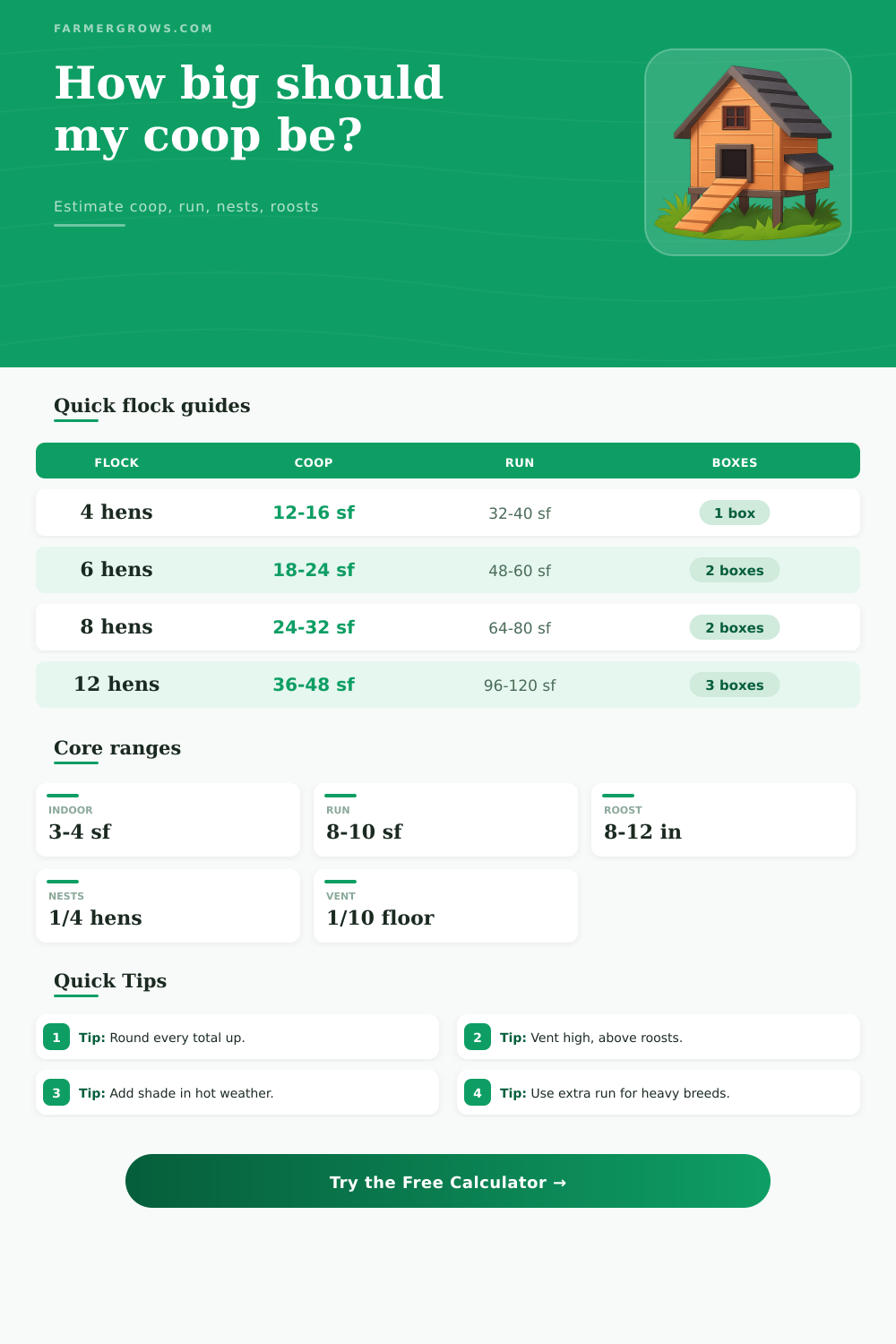
| Flock | Indoor area | Run area | Nest boxes | Roost |
|---|---|---|---|---|
| 4 hens | 12-16 sq ft | 32-40 sq ft | 1 box | 3-4 ft |
| 6 hens | 18-24 sq ft | 48-60 sq ft | 2 boxes | 5-6 ft |
| 8 hens | 24-32 sq ft | 64-80 sq ft | 2 boxes | 6-7 ft |
| 12 hens | 36-48 sq ft | 96-120 sq ft | 3 boxes | 9-10 ft |
| 16 hens | 48-64 sq ft | 128-160 sq ft | 4 boxes | 12-14 ft |
| Bird size | Indoor per bird | Run per bird | Roost per bird |
|---|---|---|---|
| Bantam | 2-3 sq ft | 6-8 sq ft | 8 in |
| Standard | 3-4 sq ft | 8-10 sq ft | 10 in |
| Heavy | 4-5 sq ft | 10-12 sq ft | 12 in |
| Giant | 5-6 sq ft | 12-15 sq ft | 14 in |
| Climate | Vent target | Area note | Layout note |
|---|---|---|---|
| Mild | 1/10 floor | Standard sizing | Open high vents |
| Cold | 1/12 floor | Keep bedding dry | Block drafts low |
| Hot/humid | 1/8 floor | Use more shade | Max cross flow |
| Wet/coastal | 1/9 floor | Dry air matters | Lift ridge vents |
| Pattern | Nest rule | Roost rule | Build note |
|---|---|---|---|
| Standard laying flock | 1 box per 4 hens | 8-10 in per hen | Simple starter layout |
| Busy egg layer flock | 1 box per 3 hens | 10-12 in per hen | Add more landing space |
| Broody friendly pen | 1 box per 3-4 hens | 10 in per hen | Keep nests private |
| Bantam mixed flock | 1 box per 4-5 hens | 6-8 in per hen | Lower perch height |
Proper coop sizing are necessary for the health of the chickens and the success of a backyard flock. If the coop is too small for the number of chickens living in it, there will be issue like chickens pecking at one another and losing feathers due to lack of sufficient space for the flock to roam. Providing adequate space for chickens is a requirement for maintaining healthy chicken.
There are two space requirement to consider for the backyard flock: indoor floor space and outdoor run area. Indoor floor space is required to prevent the chickens from trampling upon one another while sleep on the coop floor. A standard hen require three to four square feet of indoor floor area, but the number may change with the breed of chickens.
How Much Space Do Chickens Need?
Bantam chickens require only two square feet since they are small breeds. Heavy breeds require more space than bantams since they are larger, needing four to five square feet. You can calculate the total indoor floor area by multiplying the number of square feet per bird by the total number of chickens.
Outdoor run area provide the chickens with necessary space to scratch and forage for food. If the outdoor run is too small for the chickens, the chickens will exhibit abnormal behavior due to boredom with there coop. Free range chickens do not require as much outdoor run area since they will roam the farm area.
For lock in run chickens, there must be at least ten square feet of outdoor area per chicken. In areas with hot and humid climates, the outdoor run area needs extra shade. For chickens in cold climates, the coop should have a snugger indoor area since chickens must be protected from the element.
Nesting boxes and roosting bars are two component for the coop. Nesting boxes are where the hens will lay there egg. Depending upon the number of laying hens, one nesting box is required for every four chicken.
For chickens that are very productive of eggs or become broody, one nesting box is required for every three chickens. Roosting bars allow the chickens to sleep on the coop. A standard hen will need ten inches of roosting area so the chickens do not push against one another while sleep.
Both ladder setups and perimeter roost area may be used for sleeping chickens. Ventilation is required for the coop since chickens produce moisture and ammonia. If the coop is not properly ventilated, the moisture and ammonia will create respiratory problem for the flock.
Ventilation should be one-tenth the floor area for high vent. These high vents should not be directly over the roosting area. In cold climates, ventilation should be one-twelfth the floor area of the coop to retain warmth for the chickens.
In hot and humid climates, more ventilation is required to allow for a cross breeze in the coop. A lack of proper ventilation will cause respiratory problem and wet combs in the chickens. Certain breed of chickens require different amount of space than others.
For instance, heavy breed, such as Orpingtons, require more coop area since they do not fly as often as other breed of chickens. Bantam breeds require less run area since they are smaller than large breed chickens. You can add a buffer of ten percent of the total area to the total area requirements for the chickens.
This ten percent buffer allow for the addition of chickens in the future or for those that may take up most of the run area in the coop. Finally, planning for the long term for the coop and chickens is required. Deep litter system may be used to manage waste in the coop; deep litter systems naturaly break down coop waste to produce fertilizer.
You can place buried wire around the coop to prevent predator from entering the coop. Overall, if the proper amount of space is provided for the chickens, they will remain healthy and will not fight one another.