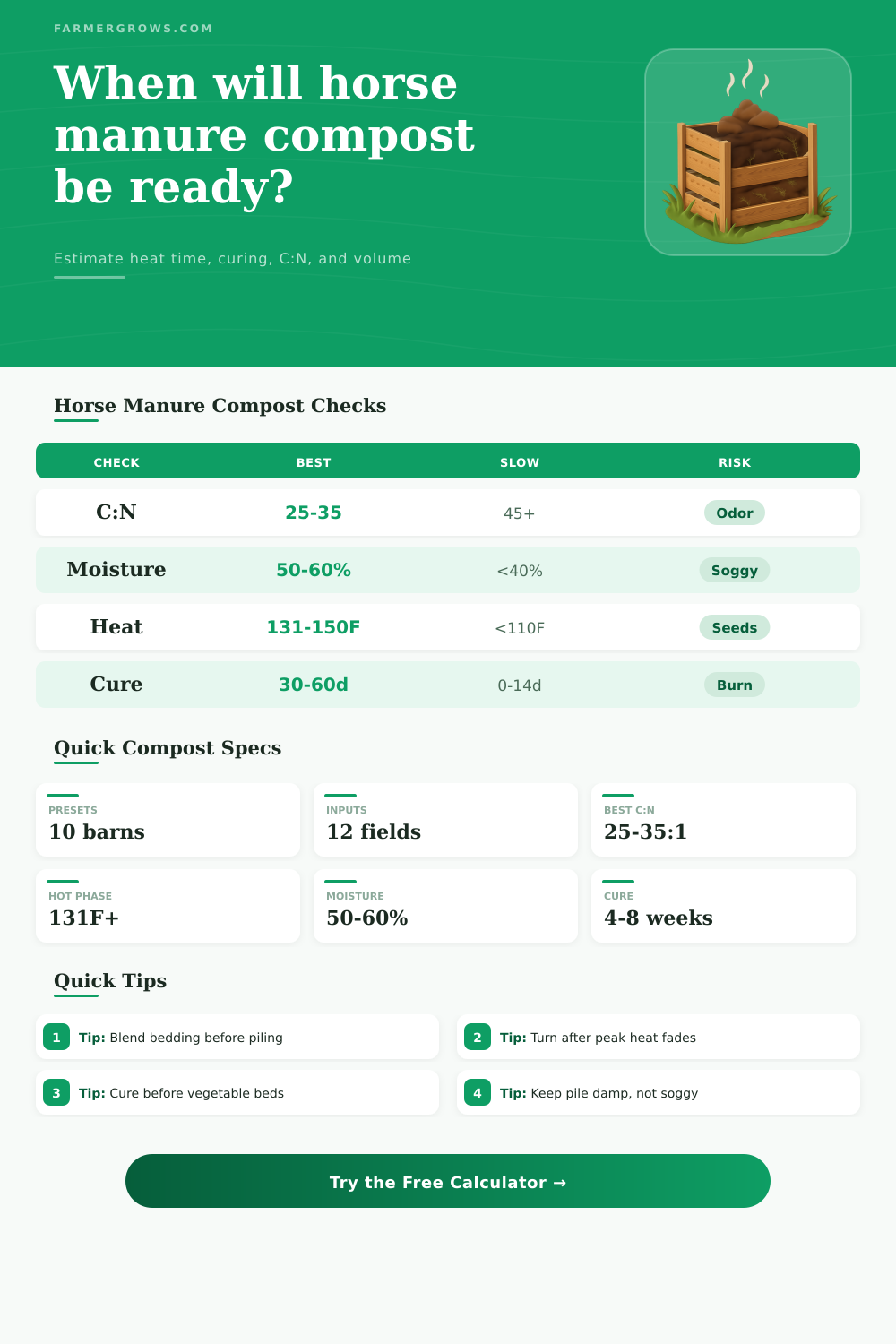
Horse Manure Composting Time Calculator
Estimate active composting days, curing date, bedding-driven C:N balance, finished volume, and heat confidence for horse manure piles from stalls, paddocks, and barns.
Horse manure behaves differently from mixed yard compost because bedding can swing the carbon load from balanced straw to very slow wood shavings. Use the estimate as a planning guide, then confirm with pile temperature, smell, texture, and a curing period before spreading near food crops.
Horse Manure Compost Estimate
Enter pile details to estimate active composting and curing.
| Bedding material | Approximate C:N | Moisture behavior | Composting speed | Horse pile note |
|---|---|---|---|---|
| Wheat straw | 70:1 to 100:1 | Drains and fluffs well | Fast to medium | Often the easiest horse bedding to heat when chopped |
| Wood shavings | 350:1 to 500:1 | Can shed water when dry | Medium to slow | Needs enough manure and moisture to avoid a pale woody finish |
| Fine sawdust | 400:1 to 600:1 | Mats when soaked | Slow | Turn gently and mix with coarser bedding for air |
| Wood pellets | 300:1 to 450:1 | Absorbent and uniform | Medium | Good texture after wetting, but still adds heavy carbon |
| Hay waste | 40:1 to 80:1 | Holds moisture | Fast if mixed | Watch weed seed risk unless the pile reaches hot composting range |
| Core temperature | Compost meaning | Pathogen confidence | Weed seed confidence | Action |
|---|---|---|---|---|
| Under 90°F / 32°C | Cold or curing | Low during active phase | Low | Rebuild pile, add moisture, or accept a long cure |
| 90 to 110°F / 32 to 43°C | Warming | Low to moderate | Low | Check pile size, moisture, and bedding carbon |
| 110 to 130°F / 43 to 54°C | Active breakdown | Moderate | Moderate | Turn after heat starts to fall |
| 131 to 150°F / 55 to 66°C | Hot composting | High with repeated exposure | High with repeated exposure | Keep all outer material moved through the hot core |
| Over 160°F / 71°C | Too hot | Uneven biology | May dry quickly | Turn, add coarse damp material, and avoid fire-prone dry pockets |
| Turning schedule | Best pile type | Speed effect | Risk controlled | Field cue |
|---|---|---|---|---|
| No turning | Static aged manure | Slow | Least reliable heat exposure | Use only for long curing or non-sensitive uses |
| Monthly | Large covered bays | Medium slow | Moisture pockets | Turn when the center cools and edges stay raw |
| Every 2 weeks | Loader-managed barn pile | Medium | Uneven bedding carbon | Good practical schedule for many horse barns |
| Weekly | Hot managed pile | Fast | Pathogen and weed seed exposure | Move outside material through the core |
| Windrow turner | Long farm windrow | Very fast | Heat uniformity | Keep windrow moist and shaped after each pass |
| Finished use | Suggested curing | Ready signs | Extra caution | Do not use if |
|---|---|---|---|---|
| Pasture or field | 2 to 4 weeks after active phase | Dark, crumbly, low odor | Follow local manure and runoff rules | Fresh ammonia smell remains |
| Orchard or landscape mulch | 3 to 6 weeks | Coarse pieces are mellow | Keep away from trunks and crowns | Large raw shavings dominate |
| Vegetable garden | 6 to 10 weeks | Earthy, stable, no reheating | Use mature compost around food crops | Pile reheats strongly after turning |
| Seed bed or potting blend | 8 to 12 weeks plus screening | Passes simple germination test | Blend lightly; compost can be salty or strong | Seedlings yellow or fail to sprout |
| Rework into hot pile | 0 to 2 weeks | Still fibrous but not foul | Add fresh nitrogen if carbon-heavy | Material is sour, anaerobic, or saturated |
For bedding-heavy stalls: Shavings, sawdust, and pellets need more time than straw because their carbon is woody. Keep them moist, mix in manure-rich material, and expect a longer cure before garden use.
For safer use: Track heat in several spots, not just the center. The outside of a horse manure pile can carry weed seeds unless turning moves edges through the hot zone.
Most barn owners treats composting like a black hole. Shovel soiled bedding in one corner, pile more over time, and wait until something dark appears. What you get depend on the type of manure/bedding mix you use, such as whether it has more or less carbon. It also depends on how much moisture there is and how long it takes. A successful compost smells earthy; a dud emits whiffs of ammonia and burns your garden beds.
Unlike other animal manures such as chicken or cow, horse manure are more fibrous, drier and contains a lot of bedding material. Horses also tend to stand up often and choose what they eat. After entering your rate of collection, the calculator (above) do the rest of the math for you. It then calculates approximate volume of finished compost, time spent curing, and number of “active” heating days. No need to guess at when the heap will decompose.
How to Make Good Compost
The single biggest variable is your bedding. With about an 80-to-1 C:N ratio (carbon-to-nitrogen), straw breaks down relatively quickly. Shavings from wood have far more heavy-duty carbon. Sometimes as high as 400 to 1. A sawdust heap require much longer to “cook” and must be moister, too, for any given level of germ action different than a straw one. Ignore this, and microbes will expend the available nitrogen breaking down wood fiber instead. The compost won’t rot, and your plants will suffer accordingly; starving in their own manure.
Days pass; heat shows improvement. To kill off common pathogens and weed seeds, a compost pile need to reach 130 to 150 degrees Fahrenheit. If your compost heap shrinks, that’s not a sign it’s finished: You can have a hot, cooking middle and a cool surface. Turning will mix cooler outer bits into the hot heart, ensuring thorough decomposition.
It’s also important to know how to manage moisture: In summer wind, a horse pile will dry fast, but sitting uncovered in heavy rain may make it rot without air. Aim to reach something like wrung-out sponge. Add more water; does it run off? Too wet. Turn it; do you see rising clouds of dust? Too dry. Your hands are the last sensor. Reach into it, touch the stuff: Is it dark and damp, or is it dusty or soggy? Seasoning, covering and the tool help you visualize that equation.
That’s what happens with most folks: they miss the cure step. As soon as the weather cools down, out comes the compost spreader. Wrong. Compost has to mature; it needs some more time for its microbe helpers to stabilize the organic material. Applying immature compost can brings too much salt, which can damage tender young roots. Or it may bring back weed seeds that were temporarly cooked but not killed. No problem if it just sits there until spring planting season.
There are no exact formulas for good compost; there’s plenty of art in it, too. Watch for steamy days early, then sniff (no ammonia); feel the texture (it should be crumbly when squeeze in your fingers). If all those cues check out, congratulations: You’ve made something useful instead of just dirty garbage. And so? That’s when your senses tell you what the timer signaled: Wait. Turn it and keep it moist.