Plot Size Calculator
Plan a growing plot from shape, dimensions, setbacks, paths, bed width, row spacing, crop spacing, headland access, and irrigation buffer before you mark lines in the field.
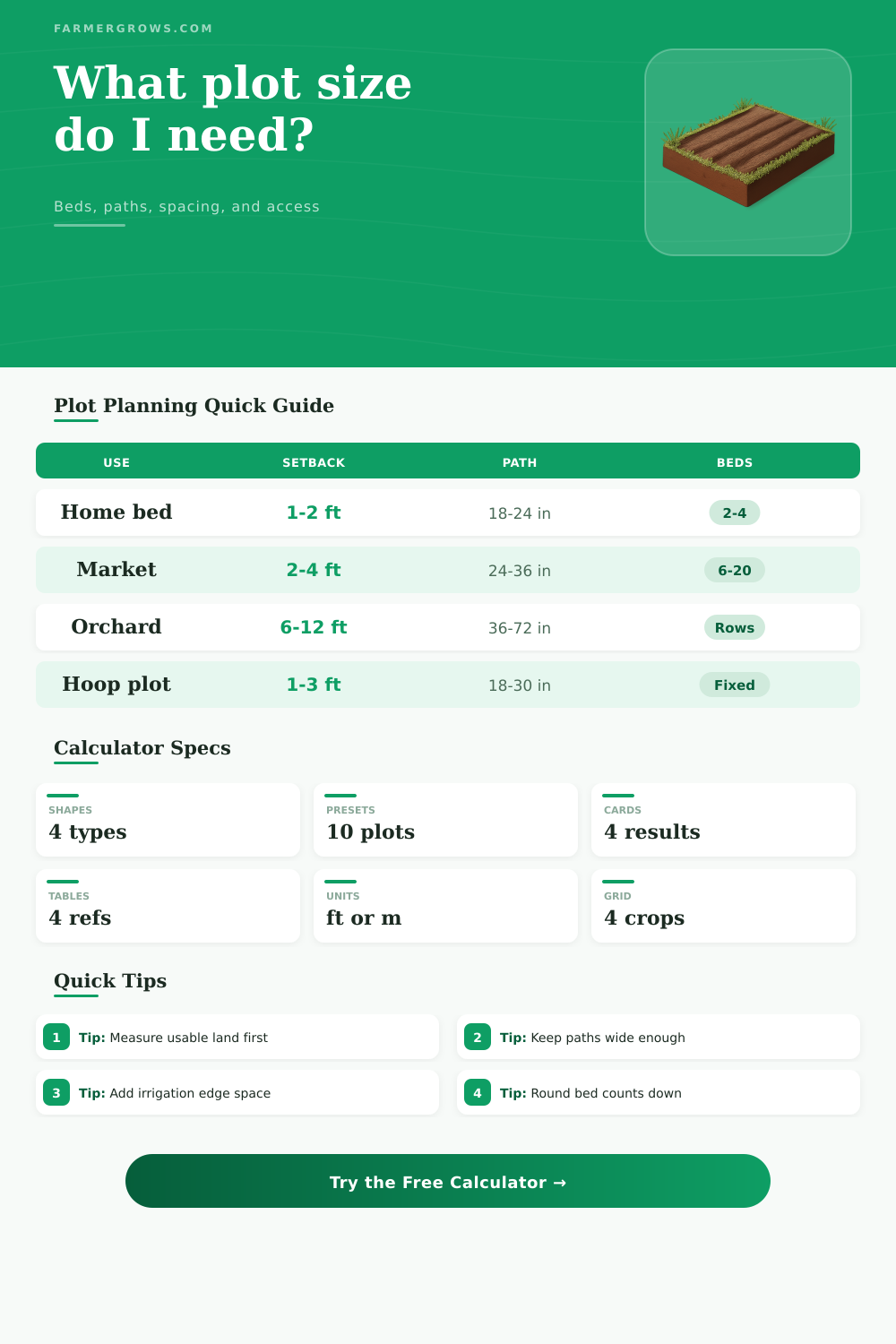
Use the calculator for gardens, raised beds, market garden blocks, orchard strips, hoop house interiors, and trial plots. It separates gross plot size from setbacks, paths, headlands, irrigation margin, bed layout, row spacing, and crop spacing.
Plot Size Results
Your calculated layout will appear here.
| Shape | Gross area formula | Best use | Planning note |
|---|---|---|---|
| Rectangle or square | Length x width | Most beds, fields, hoop houses | Most accurate for parallel beds and equal path runs. |
| Circle | Pi x radius x radius | Herb circles, tree rings, pivot corners | Bed count is estimated from equivalent square width. |
| Triangle | Base x height x 0.5 | Corner plots, irregular garden ends | Reduce plant estimate if the point is hard to cultivate. |
| Custom area | Direct square area | Mapped parcels or measured areas | Use a measured gross area, then subtract layout allowances. |
| Access type | Typical width | Use when | Impact on plot size |
|---|---|---|---|
| Foot path | 18 to 24 in | Hand harvest and small beds | Highest bed efficiency, tight tool access. |
| Wheelbarrow path | 24 to 36 in | Compost, harvest totes, mulch | Good balance for home and market plots. |
| Cart or mower alley | 36 to 60 in | Permanent crops and larger blocks | Lower plant density but easier maintenance. |
| Headland turn | 3 to 12 ft | Carts, hose turns, small equipment | Often the biggest hidden access allowance. |
| Crop style | Bed width | Rows per bed | Crop spacing |
|---|---|---|---|
| Baby greens / lettuce | 30 to 48 in | 3 to 6 | 4 to 10 in in-row |
| Roots, beets, carrots | 30 to 48 in | 3 to 6 | 2 to 6 in in-row |
| Tomato, pepper, eggplant | 30 to 48 in | 1 to 2 | 18 to 30 in in-row |
| Sweet corn / beans | 30 to 42 in rows | 1 to 2 | 6 to 12 in in-row |
| Strawberry / berry rows | 24 to 48 in rows | 1 to 2 | 12 to 36 in in-row |
| Plot | Gross size | Likely usable bed area | Good starting layout |
|---|---|---|---|
| Small kitchen plot | 20 x 30 ft | 300 to 420 sq ft | Four 30 in beds with 24 in paths. |
| Backyard production | 30 x 50 ft | 700 to 1050 sq ft | Six to eight 36 in beds plus headland. |
| Market garden block | 100 x 150 ft | 8500 to 10500 sq ft | Permanent beds, 18 to 30 in paths. |
| Hoop house | 30 x 96 ft | 1800 to 2300 sq ft | Three to five beds with narrow center paths. |
| Small orchard | 120 x 180 ft | Varies by alley width | Rows sized around mower and harvest access. |
Mark access first: Place gates, hose headers, compost staging, and harvest turns on the sketch before counting beds. These spaces are easier to plan than to reclaim after planting.
Round down for real beds: Bed counts should be whole numbers. Use the leftover strip for flowers, herbs, irrigation, trellis anchors, or a wider path instead of forcing a narrow bed.
Planning a garden plot requires that you account for several different type of space within the plot. The area that is available for planting will always be less than the total area of the land that is dedicated to the garden. You must account for the space that is occupied by a setback, irrigation buffers, and headlands.
A setback is the area between the boundary of the plot and the rows of garden bed, and this space is used to keep the garden beds away from fences or ditches. An irrigation buffer is the space dedicated to the placement of hoses and valves for the watering of the garden, and this space is provide to ensure that the gardening tool move across the garden does not compact the soil. A headland is the open space at the end of the rows of garden beds, and this space is used to turn garden equipment like wheelbarrows without damaging the plants.
How to Plan a Garden Plot
Thus, the gross area of the plot will always be larger than the area that is dedicated to the planting of vegetable beds. The width of the path within the garden plot and the width of the garden beds are two related measurement of the plot. Narrow paths will save space within the plot, but will make it difficult to harvest the vegetable from the plots.
A wide path will make it easy to move within the garden, but will reduce the number of garden beds that can be placed into the plot. Each of these dimension works together to determine the total number of garden beds that will fit into the plot. Thus, you can use a calculator to determine how changing the width of the paths or the widths of the garden beds will change the total number of beds that can be placed within the plot.
The spacing of the row of garden beds and the spacing of individual plants within each row are two other important factor to consider in determining the total number of plants that will grow within the garden. If the plants within the rows are to be closely spaced, more plants can be placed into the garden, but it may become difficult to reach the plants to weed or harvest the vegetable. If the vegetables are to be spaced further apart, there is less crowding of the plants and you can easily maintain the vegetables, but there will be fewer plant within the garden.
The row and crop space requirement of the vegetables that are to be grown will determine how closely the rows are spaced. For instance, vegetables like leafy greens may be planted into narrow path within the garden, while vegetables like tomatoes may need to be spaced further apart to allow for the evaporation of water vapor from the plants. The shape of the garden plot will also impact the number of garden beds that can be planted into the plot.
Rectangular plot tend to allow for the plots to be efficient in their use of the land within the plot. Circular plots or triangular plots of land may not be as efficient in their use of space for planting vegetables. When calculating the plots of these shapes, the plan is to treat the space as if it is to become a rectangular garden plot, and to decide whether the remaining plots at the edge of the triangle or circle are to be utilized in planting vegetables.
Many people tend to make mistake when planning their gardens. One of the most common mistake is that they fail to account for the area within the garden that is not dedicated to the growing of vegetables. Thus, they tend to focus only upon the area that is to be used for planting.
If they dont account for the area that is dedicated to paths, headlands, and irrigation buffer, they may find the garden is too small for them to effectively use when gardening. Another mistake that most people make is they round the number of vegetable bed calculated for the plot to include every inch of the plot. Thus, they may create a path for the vegetables that is too narrow for them to effectively use in the garden.
Instead, you should round the number of garden beds with a plan-bed calculator to determine how much space they will have left over within the plot. Finally, the layout of the garden plot should account for the way in which the gardener will use the garden. Thus, there should be a layout that the gardener can easily use, rather than one that appear visually pleasing to the gardener.
For instance, if the plot has very long row, it may be difficult for the gardener to manage the vegetables within each row. If the headlands are too small, there may not be enough space to turn the garden equipment. Thus, various dimension and types of vegetables should be tested within a garden plot bed calculator prior to beginning to establish the vegetables within the garden plot.
Thus, using a plan-bed calculator will help the individuals understand how the gross area of the plot will compare to the area that will be planted with vegetables, and that using such a calculator will help the individual to avoid mistakes in the gardening plot prior to moving any soil in the garden.