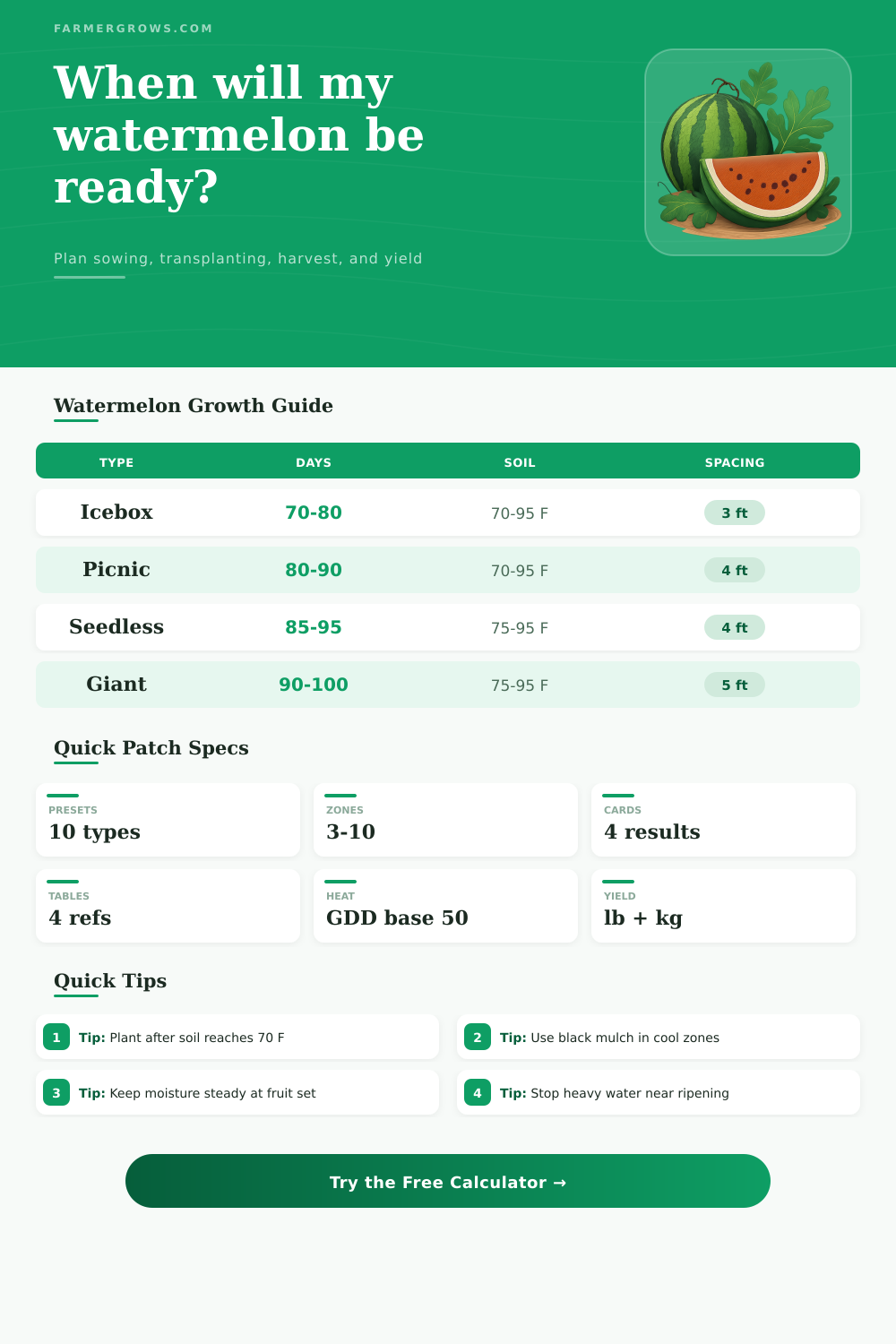
Watermelon Growth Time Calculator
Plan watermelon sowing, transplant timing, heat-unit pace, harvest window, row spacing, irrigation, and patch yield from real variety and zone assumptions.
Watermelon dates vary with soil warmth, transplant stress, fruit load, and summer weather. Use the results as a garden planning estimate, then confirm with seed packet notes and local extension advice for your microclimate.
Watermelon Growth Results
Your projected germination, transplant, harvest, and yield estimate will appear here.
| Variety | Type | Typical maturity | Fruit size | Best fit |
|---|---|---|---|---|
| Sugar Baby | Icebox | 73 to 80 days | 8 to 12 lb | Shorter seasons, small gardens, early harvests |
| Crimson Sweet | Picnic | 80 to 88 days | 20 to 25 lb | General garden rows with moderate room |
| Charleston Gray | Oblong picnic | 88 to 95 days | 24 to 35 lb | Long warm rows and market gardens |
| Jubilee | Large striped | 90 to 100 days | 25 to 40 lb | Hot climates with a long frost-free season |
| Black Diamond | Large heirloom | 85 to 95 days | 30 to 45 lb | Wide hills, heavy fruit, patient growers |
| Moon and Stars | Heirloom | 90 to 100 days | 15 to 30 lb | Warm gardens where novelty matters |
| Yellow Doll | Yellow icebox | 68 to 75 days | 5 to 8 lb | Cool or short-season patches |
| Mini Love | Mini personal | 75 to 82 days | 5 to 7 lb | Compact vines and high fruit count |
| Sangria | Hybrid picnic | 84 to 90 days | 20 to 25 lb | Warm summer rows with strong sweetness |
| Seedless triploid | Seedless hybrid | 85 to 95 days | 12 to 18 lb | Managed blocks with diploid pollinizers |
| Soil temperature | Expected germination | Seedling quality | Planting note |
|---|---|---|---|
| Below 60°F | Poor or stalled | High rot risk | Wait, warm the bed, or start indoors |
| 60 to 64°F | 10 to 14 days | Slow and uneven | Use row cover only if weather is warming |
| 65 to 69°F | 7 to 10 days | Acceptable | Better for transplants than direct seed |
| 70 to 84°F | 4 to 7 days | Strong | Good outdoor sowing range |
| 85 to 95°F | 3 to 5 days | Very strong | Ideal for rapid emergence |
| Above 100°F | Erratic | Heat stress possible | Shade seed trays and keep moisture even |
| Watermelon type | Plant spacing | Row spacing | Plants per 100 ft row | Use case |
|---|---|---|---|---|
| Mini or compact | 2.5 to 3 ft | 4 to 5 ft | 33 to 40 | Small gardens, trellis trials, personal melons |
| Icebox | 3 to 4 ft | 5 to 6 ft | 25 to 33 | Short-season gardens and easier harvest handling |
| Standard picnic | 4 to 5 ft | 6 to 8 ft | 20 to 25 | Most home garden rows |
| Seedless blocks | 4 to 5 ft | 6 to 8 ft | 20 to 25 | Needs nearby seeded pollinator plants |
| Large heirloom | 5 to 6 ft | 8 to 10 ft | 16 to 20 | Large fruit, stronger vines, better airflow |
| Market hills | 2 to 3 plants per hill | 6 to 10 ft between hills | Varies | Hill planting with cultivation alleys |
| Maturity band | Days to ripe fruit | Common varieties | Climate note |
|---|---|---|---|
| Very early | 68 to 75 days | Yellow Doll, early icebox types | Best for zones 3 to 5 or late spring delays |
| Early | 75 to 82 days | Sugar Baby, Mini Love | Good when nights warm slowly |
| Main season | 82 to 90 days | Crimson Sweet, Sangria | Fits many zones with reliable summer heat |
| Long season | 90 to 100 days | Jubilee, Moon and Stars, Black Diamond | Needs a long frost-free window or transplants |
| Seedless managed | 85 to 95 days | Triploid seedless hybrids | Needs warm germination and pollinizers |
Warm soil tip: Watermelon roots dislike cold starts. In cool springs, use black plastic mulch, low tunnels, or indoor transplants so the first two weeks happen in genuinely warm soil.
Ripening tip: A calendar date is only a target. Near harvest, check the tendril nearest the fruit, belly color, rind dullness, and variety notes before cutting the melon.
A watermelon patch begins with this single question: When do I want to have some ripe ones? Not just as many days as it says on the back of seed packet. But why not?
All the heat units needed to accumulate, space between vines, how soil warms up (and whether nights remain cool), and frost date, these factors can shifts the timing of your harvest. In one garden, a watermelon may ripen at 70 days; in another where the nights remained cool or the soil warm slowly, maybe 90 days. Understanding these factors before planting means no more guesswork; no more rush, either, or missing window altogether.
How to Plan Your Watermelon Harvest
Once you plug in your frost dates (local to you) and how you plan to grow your variety, calculator does all the math for you. It take into account heat units. Since watermelon is a warm-season crop, it doesn’t just count calendar days but cumulative warmth. It extends predicted field days if your nights are cooler than normal. If you’re starting with transplants rather than direct-sowing seeds, it add the weeks indoors and moves back the day you start outside. What comes out is not an optimistic label date, but a realistic harvest window.
The yield estimate reflect space and irrigation decisions, since these will impact how many fruit develop. Vines that are crowded don’t get as much air circulation and sunlight, so the tool reduce the number of expected fruit. Likewise, if there’s insufficient water during fruit set, it does the same thing. Before planting, check out reference tables on the page to see where your plan lies: Is it tight, average, or generous?
The tables provide typical spacing ranges depending on size of the vines, so you’ll know what to expect before digging any holes. They also indicate how fast germination happens by soil temperature, which tells you if you should of waited till the ground warms a bit, or start seeds indoors.
Not all varieties are created equal which trips up many a gardener. Heirlooms and large-podded picnic types take longer then icebox ones. These must wait for the soil to be warm enough to germinate best. Switch between ten popular variety in the calculator to see how fruit weights differ. This shows you how they impact total size of your patches and their days-to-maturity range. It makes for a rapid comparison with important tradeoffs to consider when space is tight or when you prefer a succession of pickings rather than a single wave.
Little tweaks like these are what make watermelons so responsive, beyond what you can get from the calendar. In marginal areas, black plastic mulch warms the soil, shaving a few days here or there from germination time. And when it comes to ripe fruit, backing off on watering helps concentrate sugar and prevent cracks. Such tweaks fall outside of basic math, but are sometimes what makes for good melons despite a borderline season.
You’re not aiming for a pinpoint date; just a workable range. If the tool say that it will be mid-August through early September, then tendril time starts somewhere around there, and you keep an eye out for when the rind turns color. You’ll have a sense of whether your first fall frost is uncomfortably near, too.
Now armed with these dates, do you want to get the transplants started earlier? Choose an earlier variety? Or take a load off and go with the flow?