PAR to DLI Calculator
Convert PAR or PPFD readings into daily light integral with photoperiod, fixture schedule, dimmer setting, canopy losses, sunlight contribution, crop stage, and target DLI.
Use canopy-level measurements whenever possible. This calculator treats the entered PAR or PPFD as the average over the crop area, then adjusts it for dimming, schedule efficiency, and canopy loss before adding outdoor or greenhouse sunlight.
Daily Light Result
Results use DLI = PPFD x hours x 3,600 / 1,000,000, with dimmer, schedule, canopy loss, and sunlight added as separate steps.
| Formula | Expression | Use | Example |
|---|---|---|---|
| PPFD to DLI | DLI = PPFD x hours x 3,600 / 1,000,000 | Converts canopy PPFD into daily photons | 300 x 16 h = 17.3 DLI |
| DLI to PPFD | PPFD = DLI x 1,000,000 / (hours x 3,600) | Finds average PPFD needed for a target | 18 DLI over 16 h = 313 |
| PAR W/m² to PPFD | PPFD = PAR W/m² x conversion factor | Approximates photon flux from PAR watts | 80 W/m² x 4.57 = 366 |
| Total DLI | fixture DLI + sunlight DLI | Combines greenhouse sun and lamps | 12 fixture + 6 sun = 18 |
| Crop group | Seedling DLI | Vegetative DLI | Flowering DLI | Notes |
|---|---|---|---|---|
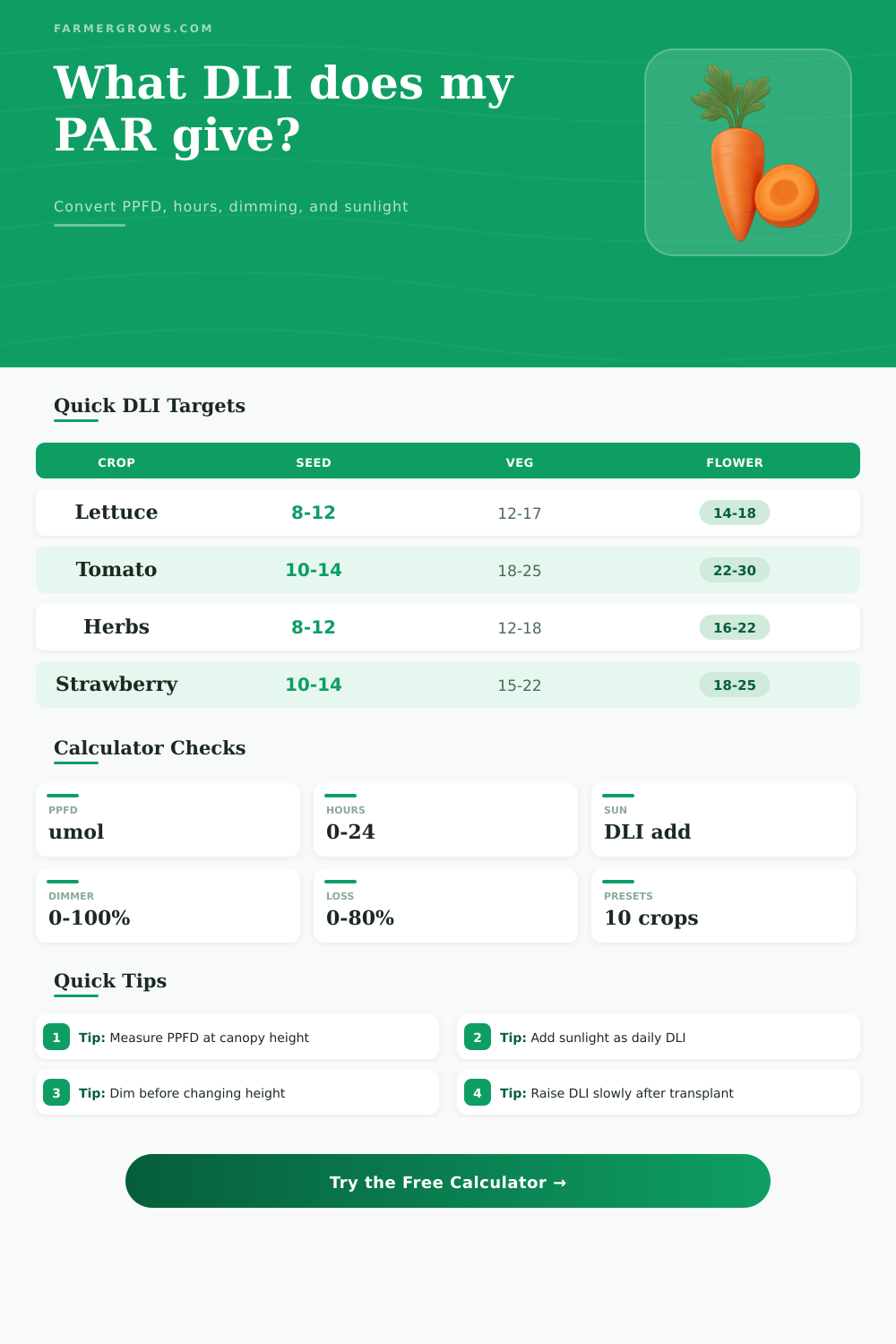
| Lettuce and leafy greens | 8 to 12 | 12 to 17 | 14 to 18 | Too much light can add tip burn risk if climate is poor |
| Basil and culinary herbs | 8 to 12 | 12 to 18 | 16 to 22 | Flavor and compactness often improve with moderate DLI |
| Tomato and pepper | 10 to 14 | 18 to 25 | 22 to 30 | High DLI needs matching CO², water, and nutrition |
| Cucumber and vine crops | 10 to 14 | 18 to 24 | 22 to 28 | Watch leaf temperature and transpiration demand |
| Strawberry | 10 to 14 | 15 to 22 | 18 to 25 | Use cultivar response and greenhouse sunlight history |
| Average PPFD | 12 hours | 14 hours | 16 hours | 18 hours |
|---|---|---|---|---|
| 150 umol/m²/s | 6.5 DLI | 7.6 DLI | 8.6 DLI | 9.7 DLI |
| 250 umol/m²/s | 10.8 DLI | 12.6 DLI | 14.4 DLI | 16.2 DLI |
| 350 umol/m²/s | 15.1 DLI | 17.6 DLI | 20.2 DLI | 22.7 DLI |
| 500 umol/m²/s | 21.6 DLI | 25.2 DLI | 28.8 DLI | 32.4 DLI |
| 700 umol/m²/s | 30.2 DLI | 35.3 DLI | 40.3 DLI | 45.4 DLI |
| Input type | Calculator factor | Best use | Caution |
|---|---|---|---|
| PPFD meter | 1.00 | Direct canopy measurement | Average many points across the bed |
| PAR W/m², sunlight | 4.57 umol per W/m² | Weather or greenhouse PAR sensors | Spectrum changes the exact factor |
| PAR W/m², white LED | 4.60 umol per W/m² | LED specs given as PAR watts | Use fixture test data when available |
| Lux, sunlight | lux / 54 | Rough outdoor estimate | Lux is visual light, not plant photons |
| Lux, white LED | lux / 60 | Rough white LED estimate | Red-blue fixtures break this shortcut |
Before raising intensity: Check leaf temperature, humidity, irrigation, and nutrient strength. A higher DLI only helps when the crop can use the extra photons.
Before trusting one reading: Take a grid of PPFD measurements at canopy height, average them, then rerun the calculator with realistic canopy loss and dimmer settings.
Daily light integral (DLI) is an total amount of usable light that reach the leaves of a plant over the course of a day. While many people tend to think about light in terms of brightness, that brightness at a single moment isnt the same as the total light output over the course of a day. Photosynthetic photon flux densities, or PPFD for short, measure the brightness at a single moment.
However, to understand how a plant is grow, the daily light integral must be calculated to determine the total amount of light that the plant receives over many hour of the day. The PAR to DLI calculator allow you to enter the PPFD value that you measured in your greenhouse, as well as the number of hours that the lights is running. You will need to make other adjustments for the actual growing conditions to those readings from a PPFD meter.
How to Calculate Daily Light (DLI) for Plants
For example, PPFD meter will register a high value for light if you hold the meter close to the plant, but the inner leaf of the plant will not receive that same amount of light due to the leaves above them blocking some of that light from reaching those inner leaves. If you dont make these adjustments, then the DLI will be overestimated, which will lead to incorrect decisions regarding the growing of the crops. Different crop will require different amounts of DLI than others.
For example, since the leaves of seedlings is smaller and have smaller root system, they will not be able to handle high amounts of DLI. Flowering and fruiting plant can handle more DLI, but require more heat, humidity, and nutrition to provide those leaves with the energy that they need to perform the processes that they require to produce flowering or fruiting plants. The selection of the apropriate growth stage will allow the calculator to compare the current DLI to that which is required for the plants to grow at that stage.
The lighting schedule that you select also contributes to the DLI calculation. For example, plants that are exposed to less efficient light schedules will lose some of the DLI value that they would otherwise receive. For instance, if plants are only exposed to bright light for part of the day, they will receive less DLI than if they are expose to steady light.
If the plants are grown in a greenhouse, the amount of sunlight that enters the greenhouse will contribute to the DLI that the plants receive. You will need to enter this value into the calculator; otherwise, the total amount of DLI that the plants receive will be under-counted. You must also enter a canopy loss percentage.
The canopy loss percentage accounts for the distance between the light and the leaves as well as the way in which the plants will shade each other. The result will show you the gap between your current daily light integral and your target daily light integral. If your current daily light integral is lower than your target daily light integral, the calculator will provide you with information regarding how much more PPFD or how many more hours of light are require to reach your target.
Based on this information, you can decide if raising the lights for the grow area or increasing the hours that the grow area is lit up is needed. However, if your current daily light integral value is higher than your target value, you must adjust the temperature and the irrigation for the plants. You should never simply turn the lights down for the plants if there is an excess of light but the plants do not have enough water or nutrient.
Reference table are provided for you to read about the different target daily light integrals for the different stages of the plant life cycle. These tables provide information regarding how the target daily light integral changes from the seedling stage of the plants until they reach the flowering stage. Furthermore, the tables display the average PPFD for the plants and the daily light integral that results.
However, the grower can only use these tables as a reference to read and understand the requirements for the plants. A light meter should still be used to take the measurements needed to determine the daily light integral for the plants. Many people will make mistake when measuring the light for their plants.
One of the most common mistake is to take a single reading for the entire grow area. The brightest spot for the plants may receive a high amount of light PPFD but the average light for the entire area may be much lower. By taking a single reading, the grower will end up with an overestimation of the daily light integral of the plants.
Furthermore, many growers will make the mistake of using the specification sheet for the light to determine the PPFD for the plants, yet they do not account for the dimmer setting for the lights or the distance that the light is from the plants. The calculator helps to ensure that these mistakes is avoided by forcing the grower to enter the different variables related to these factors. This calculator should be used repeatedly throughout the plants growing cycle.
The grower should take measurements of the daily light integral at the start of the cycle and again after the plants have grown and filled the growing area. By taking measurements at different stages of the cycle, the grower can determine how the daily light integral changes with the growth of the plants and the age of the growing equipment. Finally, ensure that the other factors of the growing environment are sufficient to that level of daily light integral.