
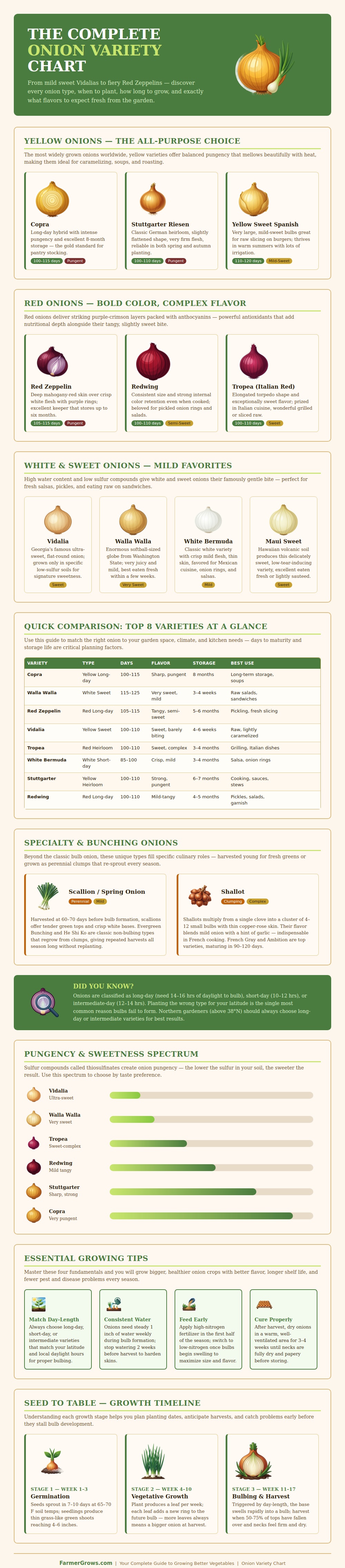
All onion varieties is not created equal, each has its own set of biological requirements, and working with nature rather than against it pays off. Onions range from sharp-flavored Copra varieties to milder Vidalia types and even bulbs. A glance at variety chart will help you understand what you’re up against. It also shows why keeping your onions in pantry instead of compost heap is possible.
The first question is: What kind of onion are you going to grow, and what color? Depending on your choice, it will factor into the onion’s flavor and how long it store. For general use in cooking, yellow onions is the default. Strong-flavored varieties such as Copra or Stuttgarter Riesen gets mellow with cooking. If cured properly after harvest, yellow onions will store for several months. This means a good supply last for a long while, so you don’t need to buy seed again and again.
How to Choose the Right Onions
Sweet onions like Maui or Walla Walla are another story, since they’re lower in sulfur and higher in water content. Raw, sweet onions taste sweet and mild. The catch: Because they aren’t intended to store well, sweet onions won’t last long at all. After a couple of weeks they’ll start to shrink up and go bad so eat them fast or plan to preserve them soon.
Yellow onions, sweet onions, and red onions serves different purposes. Sweet onions are just that. Yellow onions are in between; they are good for slicing but also good cooked. Red onions holds their color when pickled in vinegar and bring a splash of color to salad bowl. Varieties such as Redwing and Red Zeppelin retain a red hue even when cooked, which can be important if you’re selling or serving your produce at market, or simply want things to look good on the plate. That visual element influences customer perception prior to consumption.
Want some specialty onions for particular uses in kitchen? The onion-garlic-like flavor of shallots come into play in sauces. Scallions give you a fast crop of greens any time of year, so there is no need to wait for big bulb. You get more options on the plate and less picking and harvesting all at once.
The single most important technical thing to consider when growing onions are day length. Specifically, onions requires a minimum number of days of daylight before they begin their bulb-forming process. If you’re planting the incorrect onion variety for where you live, the infographic says you’ll end up with just green stems. For those in areas with a long summer, such as in the north, select long-day types (such as Copra). A common mistake here is growing short-day types and ending up with tiny, unsuitable produce. This mistake causes more crop failures than any other reason, including pests or disease. You should of avoided this.
There is also some good news about managing timing and water. Early going, when leaves are developing, it want consistent watering, each leaf is one of those rings on the bulb eventually. The more leaves, the bigger your onion will be at pulling time. But don’t give another drop after that (meaning: do not water until you pull your onions). If you do, they won’t have a chance to dry out. This next part of the process is called curing, and it helps them stay well stored. Rotting would of occur in the winter otherwise. If the skin is dry, they will not rot.
Matching the best onion variety to where you live and how you cook is about getting the right mix of plant biology and mealtime preference. Don’t attempt to grow a sweet southern kind in a cold northern garden (unless you intend to consume them immediately). Actualy, it could be difficult. Match the day length requirement to your location. Choose a level of heat intensity that suits your taste. Learn to cure bulbs correctly. When all those elements come into alignment, you’ll be happier with your harvest. Sweet or crisp onion layers enhances meals, proof that planning pays off. Naturaly, it helps too.