
The labels in the garden center confuse us. Sometimes the same common name is use for different things. Sometimes the Latin names are hard to read, which makes you panic.
Is it a perennial? Is it an annual? Does it tolerate shade, or does it need sun? We all goes through this when attempting to make a garden.
How to Understand Your Plants
Why do we get so confused? We approach plant ID as some sort of strict academic exercise instead of what it realy should be, which is a tool to help us survive. To identify plants isn’t meant to require a memory trick from your textbook. It’s meant to tell you what’s going to live and what’s going to die under your particular care.
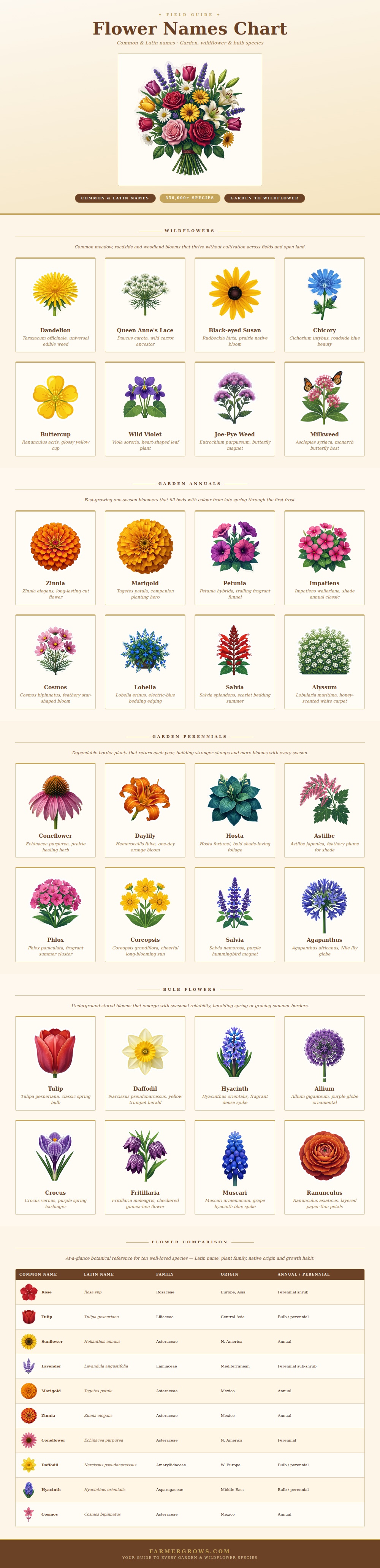
The chart divide up the flowers in a way that interests a gardener. It separates bulbs and cultivated perennials and annuals from wildflowers. Why does this make a difference?
Because some confusion exists: Many people think all wildflowers are weeds. But actualy they’re toughies, such as Queen Anne’s lace or a dandelion. They survives because you don’t fuss over them constantly like you might with your prized rose.
The lowly wildflower is foundation for a landscape of plants that grow on their own with little care. If a no-fuss, easy-garden is what you seek, learn more about such plants. They don’t need you.
Annuals, as garden plants go, are another animal altogether. Annuals is the sprinters of the plant world: fast-growing, with an explosive single-season show. Think of marigolds and zinnias.
They provide a blast of color from late spring through the first frost, then they are gone. Plant them for instant gratification. Count on them. Make allowances for your own gardening schedule as a beginner.
Appreciate their temporary nature; that’s part of their charm. It’s summer color only; you’re not buying this baby for keeps. You’re renting the beauty for a season.
With perennials, it’s a longer game: Think of them as an investment, with daylilies and coneflowers as your examples. Perennials comes back year after year; they get stronger each season.
Their first year look modest (hence the frustration factor). Sometimes all they seem to be is mass of foliage. With patience, they gain strength and size every year.
Remember, patience is what you pay for when gardening successfully with perennials. That’s the message of the chart: How these steady plants accumulate, gradually making a structure that annuals simply can’t do. It is not a fill-in-the-blank exercise, but a way to create a framework.
Bulbs are another story (and then some). Why? Because bulbs works on an inner clock we don’t see. They stash their reserves underground and then emerge with a reliability that feels almost mechanical. But they do signal us in a way that borders on mechanical.
Like clockwork, tulips announce spring, and daffodils, and hyacinths…and the list goes on. There is even a side-by-side chart of 10 popular varieties.
This chart include information about their origin and family to show their general nature. It explains where they came from and what kind of growing environment they prefer.
That matters: A Mexico-native zinnia wants something different than a European-originated rose. Knowing its history helps you provide what it craves.
But what makes this such a good guide are the explanations it offers. Instead of mindless memorization, there’s strategy here. If you know something is a perennial for a shady area, then you don’t persist in trying to grow it in full sun.
If something is a native prairie bloom, you know it wants well-drained soil and probably full sun. Knowing a word can make all the difference; they aren’t just speaking words, they are providing clues.
And speaking their language matters. It’s like learning a new language: The words are meaningless at first. And then you get it. The sentence begins to make sense. Knowing replaces guessing.
That’s when the garden becomes less of a chore and more of a conversation. You should of tried this sooner.