On Center Planting Calculator
Estimate plant sites, order quantities, row fit, bed density, and layout effects from row length, row count, bed width, on-center spacing, staggered rows, border offsets, and survival rate.
On-center spacing means the distance from one plant crown, plug, bulb, or trunk center to the next. This calculator keeps the first and last plants inside the border offset, then counts each row and checks whether those rows fit the bed width.
On-Center Planting Results
Results update from your planting layout.
Preview shows a scaled sample, not every plant in large beds.
| Planting | Typical on-center spacing | Common row setup | Notes |
|---|---|---|---|
| Baby greens transplants | 6 to 8 in | Square or tight rows | Use only for transplants with fast harvest windows. |
| Head lettuce | 10 to 12 in | 3 to 4 rows in a 30 to 48 in bed | Offset from bed edges so outer heads do not hang into paths. |
| Garlic cloves | 5 to 6 in | 4 to 6 rows per bed | Square grids make planting boards and dibblers easier. |
| Basil and compact herbs | 10 to 14 in | Triangular or staggered rows | Staggering helps the canopy close without perfectly aligned gaps. |
| Peppers | 18 to 24 in | Double row on 4 ft beds | Keep enough room for airflow and harvest access. |
| Landscape shrubs | 24 to 48 in | Single or staggered border | Use mature spread, not nursery pot size, for spacing. |
| On-center spacing | Square plants per 100 sq ft | Triangular plants per 100 sq ft | Triangular gain |
|---|---|---|---|
| 6 in | 400 | 462 | About 15.5% more plants |
| 9 in | 178 | 205 | Useful for tight leafy crops |
| 12 in | 100 | 115 | Common for herbs and lettuce |
| 18 in | 44 | 51 | Better canopy fill, harder cultivation |
| 24 in | 25 | 29 | Good for ornamentals and larger vegetables |
| 36 in | 11 | 13 | Often used for shrubs and small perennials |
| Border offset | What it protects | Where it matters most | Practical cue |
|---|---|---|---|
| 0 in | Maximum count | Containers, trays, or very small beds | Use only when edge spillover is acceptable. |
| 3 in | Light edge clearance | Small greens and bulbs | Works when paths are narrow but soil is stable. |
| 6 in | Bed shoulder and drip line | Most raised and market beds | A common starting point for hand planting. |
| 9 in | Airflow and harvest room | Peppers, basil, strawberries | Use when outer plants spread beyond the crown. |
| 12 in or more | Equipment and mulch access | Shrubs, perennials, trellised crops | Use for mature canopy, not just planting-day size. |
| Expected survival | Order for 100 filled spots | Risk level | Use case |
|---|---|---|---|
| 98% | 103 to 105 | Low | Strong plugs, protected beds, short transplant window. |
| 95% | 106 to 111 | Low to moderate | Typical vegetable transplant planning. |
| 90% | 112 to 118 | Moderate | Field planting with some weather or pest risk. |
| 85% | 118 to 125 | Elevated | Direct-set bulbs, runners, bare-root plants, or hot weather. |
| 75% | 134 to 142 | High | Use for difficult establishment or when replacements are cheap. |
Measure the actual centers: A 12 inch on-center layout means each planting hole center is 12 inches from the next center, not 12 inches of empty space between leaves or pots.
Check the row fit before planting: If the bed-width check says the requested rows are tight, reduce row count, shrink the offset, or accept a smaller row-to-row spacing only when the crop can handle it.
On-center spacing describe the distance from the center of one plant to the center of the next. On-center spacing is important to know because on-center spacing determine how many plant will fit into your garden bed and how quicky the plant canopy will close. Additionally, knowing the on-center spacing will help you to understand how many extra plant to order to account for plant deaths.
There are two main pattern for the planting of plants in a grow operation: square patterns and triangular patterns. With square patterns, each plant is placed directly across from the next. With triangular patterns, alternate rows of plants is shifted by half of the on-center spacing of the plants.
How to space plants in a garden
A triangular pattern allow for more plants to fit into the same area compared to a square pattern. A triangular pattern can be beneficial for situations in which more rapid canopy closure is desired. However, triangular patterns alter the distance between the rows to approximately 0.866 times the chosen on-center spacing for the plants.
Another important variable in creating a layout for the garden bed is the border offsets. Border offsets are the distances that account for the need to keep plants away from the edges of the garden bed. The use of border offsets protect the foliage of the plants from being damaged by the garden paths.
Additionally, border offsets prevent the irrigation lines from sitting directly over the crowns of the plants. Six-inch border offsets allow for the placement of mulch rings. Nine-inch or twelve-inch offsets allow for the movement of gardening equipment.
The calculator account for these borders in the calculations for the number of plants that will fit into the bed. The survival percentage is the estimated percentage of how many of the plants will successfully establish within the soil. For example, if the survival percentage is 92%, the grower will need to order additional plants to account for the 8% chance that the plants will not survive establishment in the soil.
The reserve percentage is a second additional number used to calculate the total number of plants that will need to be ordered for the garden bed to account for plants that will die during the transplanting process or that are otherwise weak when transplanted into the soil. The calculator use both percentages to find the total number of plants that will be ordered. It is important to check the fit of the garden rows to the width of the garden beds.
Actual garden beds may not match the drawings of the garden bed layout. As the soil settle and as the garden paths are created, the widths of the beds may change from the original layout. By ensuring that the row count will fit within the width of the garden bed, the grower can decide whether they will need to alter the layout of the planting of the plants.
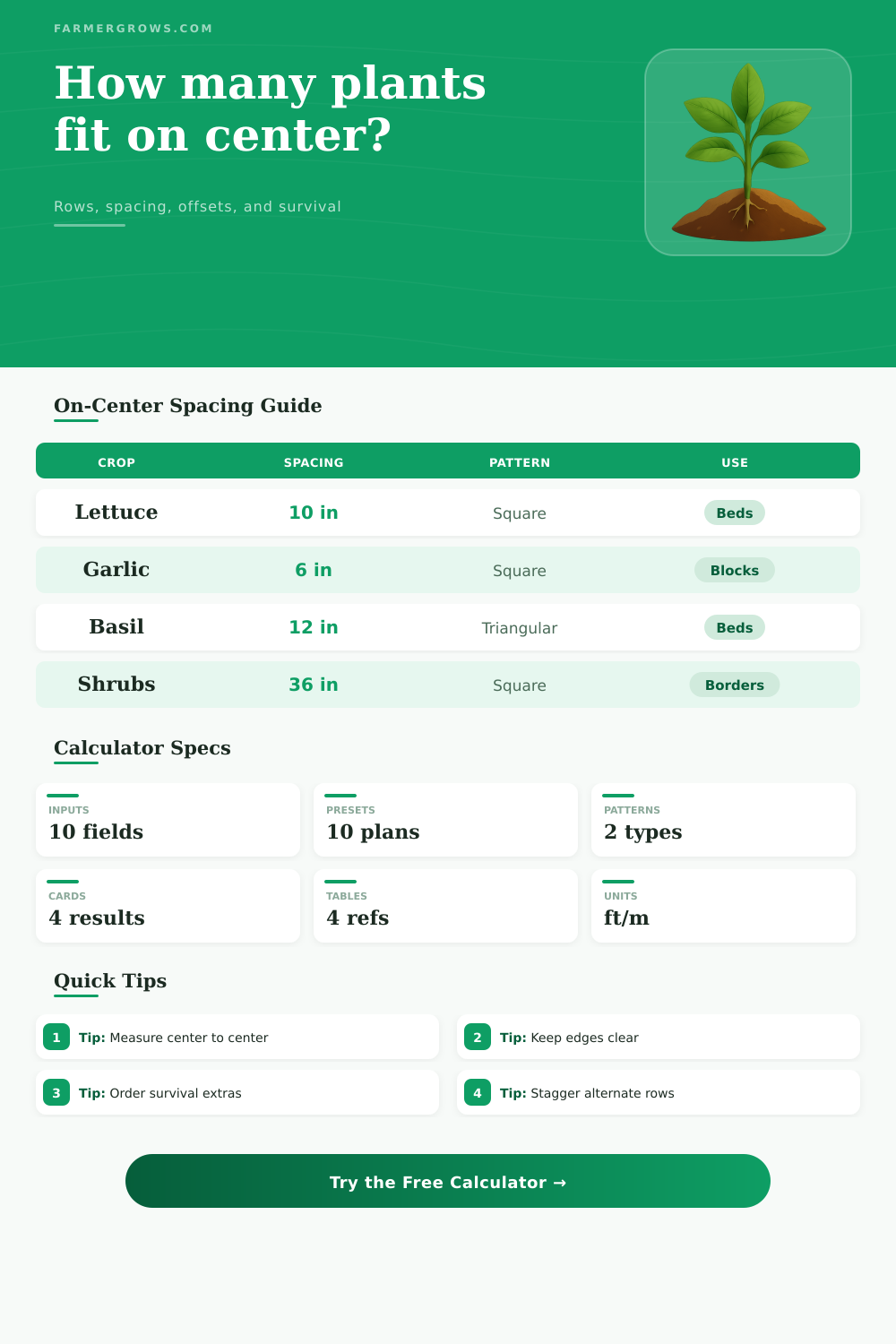
Common spacing choices exist for different types of plants. For example, head lettuce is usually planted at ten to twelve inches on center. Garlic is planted at five to six inches on center.
Landscape shrubs usually require more space so they can develop to their full potential; therefore, they are often planted at twenty-four to forty-eight inches on center. These are common spacing choices that gardeners may use; these can be compared to the on-center spacing requirements of the plants that are to be grown within the garden. The spacing decision will have an influence upon the behavior of the plants as they establish themselves and grow.
If the spacing is relatively narrow, the plants will establish a canopy over the ground more quick. Additionally, narrow spacing will assist in the suppression of the growth of weeds. However, narrow spacing can make it more difficult to cultivate the plants later in their growth cycle.
Wide spacing will allow the plants to access the resources that they require to perform well. It will also make it easier to access the plants with a person. However, more of the soil will remain uncovered which may require the application of mulch to those areas.
Weather and soil conditions may influence the survival percentage of the plants. For instance, if it rains a great deal during the spring when the plants are being established in the ground, the survival percentage may be lowered. Conditions such as hot and dry soil may lead to the death of the transplanted plants.
These variables are difficult to control and may need to account for an additional number of young plants to be placed in the garden nursery to account for the possible death of these young plants after the initial planting of the seeds into the soil. Each variable that is manipulated in the creation of a garden bed layout will impact other variables within the layout. For instance, increasing the border offsets will reduce the number of plants that may be planted in the garden bed.
However, it will improve the health of the plants along the border of the bed. Using a triangular pattern for the rows will increase the number of plants that can live in the bed. However, it will impact how the drip tape is distributed to the rows of plants.
There are many other variables that may be manipulated within the planning of a grow operation, but using the plant layout calculator will allow the grower to review each of the variables to determine their impact upon the other variables.