Rock Dust Calculator
Estimate basalt, granite, azomite, glacial, and mixed mineral dust amounts from area, application rate, soil texture, crop type, remineralization goal, bag size, and overage.
Rock dust releases minerals slowly. Use this calculator for planning a blended mineral amendment pass, then adjust with local soil-test results, crop sensitivity, and dust handling conditions.
Rock Dust Estimate
Results combine the entered rate with texture, crop, goal, overage, bag size, and selected mineral profile.
| Basalt rate class | Rate per 100 sq ft | Rate per acre | Best fit | Application note |
|---|---|---|---|---|
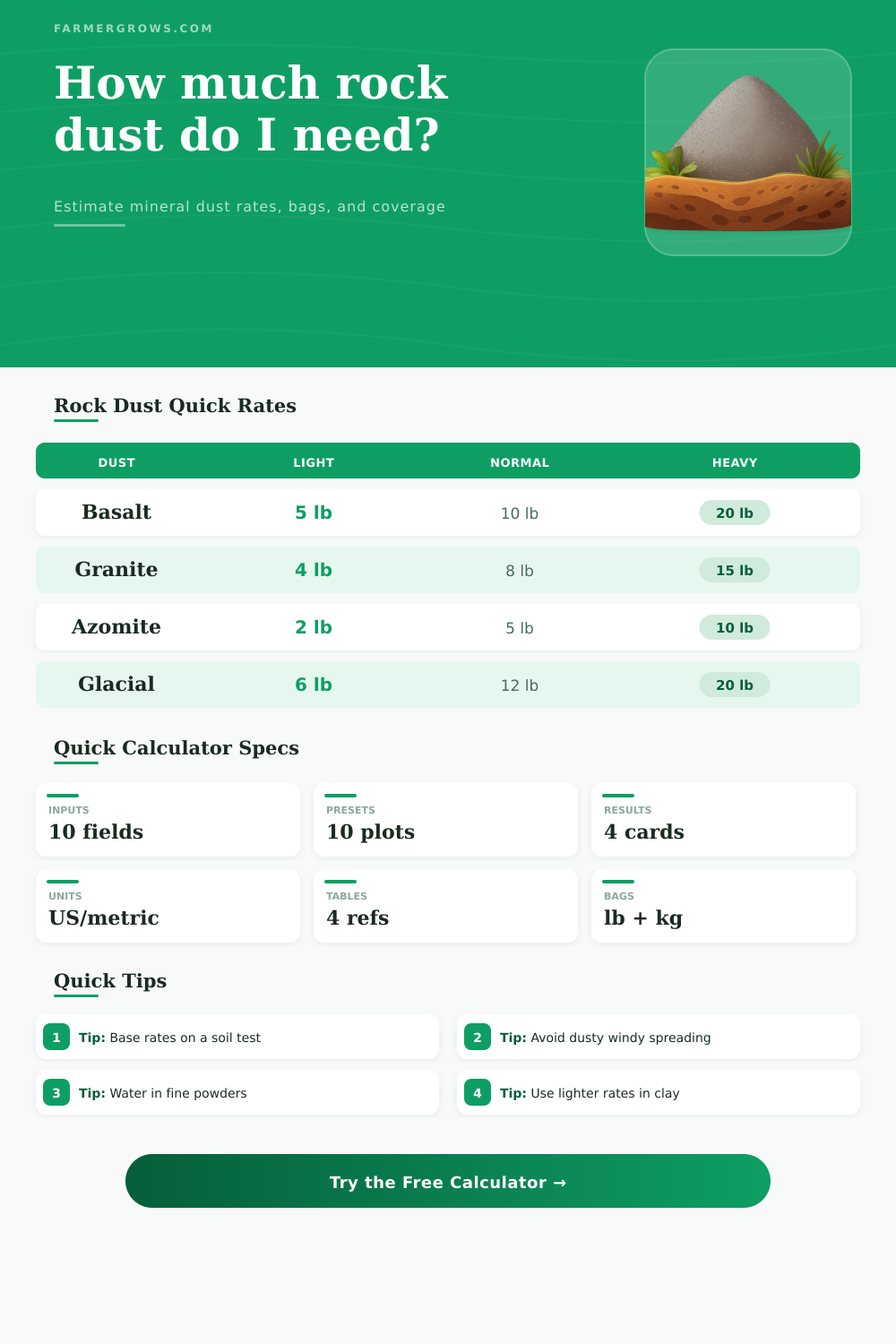
| Light maintenance | 5 lb | 2,178 lb/ac | Healthy loam, annual top-up | Spread thinly and water in |
| Standard garden | 10 lb | 4,356 lb/ac | Vegetable beds, new compost | Blend into top 2 to 4 inches |
| Heavy rebuild | 20 lb | 8,712 lb/ac | Depleted sandy soil | Split if dusty or soil test is unknown |
| Compost charge | 2% to 5% by volume | Not acre-based | Compost pile or worm bin | Mix as layers are built |
| Granite or azomite rate | Light rate | Standard rate | Heavy rate | Why rate differs |
|---|---|---|---|---|
| Granite dust | 4 lb/100 sq ft | 8 lb/100 sq ft | 15 lb/100 sq ft | Slow K and silica, usually coarser than basalt |
| Azomite | 2 lb/100 sq ft | 5 lb/100 sq ft | 10 lb/100 sq ft | Trace-element product used at lower rates |
| Glacial rock flour | 6 lb/100 sq ft | 12 lb/100 sq ft | 20 lb/100 sq ft | Broad mixed minerals with fine particle size |
| Greensand | 3 lb/100 sq ft | 7 lb/100 sq ft | 12 lb/100 sq ft | Milder K source with very slow release |
| Material | Typical mineral strengths | Release pace | Watch item | Good companion |
|---|---|---|---|---|
| Basalt | Calcium, magnesium, iron, silica | Slow to steady | Fine dust inhalation | Finished compost |
| Granite | Potassium, silica, trace feldspars | Very slow | Coarse particles act slowly | Leaf mold or mulch |
| Azomite | Broad trace elements, low N-P-K | Slow | Do not stack high trace rates | Compost tea or humus |
| Gypsum | Calcium and sulfate sulfur | Moderate | Not a full remineralizer | Clay soil structure plan |
| Soil or crop timing | Preferred window | Rate posture | Incorporation | Field note |
|---|---|---|---|---|
| Sandy vegetable bed | Preplant or fall | Moderate to heavy | Top 3 to 6 inches | Organic matter helps hold released minerals |
| Clay loam garden | Fall, winter, or early spring | Light to moderate | Surface or shallow mix | Clay already buffers mineral changes strongly |
| Orchard or berries | Dormant season or post-harvest | Light annual | Mulch zone surface | Keep dust off leaves and fruit clusters |
| Compost pile | During pile building | 2% to 5% of dry mix | Layer or blend | Avoid cement-like wet clumps |
| Bag size | At 5 lb/100 sq ft | At 10 lb/100 sq ft | At 20 lb/100 sq ft | Metric equivalent |
|---|---|---|---|---|
| 10 lb bag | 200 sq ft | 100 sq ft | 50 sq ft | 4.5 kg bag |
| 25 lb bag | 500 sq ft | 250 sq ft | 125 sq ft | 11.3 kg bag |
| 44 lb bag | 880 sq ft | 440 sq ft | 220 sq ft | 20 kg bag |
| 50 lb bag | 1,000 sq ft | 500 sq ft | 250 sq ft | 22.7 kg bag |
Apply with biology: Rock dust works best when paired with compost, mulch, root growth, and moisture. Fine minerals need soil life and organic acids to become plant-available.
Control the dust: Wear a mask when handling fine powders, avoid windy days, and water after spreading so the mineral layer settles into the root zone.
Another way to improve your soil is with rock dust. Unlike compost or manure, which feed the plant immediately, the rock dust gradually alters underlying mineral makeup upon which all life depends. After a soil test indicate a deficiency in trace elements, such as magnesium or calcium, many gardeners use rock dust. They also use it when they want to bring an exhausted garden bed back into balance.
The question becomes…how much? And will it help this crop (on this soil) enough to register? You input your crop type, soil texture and desired dust (above), then the calculator does the rest.
How to Use the Rock Dust Calculator
Why do those variables makes a difference? Because each affects how much to apply. Heavier clay soils is less likely to release their existing minerals, meaning repeated application should of be light. Sandy soils lose fertility more rapidly so the rate is increased for that texture class. Similarly, different crop require varying amounts: New orchard rows can supports a heavier dose then lawns, which can take (and even benefit from) a modest annual application. The calculator combines all these into number you get, incorporating the realities of your particular spot.
It is also important that each kind of rock dust have different effects on soil. Basalt breaks down gradually and releases a balanced range of minerals (silica, magnesium and calcium). Granite is slower and tends more toward potassium. Azomite contains a full range of trace elements but typically is used at lower rates, since it’s concentrated. With this tool, you don’t need to remember all those details. Switch the rock type. Adjust the rate. See what happens. Then, make your decision about which one fits your actualy goal.
How and when you do this is still not part of equation. A calm day is ideal for maximum dust spread (which you want to water into immediately). A light mist after spreading and a basic mask make work pleasant; fine particles are eye- and lung-irritants. Better yet: Mix the rock dust into your already-composted material prior to use; the minerals will leach more rapidely into the root zone that way. These all affects how much mineral you get where you want it, and none of them alter amount you figure out above.
Running those numbers does more than just give you an idea of how thick the mineral layer might be after incorporating it into your bed. They tells you exactly what bags to buy. They also tell you if you are better off with two light pass or one heavy pass. It’s not guesswork anymore, which makes it doable.