
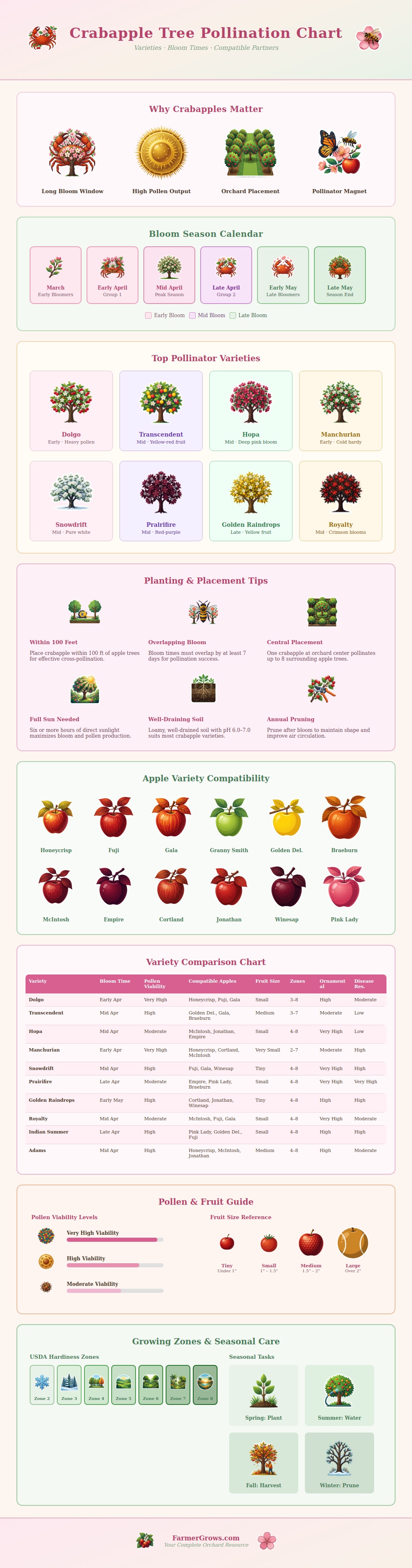
Why do apples not set fruit? (That’s the technical term for “why don’t I get any apples from that apple tree I planted?”) One reason is that most apple trees aren’t compatible with themselves for pollination. They requires another nearby apple or crabapple tree for pollination. Plant one apple tree and you’ll have blooms; then nothing else will happen. That is, unless it was pollinated by something else in your yard.
Fruit Besides being nice-looking things, crabapples can also play a role in producing fruit, both by timing and volume. Unlike most other ornamental trees of their size, they are very good at producing lots of pollen. High-pollen-viability varieties includes Manchurian and Dolgo. Why? Because pollen goes bad. You need pollen from both partners to meet in the middle of the flower to create fruit. Your apple tree blooms and then its partner’s petals fall off…and nothing happens.
How to Get More Apples
The bloom time is short, sometimes only a week or two. You will also want a crabapple to be in it’s peak bloom period. It’s about matching bloom times. A crabapple that blooms either too soon, or too late, is a loser: The early ones such as Dolgo flower in early April, and the late ones like Golden Raindrops through May. An early partner might not work if a cold spring push everything back… If that’s where your Honeycrisp apples fall on the bloom timeline. Keep in mind it’s not just what catalogs say; think also of local climate trends. Charts indicate which crabapple varieties will match up with best-selling eating apples (Gala, Fuji, Granny Smith, etc.).
Where you place them is important. The closer, the better. A crabapple located more than a hundred feet from your primary apple trees won’t work as well because bees are fond off closeness. Their source is what they want to return to. Temperature fluctuations in the springtime along with wind also change microclimates, which may shift bloom times by several days. Keep the trees in view of each other so the bee don’t have to fly far between varieties.
The health of your trees depend partly on their growing conditions, including their soil. For instance, crabapples do best in a soil that’s not too wet (meaning heavy clay) but rather is well-drained loam with slightly acidic to slightly alkaline (near neutral) pH. The genetics of each individual tree determine how much pollen it produce. But if the tree isn’t healthy, it won’t produce as much pollen, either, and you’re back at square one. Healthier trees make better blossoms. This leads to more fruit setting on adjacent trees. It is a simple cause-and-effect cycle.
Pollen power: Prune after bloom to improve air circulation and reduce disease. In areas where flowers become very congested (after bloom), remove excess growth with careful pruning to allow good air flow; the best defense against fungal diseases that impede or stop buds from opening. A healthy tree is also one that makes a good pollinator. Some trees are naturaly resistant to disease, while others are not. Here is a chart showing how different species resists disease.
Selecting a good match requires that they bloom at similar times. It is better to have two or more trees to protect against uncertain weather. So if one apple is early blooming, plant with one that’s late, and likewise with crabapples. That minimizes any chance of poor pollination. For popular varieties, there are infographics listing who goes with whom. Multiple trees make a successful orchard. An individual tree doesn’t count for much by itself. A well-chosen crabapple fits right into the mix off a landscape and does more than provide spring color. It provides the genetic link that creates blossoms to become fruit. Remember, those flowers in spring are doing what it takes for the harvest.