Meat Curing Time Calculator
Estimate curing days from the thickest point of the meat, curing method, cold-room temperature, exposed surfaces, injection, salt level, handling routine, and equalization rest.
●Meat curing presets
Choose a real starting point, then adjust thickness and handling details to match the actual piece on your cutting board.
●Schedule inputs
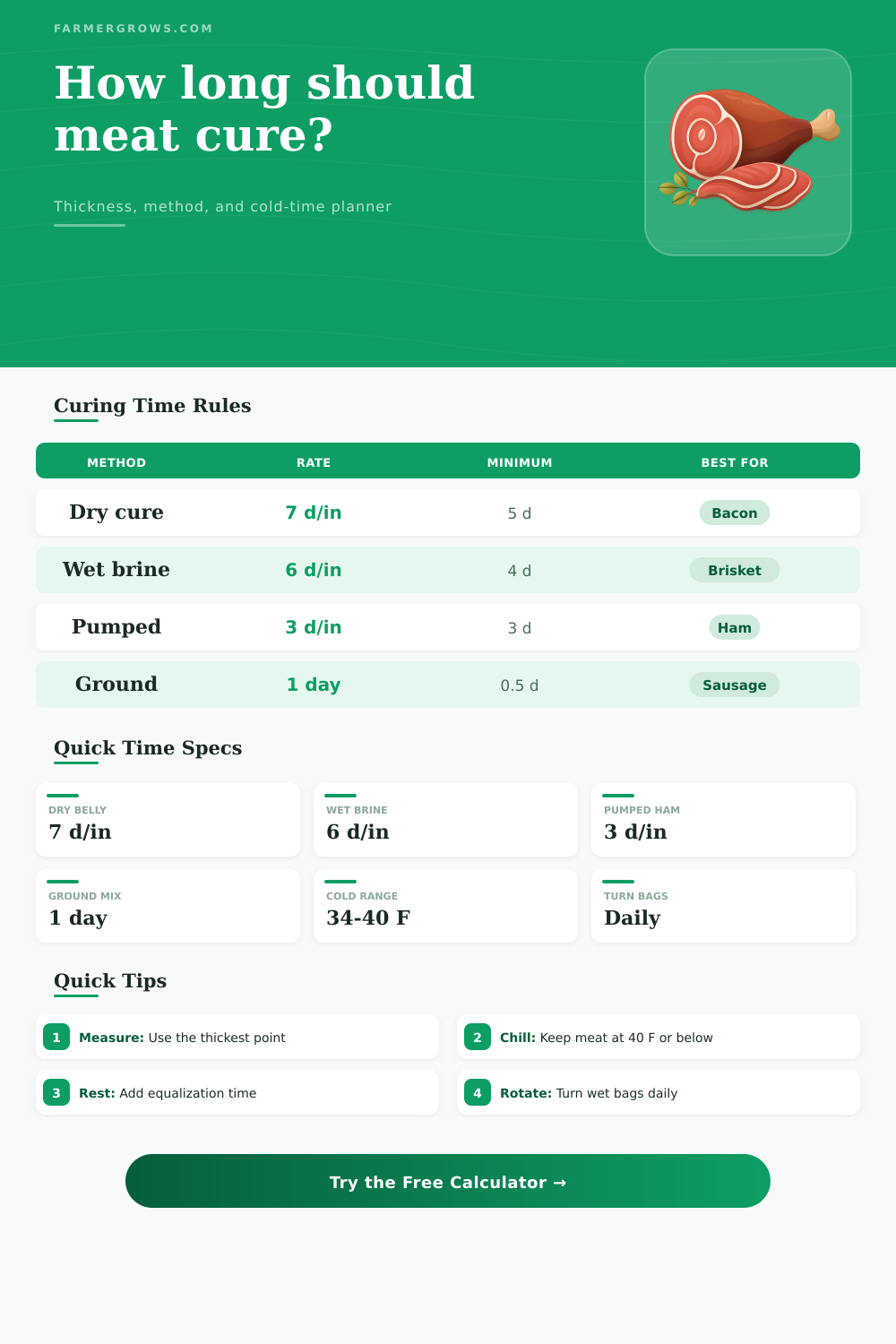
The method controls the base day-per-inch rate and minimum hold time.
Weight is used for practical checks; thickness drives the curing-time formula.
Measure the thickest section after trimming, not the average thickness.
Less exposed surface means the center needs more time.
Lower-salt cures can move more slowly and should use a tested recipe.
Use 0 for dry cure. Pumped ham often uses about 10% retained pickle.
Refrigerated curing should stay at 40°F / 4.4°C or below unless using a validated process.
Optional; the calculator will estimate pull and rest-finish dates.
●Method rate cards
●Base curing time by method
| Curing method | Calculator base rate | Minimum hold | Use for |
|---|---|---|---|
| Dry equilibrium whole muscle | 7 days per inch of thickest point | 5 days | Bacon slabs, pork loin, lean roasts, small whole-muscle pieces. |
| Traditional dry salt cure | 7 days per inch, then equalize | 7 days | Salt-box pork, country-style pieces, rind-on belly, and dense cuts. |
| Wet equilibrium brine | 6 days per inch | 4 days | Corned beef, pastrami, poultry breast, and submerged whole muscle. |
| Immersion brine, not injected | 6.5 days per inch | 5 days | Large pieces in a cover pickle where cure moves from outside inward. |
| Pumped or injected ham cure | 3 days per inch after pump adjustment | 3 days | Hams and shoulders with measured retained brine pickup. |
| Ground sausage cure hold | 0.5 to 1 day after thorough mixing | 0.5 day | Comminuted sausage, snack sticks, and cured chopped mixtures. |
| Long dry cure before drying | 14 days per inch | 14 days | Coppa, bresaola, lomo, and pieces that will enter controlled drying. |
| Thin jerky or strip cure | 12 hours for thin pieces | 0.5 day | Uniform strips under one-quarter inch before a validated heat step. |
The dry-cure rule follows the common extension guidance of about 7 days per inch of thickness. Other method rates are conservative planning estimates and should be checked against the tested recipe being used.
●Thickness comparison at normal buffer
| Thickest point | Dry cure estimate | Wet brine estimate | Pumped cure estimate |
|---|---|---|---|
| 0.5 in / 1.3 cm | 5 days minimum | 4 days minimum | 3 days minimum |
| 1 in / 2.5 cm | 8 days with buffer | 7 days with buffer | 4 days with buffer |
| 2 in / 5.1 cm | 16 days with buffer | 14 days with buffer | 7 days with buffer |
| 3 in / 7.6 cm | 24 days with buffer | 20 days with buffer | 10 days with buffer |
| 4 in / 10.2 cm | 31 days with buffer | 29 days with buffer | 14 days with buffer |
●Temperature and handling modifiers
| Condition | Schedule effect | Calculator modifier | Reason |
|---|---|---|---|
| 32 to 34°F / 0 to 1°C | Slower salt diffusion | Add 20% | Very cold meat cures more slowly and may partially freeze near the surface. |
| 34 to 37°F / 1 to 3°C | Slightly slower | Add 10% | Still a good cold range, but slower than the upper refrigerator range. |
| 37 to 40°F / 3 to 4.4°C | Target home range | No change | Cold enough for safety while allowing normal cure movement. |
| Above 40°F / 4.4°C | Unsafe for normal refrigerator curing | Warning shown | Perishable meat should remain at or below 40°F unless a validated process says otherwise. |
| Turn or massage daily | More even contact | Subtract 5% | Redistributes brine and cure around bagged or submerged meat. |
| Static tub or rarely moved | Uneven contact risk | Add 15% | Dense spots and contact shadows need more margin. |
●Common project schedule table
| Project | Typical thickness | Method selected | Planner result |
|---|---|---|---|
| Pork belly bacon slab | 1.5 to 2 in | Dry equilibrium | 12 to 16 curing days, plus 2 to 3 days rest. |
| Corned beef brisket | 2 to 3 in | Wet brine | 14 to 20 curing days for full penetration in thick flats. |
| Injected picnic ham | 3 to 4 in | Pumped cure | 10 to 14 curing days after a measured pump, plus rest. |
| Canadian bacon loin | 2.5 to 3.5 in | Dry equilibrium | 20 to 28 curing days when treated as a thick roast. |
| Ground cured sausage | Mixed throughout | Ground cure hold | 12 to 24 hours cold hold before cooking or smoking. |
●Curing method comparison
Dry equilibrium cure
Best when cure, salt, and sugar are weighed against the meat and sealed with the piece. Time is thickness-driven, and an equalization rest helps the center and edge taste more even.
Wet immersion brine
Useful for brisket, poultry breast, and lean roasts. Cure starts at the surface, so thick cuts need enough days even when the brine is fully seasoned.
Pumped or injected cure
Injection shortens the path to the center, but the schedule depends on true retained pickup and even needle spacing. Large bone-in pieces still need a cold rest.
●Practical curing-time tips
Curing meats requires an understanding of the thickness of the meat that you will be curing. The thickness of the meat will determine how long it will take for the salt to travel to the center of the piece of meat. Salt must travel to the center of the meat to prevent the growth of bacteria in that meat and to prevent the development of off flavor in that meat.
The thickness of the thickest portion of the meat is the consideration for salt movement into the center of the meat. The thickness of the meat is more important then the total weight of the meat being cured. The calculator consider each of these factors to produce a timeline for curing the meat.
What Affects How Long Meat Takes to Cure
A curing schedule is helpful in preventing the meat cure participant from guessing at meat curing times. Thickness is one of the primary factors in determining curing time. The thicker the slab of meat will be cured the further that the salt must travel to reach the center of the slab of meat.
For instance, a slab of meat that is two inches thick will require more time for the salt to travel to the center of the slab than a slab that is one inch in thickness. Additionally, the type of meat that is cured does not affect the rate at which the salt travels through the slab of meat. Whether the slab of meat is pork belly or venison the rate of movement of the salt is approximately the same.
The curing method is also one of the primary factors in determining curing time. Dry equilibrium cures will take more time to cure the meat than wet brines. Wet brines will move at a faster rate than dry equilibrium cures because the liquid in the wet brine moves the salt.
However, there will need to be enough days for the salt to reach the center of the cured meat to reach equilibrium with the meat. Pumped cures will be the fastest of the three methods. Pumped cures will place the salt directly into the muscle, meaning that it will take less time for pumped cures to reach the center of the meat than wet brines or dry equilibrium methods.
For instance, hams that are cured with pumped cures will take about half the time to reach the center of the ham as dry cured ham. Thus, the curing calculator will adjust for each of the curing methods. Another factor in determining curing time is temperature.
The temperature will affect the movement of the salt into the meat. If the temperature of the meat is between 34 and 40 degrees it will allow the salt to move at a more rapid rate. If the temperature of the meat is colder than that range, though, the movement of the salt will slow as a result of the cold temperature.
In addition, if the temperature is low enough to cause the growth of ice on the surface of the meat, the movement of the salt will be significantly slowed. Therefore, the curing calculator will add time for low temperatures to allow for the movement of the salt and will warn the meat cures of temperatures that are too high for the safety of the meat. Additionally, another factor in curing time is in the handling of the meat during the cure.
If the meat is to be turned each day, it will allow for the even distribution of the salt to the meat. If the meat is to be cured in a static tub or if it is to be rolled into a roast the amount of exposed meat will be less and it will take more days to cure the meat to the same degree as if it was turned each day. Additionally, if the meat is vacuum bags, it will remain tight and even during the cure.
However, if cured in a loose tub, it may be less efficient than using vacuum bags to hold the meat. The curing calculator will consider these factors. One more factor to consider in the curing of meat is equalization rest.
After the meat has been cured it is necessary for the salt and the water in the cured meat to equalize throughout the meat. If it is skipped the edges of the meat may be too salty while the center of the meat has not been cured enough. Thus, the calculator will include time for equalization rest.
While skipping equalization rest will not ruin the meat, it will likely result in an uneven flavor of the meat when sliced. Many people make mistakes with curing meat. One common mistake is measuring the wrong dimension of the meat.
For instance, many people will weigh the meat and use that to calculate the time for curing. However, the weight of the meat has little to do with curing time. Thickness does matter and that is factored into the curing calculator to avoid this mistake.
In addition, the calculator includes both a minimum holding time and a recommended time with a buffer. The minimum time to hold the cured meat is required for the salt to reach the center of the meat. However, a buffer is added to that time to account for variables in the curing method.
Ground sausage is different from cured whole muscle meat. With ground sausage, the cure will be mixed with the entire mass of the ground sausage. Thus, the thickness of the ground sausage does not matter.
Instead, there will be a short cold hold to allow the flavors of the ground sausage to develop. The curing calculator accounts for the different from thickness of ground sausage by reducing the thickness formula for ground sausage. Long dry cures require meat to be cured and then dried.
The drying period will depend upon the humidity of the area in which the meat is cured. Thin jerky strips is the opposite of long dry cures as they are cured to a thickness of a quarter inch or thinner. These thin jerky strips require hours to cure instead of days.
Finally, the curing calculator will provide an accurate time to cure meat of any dimension. For instance, if the piece of meat to be cured is a ham with the bone it will take longer than a loin that does not have a bone in it if the thickness of the ham with the bone is four inches. The bone and the uneven thickness of the meat will slow the rate at which the salt enters the meat.
Though the goal of curing meat is not to have it hit a specific day for curing it is essential that the center of the meat is cured enough for safety while the edges of the meat are not too salty. Thus, once the participant in the curing process understands these factors the time to cure meat will be a plan that the participant can use for the curing process.