Lux to DLI Calculator
Convert canopy lux readings into estimated PPFD and daily light integral using crop targets, lamp spectrum factors, photoperiod, grid averaging, canopy correction, and daylight versus supplemental light split.
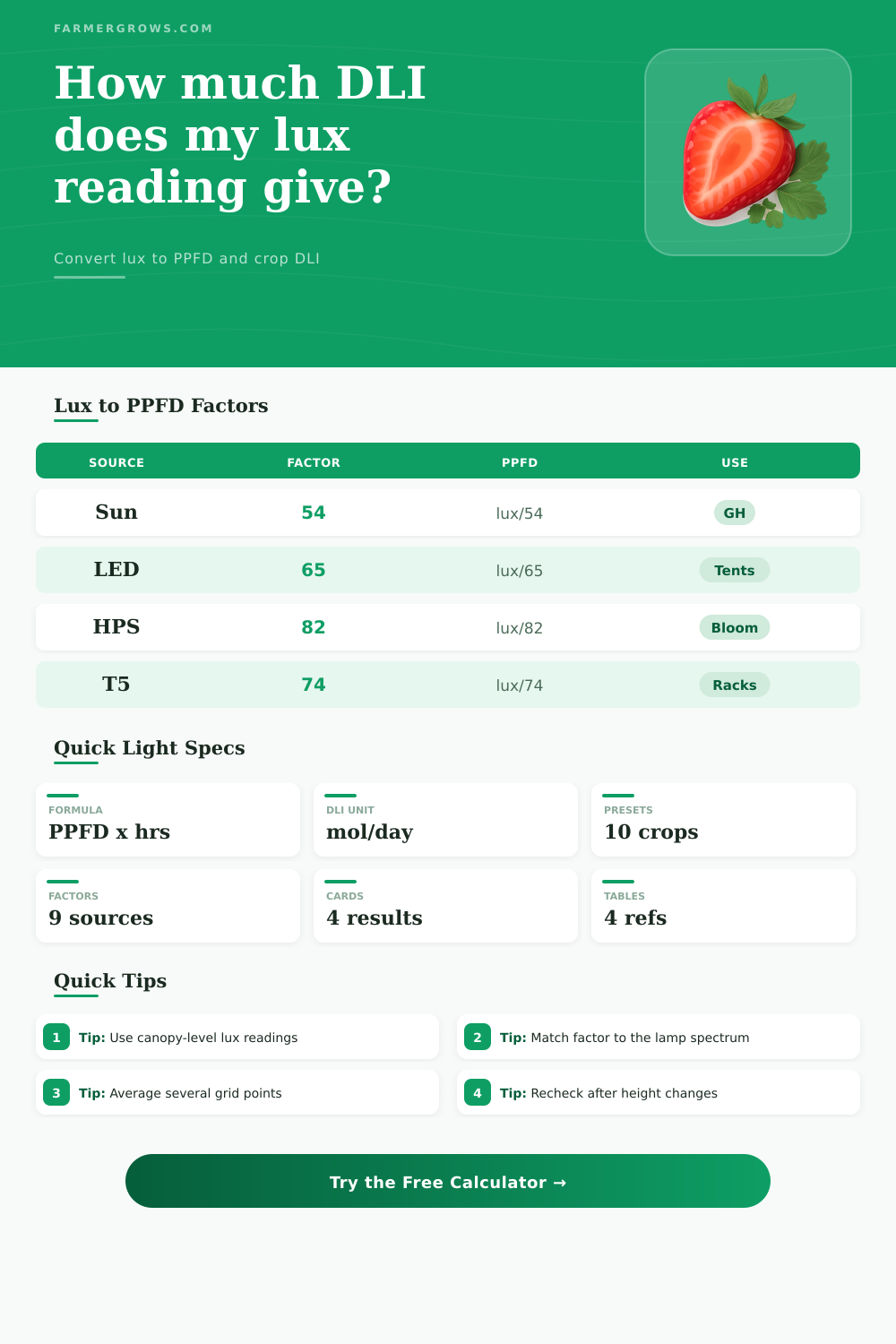
Lux meters are weighted for human vision, so the conversion changes by spectrum. This calculator uses practical horticulture approximations in lux per μmol/m²/s, then applies DLI = PPFD × photoperiod hours × 0.0036.
Lux to DLI Results
Estimated PPFD, DLI, target fit, and supplemental gap will appear here.
| Light source | Approx factor | PPFD from 20,000 lux | Best use |
|---|---|---|---|
| Sunlight / greenhouse daylight | 54 lux per μmol/m²/s | 370 μmol/m²/s | Daylight or high-transmission greenhouse readings |
| Full-spectrum white LED | 65 lux per μmol/m²/s | 308 μmol/m²/s | Modern horticulture LED bars and boards |
| Warm white LED 3000K | 62 lux per μmol/m²/s | 323 μmol/m²/s | Warm fixtures, flowering rooms, mixed home grows |
| Cool white LED 5000K | 70 lux per μmol/m²/s | 286 μmol/m²/s | Propagation shelves and vegetative benches |
| Red-blue LED blend | 45 lux per μmol/m²/s | 444 μmol/m²/s | Blurple fixtures where lux under-reads red and blue photons |
| High pressure sodium | 82 lux per μmol/m²/s | 244 μmol/m²/s | Warm supplemental lighting and older flowering bays |
| Ceramic metal halide | 58 lux per μmol/m²/s | 345 μmol/m²/s | Broad-spectrum HID benches and displays |
| T5 fluorescent | 74 lux per μmol/m²/s | 270 μmol/m²/s | Seedlings, herbs, microgreens, and shelves |
| Metal halide | 68 lux per μmol/m²/s | 294 μmol/m²/s | Vegetative HID spaces and greenhouse supplements |
| Crop or stage | Typical target DLI | Target PPFD at 16 hr | Notes |
|---|---|---|---|
| Vegetable seedlings | 8–14 mol/m²/day | 139–243 μmol/m²/s | Keep uniform to avoid stretching and uneven trays. |
| Microgreens | 6–12 mol/m²/day | 104–208 μmol/m²/s | Many crops prefer moderate light and good airflow. |
| Lettuce and leafy greens | 12–17 mol/m²/day | 208–295 μmol/m²/s | Higher DLI can raise quality when temperature is managed. |
| Basil and culinary herbs | 14–22 mol/m²/day | 243–382 μmol/m²/s | Often responds well to stronger light than lettuce. |
| Strawberry flowering | 17–25 mol/m²/day | 295–434 μmol/m²/s | Fruit quality improves when total light is consistent. |
| Tomato fruiting | 22–30 mol/m²/day | 382–521 μmol/m²/s | High-wire crops commonly need more light than seedlings. |
| Average PPFD | 12 hours | 16 hours | 18 hours |
|---|---|---|---|
| 150 μmol/m²/s | 6.5 DLI | 8.6 DLI | 9.7 DLI |
| 250 μmol/m²/s | 10.8 DLI | 14.4 DLI | 16.2 DLI |
| 350 μmol/m²/s | 15.1 DLI | 20.2 DLI | 22.7 DLI |
| 500 μmol/m²/s | 21.6 DLI | 28.8 DLI | 32.4 DLI |
| 700 μmol/m²/s | 30.2 DLI | 40.3 DLI | 45.4 DLI |
| Canopy size | Suggested readings | Pattern | How to use the average |
|---|---|---|---|
| Seed tray or 2 ft shelf | 5 points | Center plus four corners | Good for small racks with even bars. |
| 2 ft x 4 ft bench | 9 points | Three by three grid | Use the simple average for the lux input. |
| 4 ft x 4 ft tent | 16 points | Four by four grid | Check edge readings before raising intensity. |
| Greenhouse bay | 25+ points | Repeatable row grid | Separate daylight and supplemental periods when possible. |
Metering tip: Hold the lux meter level at canopy height and average repeated points. A single center reading usually overstates the daily light that edge plants receive.
Fixture tip: When DLI is close but uneven, adjust fixture height or spacing before increasing power. Better uniformity can improve the crop without adding more total watts.
Lux meter are used to measure the amount of light intensities, but the lux meter is designed to measure the amount of light falling on the human eye, not the leaves of a plant. Because lux meters is designed to measure the amount of light for the human eye, the reading on a lux meter will not necessarily accurate represent the amount of light that the plant can use for performing the processes necessary to grow. Because different types of lights emit different light spectrum, and because the light spectrum impacts the amount of photons that fall on the plant, it is necessary to convert the lux reading to a measurement of light that takes into account the spectrum of that particular light source that is being use.
The light spectrum is the range of wavelengths of light that a particular light source emits. For example, sunlight contains a broader spectrum of light than white LED light and high pressure sodium lamp. High pressure sodium lamps emit more yellow and red light than white LED lights, for instance.
How to Convert Lux to DLI for Plants
The different light spectrums lead to different readings of light intensity for the same amount of watt of light emitted by each type of lamp. To account for these different types of light spectrums, it is necessary to use a calculator to convert the lux reading to a measurement of light that takes into account the light spectrum being use. For instance, one of the measurements that can be calculated is the Daily Light Integral (DLI), which represents the total amount of light that reaches the plants each twenty-four hour period.
While PPFD (Photosynthetic Photon Flux Density) is a measurement of the amount of light at a given time, DLI represent the total amount of light that will impact the growth of the plants during that period. Both of these measurements can be represented by the same amount of light if that light is strong for a short period of time or weak for a longer period of time. Therefore, you must provide both the photoperiod and the lux reading of the space to the calculator to determine the DLI that will be provided to the plants.
Because lux meters will not provide a true representation of the amount of light that falls on the plants in an entire growing area, it is common for growers to measure the lux reading of only one spot within the growing area. However, the bright spot that is measured will not necessarily represent the lux level of other spots within the same growing area. To avoid this mistake, take the lux readings at several different points across the crops canopy and calculate the average lux reading.
Taking the average of several lux readings will ensure that you are not overestimating the lux reading due to one bright spot within the crop. It is also important to take the lux reading at the height of the plant canopy. Any change in the height at which the lights are placed will change the lux value that is provided to the crop.
Different types of crops has different requirements for the amount of light that they receive during the growing period. The DLI that is calculated for a specific crop can be compared to the amount of light that is required by that crop. For instance, crops like seedlings and microgreens require low levels of DLI to fulfill their light requirements.
Fruiting plants like tomatoes and cucumbers, however, require high levels of DLI to satisfy their need for light. Leafy greens fall somewhere in the middle in terms of the amount of light that is required for optimal growth. If the DLI is too low for the requirements of the crop, the crop may stretch and not grow as well as it should.
If the DLI levels are too high for the requirements of the crop, however, the crop may experience heat stress, or the plants may consume the lights without producing an extra yield. In environments that are exposed to both sunlight and supplemental lights (like greenhouses), you must account for both types of light in the calculation of the Daily Light Integral (DLI). Greenhouses receive sunlight as well as supplemental light from the growing lights placed within the greenhouse structures.
Thus, two different conversion factors must be applied to the lux reading to account for each type of light. A daylight share slider can be employed into the lux to DLI calculator to split the lux reading into sunlight and supplemental light components. If the daylight share slider is not used to split the light contribution from the lux sensor, the DLI calculation will indicate the amount of light that the supplemental lights are providing instead of the DLI that the plants are receiving.
In order to calculate the DLI for a greenhouse or growth area, a series of steps can be followed to ensure accuracy in the calculated value. First, take lux readings at several different point within the crop canopy. Second, determine the type of lighting fixture that is present within the greenhouse.
Third, determine the length of the photoperiod. Fourth, input each of these variables into the lux to DLI calculator. Finally, compare the calculated DLI to the DLI requirements of the crops within the greenhouse.
Following these steps will allow the grower to determine if any changes need to be made to the greenhouse setting to better provide for the growth of the plants.