
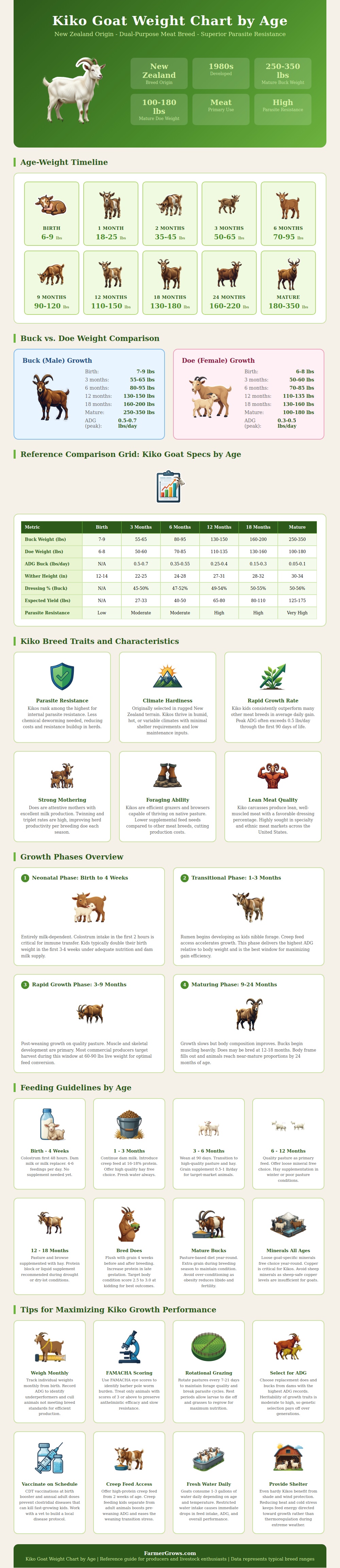
Kiko goats’ fame in New Zealand stems from surviving on tough pasture that other breeds cannot handle. This toughness impacts their growth, which follow this path (weight chart shown above). Knowing this time frame is important so you know what to expect from your kid as they grow, when you need to make adjustments to feeding, and when market weight become achievable. Often, it’s not luck but timing that makes a goat lag behind or reach its target weight.
Early weeks set the foundation for their growth pattern. Kids is born small. They depend on colostrum for nutrition and immunity, and they triple in size approximately within a month (chart). This is why it’s important that they gets good colostrum during those early weeks; otherwise you’re slowing their growth later.
Understanding Kiko Goat Growth Patterns
Around three to four weeks old, the rumen begin to develop as kids start nibbling creep feed and grass. At this time, they shift from being animals driven by milk growth to ones growing via forage. The steepest part of the growth curve appears on chart from one month to three months. At this stage, gains is greatest in relation to body size. It’s also where quality of forage and access to supplemental feeds with more protein has their greatest impact. This happens because rumen is still developing. Because feed conversion are most efficient prior to six months, many producers use this timeframe to get kids marketed at an early weight.
From there, the rate tapers while they continue to fill out with muscle and frame. The chart also shows the difference between doe and buck growth, which is especially important when the animal gets close to breeding age. Bucks continue to gain weight through their second year and beyond, while becoming considerably heavier then a doe. Since their energy resources aren’t directed at growing so much as reproduction, does tends to top out sooner. The chart allows you to judge your individual doe’s size by comparing her to the norm, so you don’t have to guess if she is too big or too small.
But the true benefit of this breed goes beyond statistics. They are also resistant to parasites which helps them avoid routine deworming and they continue to gain if you have multiple types of animal grazing in the pasture together. Also, because Kikos are a hearty breed, they handle the varying forage levels as well as heat and humidity better than most meat breeds does. This eventually shows up on the weight chart because they stay healthy and keep growing even during stressful times.
Later stages of development is represented in the second half of the graph. At this point it’s no longer about gaining weight every day but maintaining it. Now it’s time to pay attention to body condition and not just pounds. Rested pasture is higher in protein; that’s where rotational grazing earns its keep. It also breaks cycle of parasites.
Loose minerals and fresh water are still essential for success. The wrong mineral mix can causes copper deficiency which shows itself as poor gains, and restricted water instantly reduces feed consumption.
The reason to select for growth is that it’s a heritable trait. By making notes on which dam has the fastest kids, we’re able to use that information to improve next generation without purchasing new genetics. With the baseline from the chart, you’ll know if a kid’s performance was due to breeding or management. Monthly weighings translates that baseline into something we can use; it’s not just a guess.
The chart is valuable for everyday management. It demonstrates a reasonable growth pattern so you can identify trouble earlier. You can also determine when to market and start weaning, and align feeding programs with what your animals realy need. After you’ve seen the graph flatten out after one year, you no longer hold unrealistic expectations about daily gains on older animals. This change alone keeps most people from over-feeding and causing the health problems that come with it.
In fact, Kiko goats reward careful attention during the first few months more than ongoing tinkering thereafter. You’ll find it easier to hit these marks with this breed on difficult pastures because they’re naturaly more robust. The chart shows that pattern.