⚙️ Hydraulic Pump Flow Rate Calculator
Calculate flow rate (GPM or L/min) from pump displacement, RPM, and volumetric efficiency
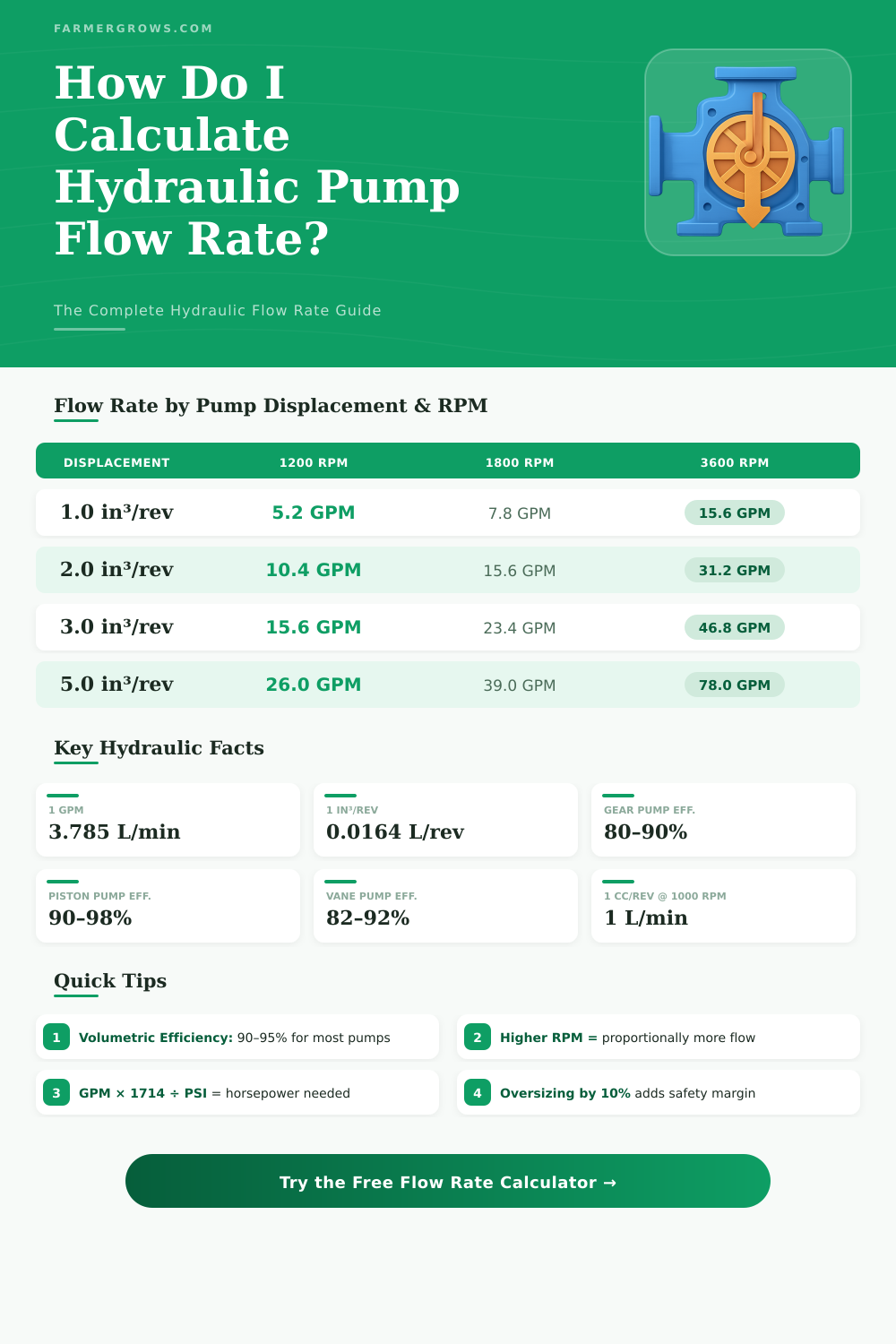
| Displacement (in³/rev) | 1200 RPM | 1500 RPM | 1800 RPM | 2400 RPM | 3600 RPM |
|---|---|---|---|---|---|
| 0.5 | 2.6 GPM | 3.2 GPM | 3.9 GPM | 5.2 GPM | 7.8 GPM |
| 1.0 | 5.2 GPM | 6.5 GPM | 7.8 GPM | 10.4 GPM | 15.6 GPM |
| 1.5 | 7.8 GPM | 9.7 GPM | 11.7 GPM | 15.6 GPM | 23.4 GPM |
| 2.0 | 10.4 GPM | 13.0 GPM | 15.6 GPM | 20.8 GPM | 31.2 GPM |
| 3.0 | 15.6 GPM | 19.5 GPM | 23.4 GPM | 31.2 GPM | 46.8 GPM |
| 5.0 | 26.0 GPM | 32.5 GPM | 39.0 GPM | 52.0 GPM | 78.0 GPM |
| Displacement (cc/rev) | 750 RPM | 1000 RPM | 1450 RPM | 1800 RPM | 3000 RPM |
|---|---|---|---|---|---|
| 10 cc/rev | 6.8 L/min | 9.0 L/min | 13.1 L/min | 16.2 L/min | 27.0 L/min |
| 25 cc/rev | 16.9 L/min | 22.5 L/min | 32.6 L/min | 40.5 L/min | 67.5 L/min |
| 40 cc/rev | 27.0 L/min | 36.0 L/min | 52.2 L/min | 64.8 L/min | 108.0 L/min |
| 63 cc/rev | 42.5 L/min | 56.7 L/min | 82.2 L/min | 102.1 L/min | 170.1 L/min |
| 100 cc/rev | 67.5 L/min | 90.0 L/min | 130.5 L/min | 162.0 L/min | 270.0 L/min |
| Flow Rate (GPM) | 1000 PSI | 1500 PSI | 2000 PSI | 3000 PSI | 5000 PSI |
|---|---|---|---|---|---|
| 5 GPM | 2.9 HP | 4.4 HP | 5.8 HP | 8.8 HP | 14.6 HP |
| 10 GPM | 5.8 HP | 8.8 HP | 11.7 HP | 17.5 HP | 29.2 HP |
| 15 GPM | 8.8 HP | 13.1 HP | 17.5 HP | 26.3 HP | 43.8 HP |
| 20 GPM | 11.7 HP | 17.5 HP | 23.3 HP | 35.0 HP | 58.3 HP |
| 30 GPM | 17.5 HP | 26.3 HP | 35.0 HP | 52.5 HP | 87.5 HP |
| 50 GPM | 29.2 HP | 43.8 HP | 58.3 HP | 87.5 HP | 145.8 HP |
| Convert From | Convert To | Multiply By | Example |
|---|---|---|---|
| GPM | L/min | 3.7854 | 10 GPM = 37.85 L/min |
| L/min | GPM | 0.2642 | 50 L/min = 13.21 GPM |
| in³/rev | cc/rev (mL/rev) | 16.387 | 1 in³/rev = 16.39 cc/rev |
| cc/rev | in³/rev | 0.06102 | 25 cc/rev = 1.526 in³/rev |
| PSI | bar | 0.06895 | 2000 PSI = 137.9 bar |
| bar | PSI | 14.504 | 100 bar = 1450.4 PSI |
| HP | kW | 0.7457 | 10 HP = 7.46 kW |
| kW | HP | 1.3410 | 10 kW = 13.41 HP |
The flow of hydraulic pump matters a lot when you use machine on farm or tractor. Whether you turn posthole auger up, operate planting circuit or actuate harvesting mechanism, you know the flow rate matters.
Every pump has two main specifications: pressure and flow. Pressure is commonly in PSI (pounds per square inch) and flow in GPM (gallons per minute). Metric matches are bar and LPM (liters per minute).
Why Hydraulic Pump Flow Matters on the Farm
The pump does not generate pressure. It gives flow, transporting a set amount of liquid from the tank or reserve to the outlet during a set time.
Flow rate depends mainly on the displacement of the pump (cc/rev) and its speed (RPM). For instance, pump with 100 cc/rev at 1000 RPM reaches theoretical flow of 100 LPM. If you expand the speed, the flow of hydraulic oil grows directly, if other things stay the same.
Flow rate is proportional to the pump speed. Bigger flow makes work happen more quickly. Piston will move twice as fast with 10 GPM than with 5 GPM.
You use three kinds of efficiency for describing hydraulic pumps. For rough calculations, total efficiency is around 0.75, although you add 10 to 20 percent according to the usage.
For big production machines with continuous hydraulic circuits, as planting or harvesting, the variable displacement piston pump stays the usual choice. Pressure-compensated and load-sensing piston pump beats the problems of simple gear type. It automatically fixes the flow to the needs of cylinders and hydraulic motors in several parallel circuits.
Also it limits the maxiumum pressure a bit above the presently required for the load.
Matching the flow rate with the gear is key. If hydraulic utility requires minimum of 11 GPM, but the main tractor pump gives only 9.3 GPM, problems will come. It is not enough to simply lay a stronger pump.
The operating valve has maximum flow rate for the OEM pump. If the pump surpasses the skill of the valve, crashes will happen.
Also the flow velocity matters. Pump of 22 GPM through half-inch tubes move oil in 35. 36 feet per second. Then many dynamic impacts happen, and the pump slows down sooner than planned.
For suction lines you want 2 to 4 feet per second. If you remember those values, your farm equipment will operate smoothly.