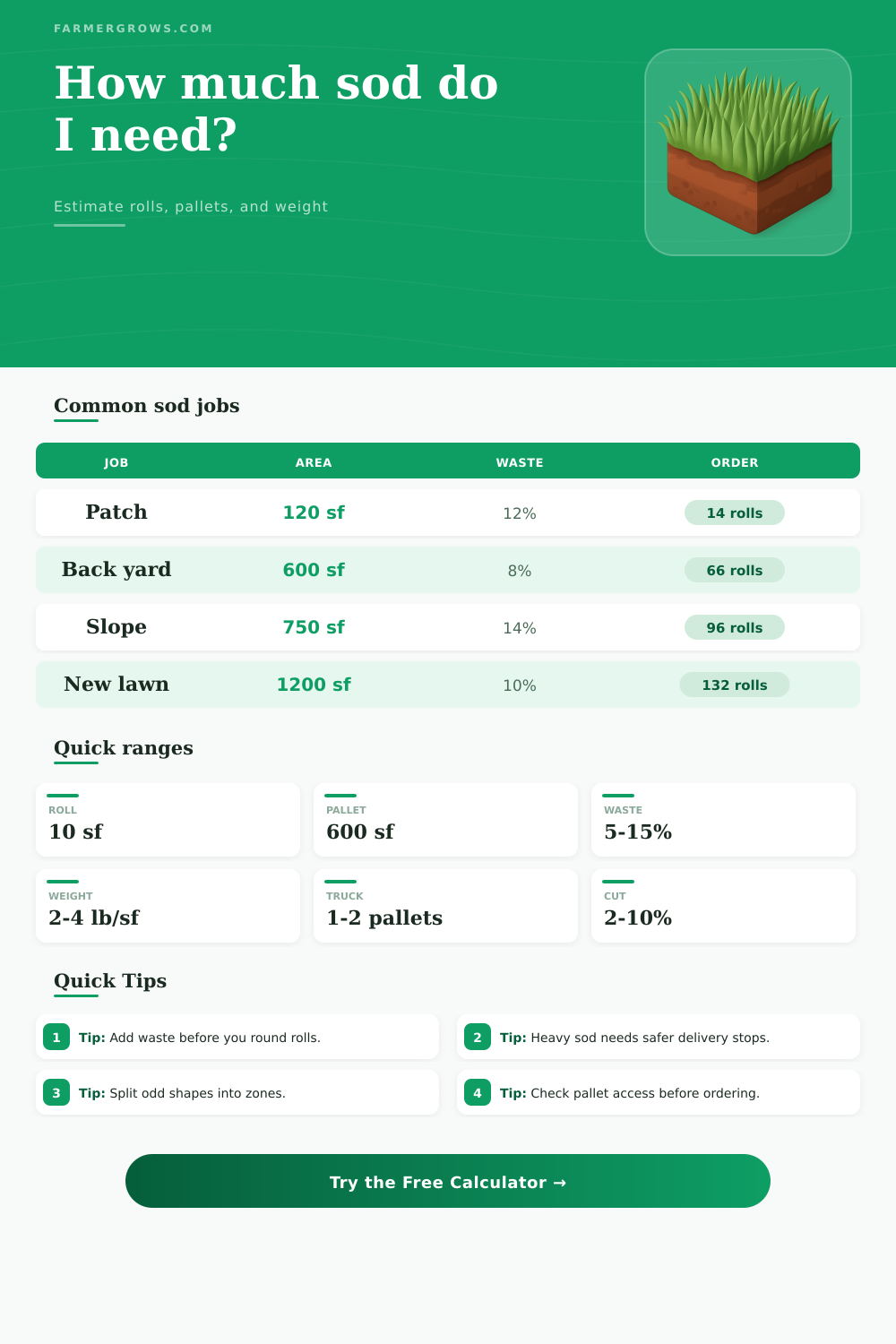
Sod Calculator
Estimate sod area, waste, rolls, pallets, weight, and delivery load so your order matches the lawn, the crew, and the truck. Start with a preset, then tune the roll and pallet settings to fit your supplier.
Choose a real-world install layout to seed the fields. Each preset sets the shape type, turf variety, lawn size, waste band, roll size, rolls per pallet, weight, and truck payload.
Sod Order Output
Calculated from your lawn size, project shape, waste rate, roll format, and delivery capacity.
| Format | Typical size | Coverage | Best use |
|---|---|---|---|
| Slab | 16 in x 24 in | 2.67 sf | Patch repairs and tight edges |
| Strip roll | 16 in x 48 in | 5.33 sf | Small yards and quick seams |
| Standard roll | 2 ft x 5 ft | 10 sf | Most home lawn installs |
| Big roll | 4 ft x 50 ft | 200 sf | Sports turf and broad fields |
| Grass type | Avg weight | Best climate | Install note |
|---|---|---|---|
| Bermuda | 2.3 lb/sf | Hot and sunny | Lighter roll, quick knit |
| Tall fescue | 2.8 lb/sf | Mixed shade | Dense mat for home lawns |
| Kentucky bluegrass | 3.0 lb/sf | Cool season | Fine texture, steady weight |
| Zoysia | 3.1 lb/sf | Warm transition | Tight weave, slower dry-down |
| Rye blend | 2.6 lb/sf | Fast cover | Useful for quick restoration |
| St. Augustine | 3.6 lb/sf | Humid coastal | Heavy turf with wide blades |
| Site type | Waste | Why it changes | Planning hint |
|---|---|---|---|
| Clean rectangle | 5-7% | Few cuts and seams | Order close to measured area |
| Corner lot | 7-9% | Extra turns at borders | Add trim pieces for edges |
| Curved bed line | 8-12% | More offcuts near arcs | Round up before unloading |
| L-shape | 10-14% | More joints and notches | Split into two rectangles |
| Slope repair | 12-15% | Cut loss and slip risk | Keep extra rolls on hand |
| Patch repair | 12-18% | Small zones waste more | Order the next full roll |
| Load | Weight band | Pallet count | Good fit |
|---|---|---|---|
| Light truck | up to 4,000 lb | 1-2 | Small repairs and side yards |
| Half load | 4,000-8,000 lb | 2-4 | Most suburban lawn jobs |
| Flatbed drop | 8,000-12,000 lb | 4-6 | Multiple pallets and longer runs |
| Full route | 12,000 lb+ | 6+ | Big rolls and field installs |
When ordering sod for a yard, calculating the amount of sod needed is necessary to ensure that a customer dont run out of sod during the installation process. Many people attempt to calculate the amount of sod needed for a yard by guessing at the number of square feet in the yard. However, guessing at the amount of sod that is needed is inaccuracy due to the fact that sod comes in rolls and the need to trim the sod rolls to the shape of a yard.
Additionally, the weight of the sod play a crucial role in determining how many delivery trips are necessary for the sod to arrive at the customers yard. The shape of the yard will determine how much sod will be wasted during the installation process. Yards that are in the shape of a rectangle are the easiest to cover with sod without wasting any of the sod rolls.
How Much Sod You Need for Your Yard
Rectangular yards only require a waste allowance of five to seven percent of the sod rolls. Yards that has curves or areas for flower beds require you to trim sod to match the shape of the yard. This trimming of sod rolls wastes some of the sod because the trimmings cant be used elsewhere in the yard.
Curves and slope in the yard require a waste allowance of twelve to fifteen percent of the sod rolls. To account for the waste of sod rolls, the length and the width of the yard should be measured and a percentage of the total area for the yard should be added to account for waste of sod rolls. The type of grass that you choose for a yard will determine the weight of the sod that is ordered.
Different types of grass has different weights. The weight of the sod will determine