Grass Seed Calculator
Estimate seed pounds for new lawns, overseeding, renovation, and patch repair. The calculator handles rectangles, circles, triangles, custom areas, imperial or metric inputs, and common bag sizes.
Pick a common grass job to fill the calculator fast. Each preset sets shape, size, grass type, method, buffer, and bag size so the output stays practical.
Grass Seed Output
Calculated from the current shape, grass type, method, and allowance settings.
| Grass type | New lawn | Overseed | Notes |
|---|---|---|---|
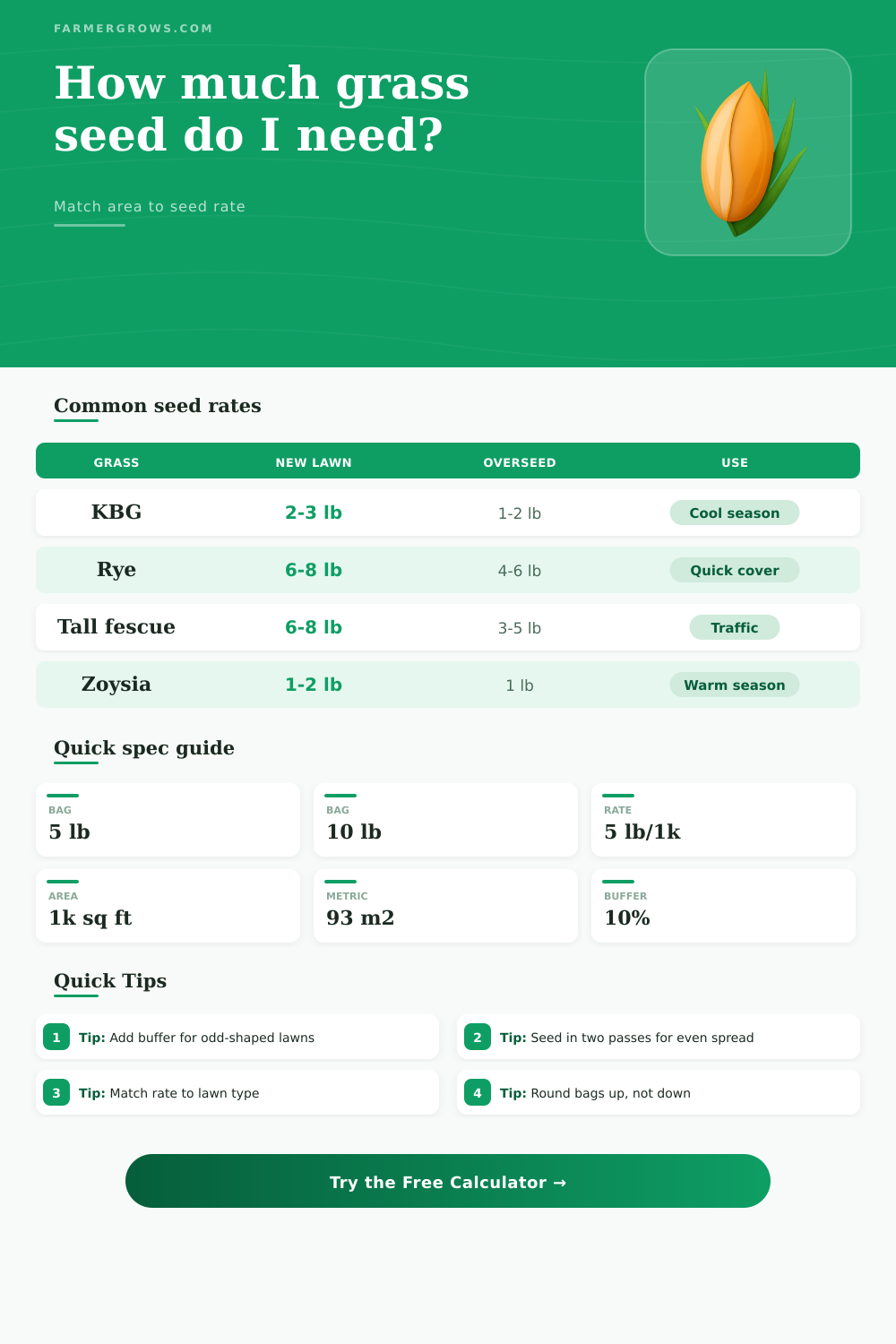
| Kentucky bluegrass | 2-3 lb | 1-2 lb | Cool season |
| Perennial ryegrass | 6-8 lb | 4-6 lb | Quick cover |
| Tall fescue | 6-8 lb | 3-5 lb | Traffic |
| Fine fescue | 4-6 lb | 2-4 lb | Shade lawns |
| Bermuda grass | 1-2 lb | 1 lb | Warm season |
| Zoysia grass | 1-2 lb | 1 lb | Dense turf |
| Rate | Sq ft per lb | m2 per kg | Use note |
|---|---|---|---|
| 2 lb/1000 | 500 | 102.4 | Very light |
| 5 lb/1000 | 200 | 41.0 | Common rate |
| 8 lb/1000 | 125 | 25.6 | Dense cover |
| 10 lb/1000 | 100 | 20.5 | Patch fill |
| Bag size | At 2 lb/1000 | At 5 lb/1000 | At 8 lb/1000 |
|---|---|---|---|
| 3 lb | 1500 sq ft | 600 sq ft | 375 sq ft |
| 5 lb | 2500 sq ft | 1000 sq ft | 625 sq ft |
| 10 lb | 5000 sq ft | 2000 sq ft | 1250 sq ft |
| 25 lb | 12500 sq ft | 5000 sq ft | 3125 sq ft |
| Shape | Example size | Area | Seed @5 lb/1000 |
|---|---|---|---|
| Rectangle | 20 x 25 ft | 500 sq ft | 2.5 lb |
| Circle | 20 ft dia | 314 sq ft | 1.6 lb |
| Triangle | 24 x 20 ft | 240 sq ft | 1.2 lb |
| Custom | 1,000 sq ft | 1000 sq ft | 5.0 lb |
To calculate the amount of grass seed that you need to buy, you must first calculate the total area of your lawn. Lawns are not always rectangular in shape; many lawns is triangular or circular in their plots. In order to calculate the total square footage of the lawn that you have, you must measure the dimension of the lawn.
For instance, if your lawn is circular in shape, you would use the diameter of the lawn to calculate the total square footage of the grass area that your lawn feature. Once you have calculated the total square footage of the lawn, you can calculate the amount of grass seed that are necessary for that lawn. The amount of grass seed that you will need to purchase for your lawn will depend upon the type of grass that you plan to plant on the lawn.
How Much Grass Seed Do I Need
Kentucky bluegrass, a cool-season grass, requires a rate of 2 to 3 pounds of grass seed to be planted per thousand square feet of lawn area. The grass spreads rhizomes, which are runners that help to fill any gap in the grass. Perennial ryegrass also is a cool-season grass, but it requires 6 to 8 pounds of grass seed per thousand square feet of lawn area.
Additionally, tall fescue spreads similar to perennial ryegrass, as it spreads well in areas that are exposed to much foot traffic. Finally, warm-season grasses, such as Bermuda or Zoysia grass, only require 1 to 2 pounds of grass seed to be planted per thousand square feet of lawn area, as these grass types naturaly spread quite dense. Each of these grass types may be appropriate for your area and lawn; using the wrong type of grass seed will waste both the grass seed and the planting effort, as the grass may grow as weeds in certain instances.
The method in which you will plant the grass seed will also influence the amount of grass seed that you need to purchase. If you are establishing a new lawn, you should use the full rate for grass seed application. However, overseeding an existing lawn will require a lighter rate of grass seed application.
Additionally, lawn renovations may require a slightly higher rate of grass seed application than overseeding. Finally, if you are simply patching a bare spot in your lawn, you will need to use a dense application rate of grass seed to ensure that the grass patches will grow together and fill the area. It is recommended to include an allowance for grass seed waste in your total calculation of the amount of grass seed that is required for your lawn.
Grass seed spreaders are rarely 100% efficient in their application of grass seed to the lawn; some grass seed gets scattered by the wind, and some grass seed patches may be planted multiple times when the grass seed is being planted. Thus, an allowance of 10% grass seed is suggested, and 15 or 20% grass seed may be required if you are to hand seed the grass or if the lawn features any odd shapes. Another consideration prior to purchasing grass seed will be the size of the bags of grass seed that are available at the stores.
Grass seed is available in bags that weigh 5, 10, or 25 pounds. Therefore, your total calculation of grass seed will need to be rounded up to the nearest bag of grass seed; you cant purchase part of a bag of grass seed. For instance, if you calculate that you need 7.2 pounds of grass seed to properly lay your lawn, you will need to purchase two bags of 5 pound grass seed.
By knowing how many pound of grass seed are in each bag, you can calculate how many pounds of grass seed are necessary to cover the area that you need to cover based off the rate of grass seed application that you choose. The time of year when you apply the grass seed will also be important. Cool-season grasses, such as Kentucky bluegrass and perennial ryegrass, should be planted in the fall or the spring.
During these months, the soil temperature ranges between 50 and 65 degrees; this range ensures that the grass seed will germinate. Warm-season grasses, such as Bermuda and Zoysia grass, should be planted in the summer, when the soil temperature are above 80 degrees. If you plant grass seed at the wrong time of year, the winter weather may kill the tender sprouts of grass seeds.
Additionally, you should prepare the soil prior to planting the grass seed; you should rake it to remove any debris from the soil, and you should loosen it to allow the grass sprouts to properly take root into the soil. There are some mistake that should be avoided in the sowing of grass seed. One mistake to avoid is the spreading of grass seed in only one direction.
Grass sprouts may appear in stripes in some areas of the lawn, leading to bare spots elsewhere. Instead, you should spread grass seed in two different directions at 90 degree angles to the other direction to even distribute the grass seed. Additionally, it is recommended to avoid walking on the newly-planted grass for 4 to 6 weeks.
Any foot traffic may damage the grass sprouts during this time. It is also recommended to remove any weeds in the lawn before planting grass. Finally, grass seed should be watered during the first two weeks after sowing, though it should never be flooded with water during this time.