🛠 Diagonal Gate Brace Calculator
Size the brace length, angle, load path, and stock fit for timber, tube, or cable gate repairs.
Calculated Brace Output
Enter the gate dimensions to see the diagonal, angle, and load estimate.
Build Breakdown
| Angle band | Load effect | Typical fit | Notes |
|---|---|---|---|
| 30 to 35 deg | High axial load | Long heavy gate | Use stiffer stock and strong anchors |
| 36 to 45 deg | Balanced | Most farm gates | Best all-round brace zone |
| 46 to 55 deg | Lower load | Medium tall gate | Shorter brace with good lift |
| 56 to 65 deg | Very low load | Tall narrow gate | Check latch reach and hinge clearance |
| Gate size | Diagonal | Typical style | Use case |
|---|---|---|---|
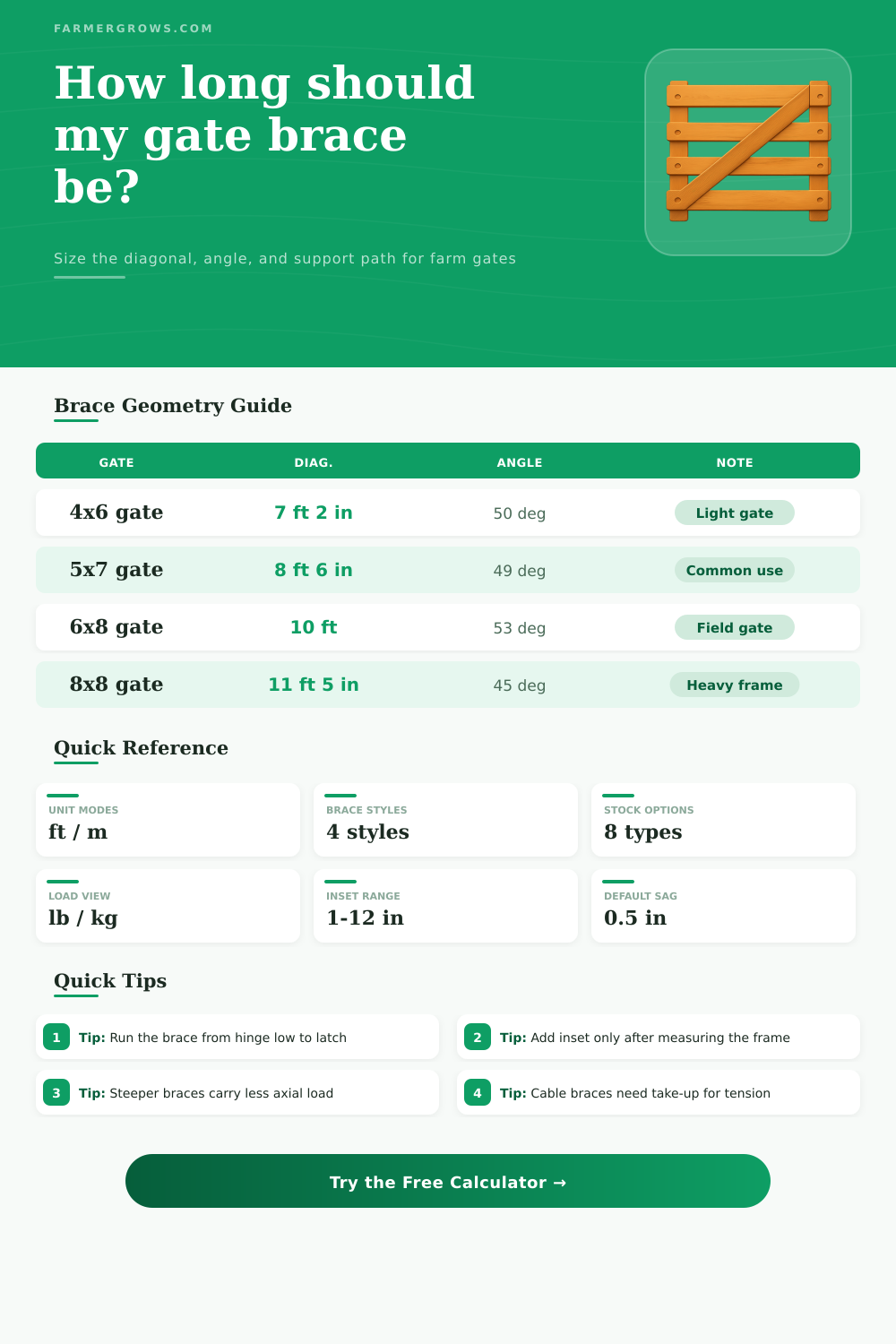
| 4x6 | 7 ft 2 in | Compression | Walkthrough |
| 5x7 | 8 ft 6 in | Compression | Garden and lane |
| 6x8 | 10 ft | Cable or tube | Field service |
| 8x8 | 11 ft 5 in | X-brace | Heavy duty |
| Brace style | Main fastener | Extra parts | Spacing idea |
|---|---|---|---|
| Compression board | Lag screws | Washers, glue | Every 8 to 10 in |
| Cable brace | Eye bolts | Turnbuckle, clamps | Tension from latch corner |
| X-brace | Through bolts | Plates, spacers | Anchor both diagonals |
| Steel tube | Bolts or welds | Paint, caps | Match frame nodes |
Measure the frame first, then set the inset so the brace lands clear of welds, hinges, and latches.
For cable braces, add take-up before tensioning so the gate can be squared after the hardware is snug.
Use this diagonal gate brace calculator to size the main brace, check the angle, estimate gate load, and choose stock that fits your farm or garden gate cleanly.
A farm gate may sag due to the force of the wind or the livestock leaning on the gate. When the gate sags, the hinges may groan and the latch may not catch on the gate. To fix the problem of a sagging farm gate, install a diagonal brace.
A diagonal brace is a piece of material that converts a rectangular farm gate into a rigid gate. The diagonal brace is important because it adds the necessary supports to the gate to prevent it from collapsing. Most farm gate frames has two uprights and rails.
How to Fix a Sagging Farm Gate
Without a diagonal brace, a farm gate may develop into a parallelogram due to the weight of the gate or the pressure that livestock may place upon it. Place the diagonal brace from the bottom corner where the hinge meets the gate to where the latch meets the top side of the gate. Place the diagonal brace in this direction to allow it to provide compressive strength to the free end of the gate.
If the length of the diagonal brace is not correct, it may either prevent the gate from swinging or it may be too slackly within the frame. If the angle of the diagonal brace is too low, it may not be able to provide enough crushing strength to the gate. However, if the angle is too high, the diagonal brace may not be able to lift the gate.
Many people try to place a diagonal brace by eye. However, eyeballing the measurements can make errors when measuring the offset for the diagonal brace. The offset prevents the diagonal brace from placing too much pressure on the hinge or welds on the frame.
Both ends of the diagonal brace have to be trimmed to accommodate for the hinge on the gate. The amount of sag that the gate may experience due to the weight of the gate has to be accounted for in the measurements for the diagonal brace. Allow half an inch more to the measurements to account for sag in the gate.
If you will use cables instead of wooden boards for the diagonal brace, the length of the cables will have to be accounted for in the hardware take-up. The angle of the diagonal brace has a great deal of importance to the strength of the farm gate. A 45-degree angle is the ideal angle for the diagonal brace.
If the angle of the diagonal brace is less than 35-degrees, stiffer materials will be required for the diagonal brace because the force that the brace will experience will be much greaterly. If the angle of the diagonal brace is steeper, there will be less pressure on the frame. However, the steeper angle may prevent the latch from properly engaging on the post.
The total weight of the farm gate has to be estimated. The weight of the fill material in the gate has an impact on the weight of the gate. Whether the gate uses light chain link or heavy wood panels can determine the weight of the gate.
Knowing the total weight of the farm gate will allow you to know the length of stock that is needed for the gate as well as the number of fasteners that will be needed to secure the gate properly. Wooden boards can be used for the diagonal brace. However, you should use pressure-treated wood for the type of wood that is used because it can handle the compressive strength of the gate.
The alternative to wooden boards is using steel tubes. Steel tubes add more weight to the gate but are more rigid. Using cables for the diagonal brace will make the gate lighter but require more tension on the gate.
If the farm gate is very heavy, X-bracing can be used. X-bracing involves using two diagonals that cross each other within the gate frame. When placing the diagonal brace, there are some mistakes that should be avoided.
Do not notch the corners of the frame too deep into the frame as this may weaken the frame. Make sure the gate is squared before placing the diagonal brace. If the gate is not squared before placing the diagonal brace, the sag of the gate will be baked into the frame.
If you will use a cable brace, account for the length of hardware that will be used to allow for tension on the brace after it is installed. If you will use a compression board, use lag screws every eight inches along the gate and use wood glue to prevent the board from shearing from the frame. The environmental conditions in which the farm gate is located have an impact upon the design of the diagonal brace.
The force of the wind on solid farm gates will place more force on the frame so a diagonal brace should be used that allows for a safety margin if the area is known to have strong winds. If the farm gate is in an area with a lot of livestock, metal diagonal braces may be better then wooden braces. In wet climates, treated lumber or galvanized metal will be required for the diagonal braces.
Additionally, if the gate has a large swing arc, you will have to consider the diagonal brace such that it will not hit the gate post. The hardware used for the diagonal brace should be selected properly. If you are to use wooden boards for the diagonal brace, lag screws and washers will be used.
If you will use a cable for the diagonal brace, eye bolts and turnbuckles will be used. Through-bolts will be used for the X-bracing. Using the proper hardware will ensure that the diagonal brace evenly distributes the pressure on the frame of the farm gate.