🛥 Diesel Fuel Mileage Calculator
Estimate diesel mileage from real trip data, then correct for idle time, terrain, load, weather, and tire condition on farm routes.
Empty shuttle
Light loads and steady roads keep burn lower when the truck is not working hard.
Loaded hay run
Payload, turnarounds, and slow pulls bring mileage down before the route ends.
Trailer tow
Drag from the trailer and hills can raise fuel use even when distance stays short.
Winter check
Cold idling and denser air usually make the trip use more fuel than planned.
| Setup | MPG | Fuel | Note |
|---|---|---|---|
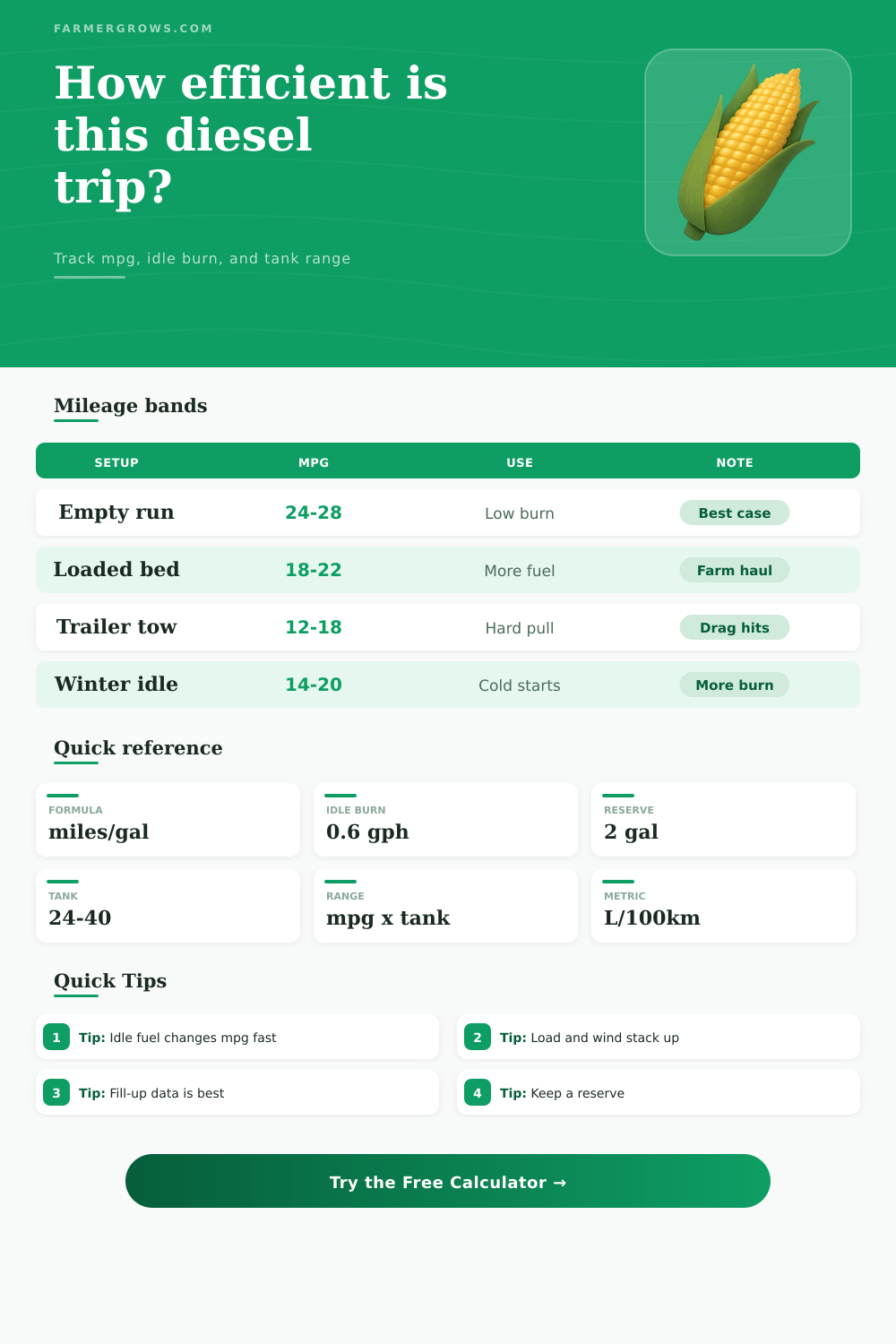
| Empty run | 24-28 | Low burn | Best case |
| Loaded bed | 18-22 | More fuel | Farm haul |
| Trailer tow | 12-18 | Hard pull | Drag hits |
| Winter idle | 14-20 | Cold start | More burn |
| Factor | Value | Effect | Use |
|---|---|---|---|
| Empty | 1.00 | No loss | Highway |
| Loaded | 0.92 | Clear drop | Farm haul |
| Rough | 0.86 | More burn | Soft lane |
| Winter | 0.87 | Cold drag | Short trip |
| Idle state | GPH | 10 min | Note |
|---|---|---|---|
| Warm engine | 0.50 | 0.08 | Light use |
| Work idle | 0.62 | 0.10 | Typical |
| Cold idle | 0.72 | 0.12 | More fuel |
| High idle | 0.82 | 0.14 | Fast burn |
| Tank | Reserve | Range | Note |
|---|---|---|---|
| 20 gal | 2 gal | Short | Quick trip |
| 24 gal | 2 gal | Mid | Daily use |
| 30 gal | 3 gal | Wide | Long route |
| 40 gal | 4 gal | Big | All day |
Diesel fuel efficiency is a critical measurement for farm operations. Diesel fuel efficiency is the measurement of how much work a diesel truck can perform before it require more fuel to continue performing that work. Many people calculate diesel fuel efficiency by dividing the number of miles the truck traveled by the number of gallons of fuel that they added to the truck.
However, this calculation is often inaccurate due to the fact that this calculation does not account for variables that impact fuel consumption of a diesel truck. One of the variables that can impact the fuel consumption of a diesel truck is the idling of the diesel engine. When idling, the diesel engine consume fuel without moving the diesel truck.
How to Measure and Save Diesel Fuel on the Farm
For instance, a typical diesel engine may consume 0.5 gallon of fuel each hour while idling. Thus, if an engine is idling while performing a task that does not require the movement of the truck, such as waiting for a load to be secure to the truck, that consumption of fuel can be subtracted from the total amount of fuel that is calculated as being consumed by the diesel truck. The remaining amount of fuel can then be used to calculate the moving mileage of the diesel truck, which is a more accurate measurement of the fuel efficiency of the diesel truck while it is moving.
Another of the variables that can impact the fuel consumption of a diesel truck is the weight of the payload that the truck is transporting. For example, a diesel truck that does not have any hay in its bed will travel more further miles per gallon of fuel than a diesel truck that is transporting a heavy load of hay. This is due to the fact that the heavier the load, the more fuel that the truck requires to move that truck and its load.
Thus, the weight of the load must be considered in the calculation of the fuel consumption of the diesel truck. Terrain and weather are two additional variables that may impact diesel fuel consumption. For instance, driving on a gravel road may require the diesel truck to use more fuel than if it were driving on a paved road.
Additionally, driving uphill may require the diesel engine to use more fuel than if the diesel truck were driving on level ground. Finally, weather may also play a role in the fuel consumption of a diesel truck; for instance, driving in cold weather may cause the diesel truck to consume more fuel than when driving in warm weather, since cold air create more resistance for the truck and against headwinds. These variables can change while the diesel truck is in operation, however; thus, fuel consumption calculations must be adjusted according to the conditions in which the truck is driving.
One additional factor that can impact the fuel consumption of a diesel truck is the pressure of the trucks tires. Underinflated tires require more fuel to move the truck than tires that are properly inflated to the manufacturer’s specifications. Thus, fuel consumption calculations must take into account the fuel consumption of the diesel truck’s tires, and ensuring that the driver inspects and properly inflates them every few weeks can improve fuel consumption.
There are a few different practices that can be followed in order to improve the fuel efficiency of the diesel truck. For instance, maintaining the proper inflation of the truck tires can improve the fuel efficiency. In addition, the driver can improve fuel efficiency by choosing routes that is smooth and even instead of rough and uneven.
Furthermore, the idling of the diesel engine can be reduced by turning off the engine when the diesel truck is not in use; this will reduce the fuel consumption of the engine while it is not moving. Finally, any fuel that is purchased for the diesel truck should be recorded in a notebook; by recording the amount of fuel that is purchased and the odometer miles of the truck, a farmer can determine how efficient the diesel truck is. By determining fuel efficiency of the diesel truck, the farmer can plan his or her farm operation accordingly.
The farmer will also need to make provision for a fuel reserve for the diesel truck. A fuel reserve is the amount of fuel that is left in the fuel tank for situations that may arise. For instance, if the farm implements a diesel fuel truck with a thirty gallon tank, a two gallon reserve of fuel can be established for emergencies.
Thus, the amount of usable fuel would be only twenty-eight gallons. Fuel reserves are a good practice to employ; if the amount of fuel that is consumed is more than that which was initially calculated for the operations of the farm, there will still be fuel in the tank for emergencies. Overall, diesel fuel efficiency is a variable that changes with different factors in the operation of the diesel truck.
Thus, fuel efficiency can be calculated more accurate by taking into account the idling of the truck. Additionally, the farmer can improve fuel efficiency by maintaining the truck’s tires, reducing the idling of the diesel engine, and driving on smooth routes instead of rough routes. By tracking how efficient the diesel fuel tank is, the farmer can understand the true costs of using that fuel; thus, understanding the costs of fuel allows the farmer to budget his or her farm operations according to that fuel cost.