🚪 Gate Weight Calculator
Estimate farm gate weight, frame load, infill weight, and hinge demand for swing gates, driveway gates, and livestock panels.
Gate Weight Results
Total weight includes the selected buffer and hardware allowance.
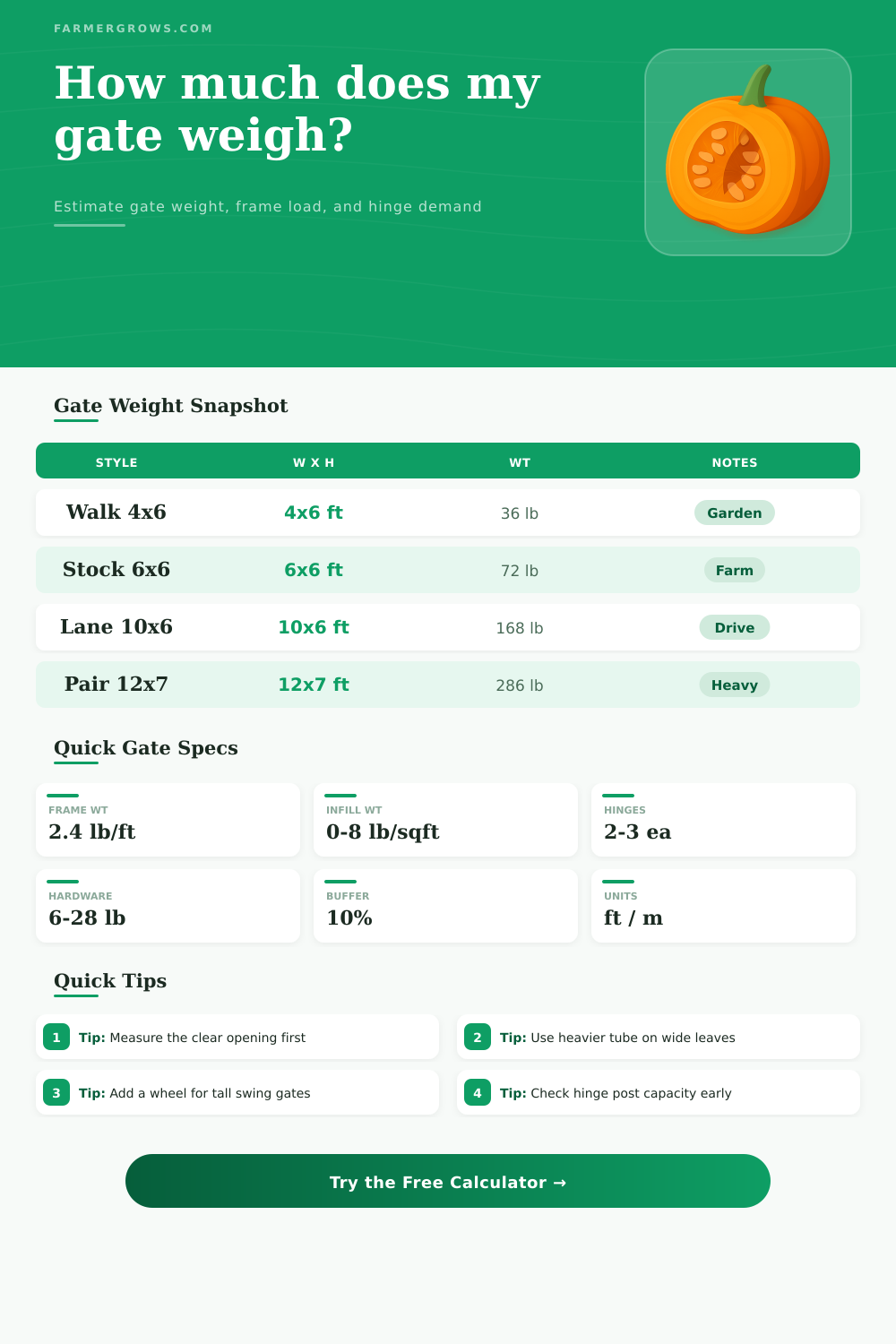
| Gate type | Size | Approx wt | Use |
|---|---|---|---|
| Garden walk | 4 x 6 ft | 30-40 lb | Yard access |
| Stock gate | 6 x 6 ft | 60-80 lb | Pen entry |
| Lane gate | 10 x 6 ft | 150-190 lb | Farm lane |
| Driveway pair | 12 x 7 ft | 260-320 lb | Wide opening |
| Pack | Added wt | Hinges | Note |
|---|---|---|---|
| Light | 6 lb | 2 | Small walk gate |
| Standard | 12 lb | 3 | Most farm gates |
| Heavy | 22 lb | 3 | Wide steel gate |
| Wheel kit | 28 lb | 3 | Long swing gate |
| Infill | lb/sq ft | kg/m2 | Use |
|---|---|---|---|
| Open frame | 0.0 | 0.0 | Lightest build |
| Welded mesh | 0.8 | 3.9 | Small stock |
| Cattle panel | 1.5 | 7.3 | Livestock |
| Sheet steel | 8.4 | 41.0 | Solid privacy |
Use the clear opening, not the post spacing, so the hinge and latch layout matches the real gate leaf.
Wide or tall gates usually need heavier tube, more hinges, or a support wheel to keep the swing smooth.
Calculating the weight of a gate is a necessary step in the construction of the gate. The weight of a gate will determine the stress that the hinges and posts will have to endure. If an individual dont calculate the weight of the gate prior to building the gate, there is a chance that the gate will sag or that the hinges will fail due to an excess weight of the gate.
Gates that are too heavy for their posts will sag, which will prevent the gate from swinging smooth. Thus, each component of the gate that contribute to its weight must be accounted for. The frame of the gate will be the primary source of the weight of the gate.
How to Calculate the Weight of a Gate
The frame of the gate consist of the perimeter rails of the gate and the braces. The frame of the gate must be strong enough to hold the weight of the infill of the gate. The infill of the gate may be welded mesh or cattle panels, which will add to the weight of the gate.
Additionally, the infill of the gate may be chain-link or wood slats, which will also add to the weight of the gate. Finally, the weight of the hardware components of the gate, such as the latches and the hinges, will also add to the total weight of the gate. Many individuals tend to forget to account for the weight of the hardware.
The width of the gate will also affect the total weight of the gate. Gates with narrow openings are generaly easier to manage than gates with wide openings. Gates with narrow openings will have less weight than those with wide openings.
For instance, a 6-foot gate will have less weight than a 10-foot gate. Wide gates require steel that can withstand more flexing due to wind. Thus, if the gate is to be wide in size, the gate will sag unless it is made of thicker steel.
Additionally, utilizing a pair of gates can reduce the weight of each individual gate. However, using a pair of gates will require more hardware for each pair of gates. The type of infill for the gate will also have an impact upon the weight of that gate.
Gates with open frames will be lighter than those with solid sheet metal infills. Open frames allow for visibility of those passing the gate. Sheet metal is heavy, however, at 8 pounds per square foot.
Thus, using sheet metal will require heavy posts to support the gate. Wood boards can also be used to fill the gates. The wood boards add to the weight of the gate, though it can gain more weight over time due to the ability of wood to absorb moisture from the environment.
Thus, it is important to ensure that the type of infill chosen for the gate will not make the gate too heavy for the hinges. Bracing is one method of preventing the gate from twisting. Bracing for the gate will add to the weight of the gate, though.
A diagonal bar can prevent the gate from developing into a parallelogram, but that bar adds to the weight of the gate. Gates that are large require more bracing than small gates. Thus, large gates will have more weight from the additional bracing for the gate.
It is also important to consider the number of hinges that will be used for the gate. A greater number of hinges will allow the gate to better distribute the weight of the gate, but will also add to the total weight of that gate. Gates that weigh more than 100 pound may require upgraded posts for the gate or the gate may need to have wheels.
When calculating the weight of a gate, it is important to add a buffer to that calculation. A buffer is needed to account for the fact that wood that is cut at a shop will not be exact to the measurements needed for constructing the gate; some wood will be waste. Additionally, the weight of the paint and welds that will be used to construct the gate will also add to the total weight of the gate.
Therefore, a buffer of 10 to 20 percent can be added to the total weight of the gate to ensure that there is enough provision for each of these additional components to the gate. Environmental factors can impact the weight of a gate. For instance, the type of soil will determine the type of posts that will need to be used for the gate.
If the soil is soft clay, concrete posts may be needed. However, if the soil is rocky, driven stakes may be used instead. Additionally, any gate that is exposed to strong winds may experience additional force that will make it act as if the gate is heavier than it’s actual weight.
Some common mistakes in the building of gates includes underestimating the weight of the infill panels for the gate, as well as failing to measure the correct openings for the gates. Underestimating the weight of the infill can make the gate too heavy for its hinges. For instance, if a pair of gates is to be used, the weight of both gate leaves should be the same.
Any imbalance in weight between the two leaves will make the gates crooked. Finally, it is necessary to periodically grease the hinges of the gate to prevent the hinges from becoming too stressed from the weight of the gate.