⚡ Diesel Generator Sizing Calculator
Estimate running load, motor starting surge, and recommended diesel generator size for homes, farms, shops, and job sites.
Generator Sizing Results
These results show your continuous load, startup surge, recommended diesel generator size, and spare capacity at the installed rating.
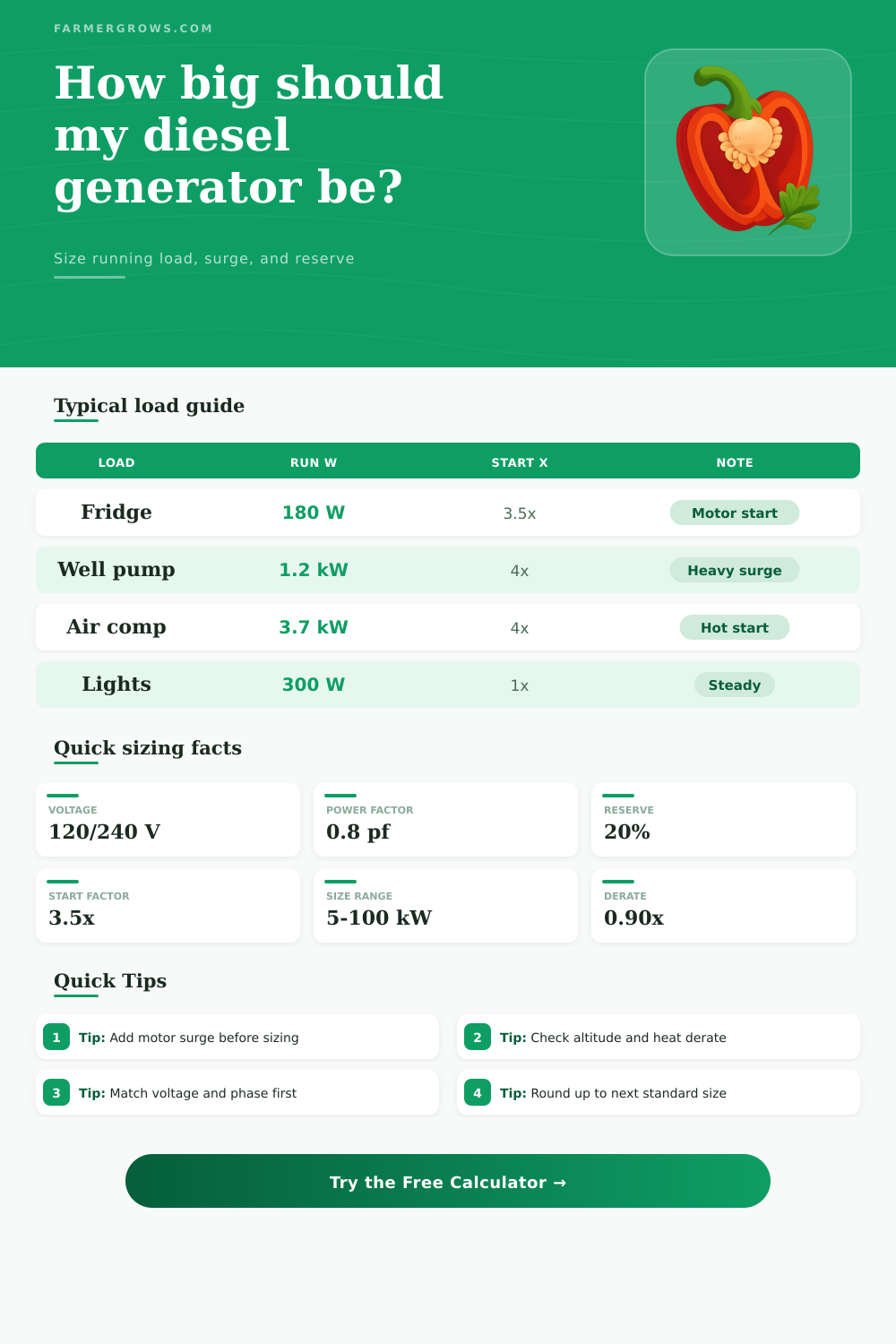
| Load | Running | Start | Typical note |
|---|---|---|---|
| Fridge | 180 W | 3.5x | Short motor surge |
| Well pump 1 hp | 1.2 kW | 4.0x | High inrush |
| Air compressor | 3.7 kW | 4.0x | Hard start |
| LED lights | 300 W | 1.0x | Steady load |
| Heat pump | 4.5 kW | 5.0x | Large compressor |
| Grain auger | 5.0 kW | 3.5x | Long start ramp |
| Size | 120 V amps | 240 V amps | Typical use |
|---|---|---|---|
| 5 kW | 41.7 A | 20.8 A | Small backup |
| 10 kW | 83.3 A | 41.7 A | Basic home |
| 20 kW | 166.7 A | 83.3 A | Farm service |
| 30 kW | 250.0 A | 125.0 A | Shop and pump |
| 50 kW | 416.7 A | 208.3 A | Large loads |
| 75 kW | 625.0 A | 312.5 A | Mixed duty |
| Condition | Factor | Effect | Note |
|---|---|---|---|
| 0-1000 ft | 1.00x | No derate | Sea level plan |
| 1000-3000 ft | 0.96x | Small loss | Common hill site |
| 3000-5000 ft | 0.92x | Clear loss | Upsize a little |
| 5000-8000 ft | 0.88x | Noticeable | Plan extra margin |
| Below 77 F | 1.00x | Baseline | Normal air |
| 95 F+ | 0.97x | Hot air | Cooling drop |
| Service | Voltage | Phase | Best for |
|---|---|---|---|
| Split-phase | 120/240 V | Single | Homes, cabins |
| Single-phase | 230 V | Single | Pumps, shops |
| Light three-phase | 208 V | Three | Commercial gear |
| Heavy three-phase | 480 V | Three | Large motors |
Start with the biggest motor first, then add the steady loads around it.
Use the derate table when you are sizing for heat, altitude, or both.
A diesel generator is a machine that can provide electrical power to a home in the event that the main power supply to that home fail. The diesel generator that you purchase for a home must be able to handle both the continuous electrical load of the appliance of that home, as well as the surge electrical load that motor create when starting. The continuous electrical load of appliances is the amount of electricity that the appliances use while they are continuous running.
The surge electrical load of motors, appliance like pumps and air compressor, is three to five time the amount of electricity of the continuous electrical load. Should you use a diesel generator that is too small to handle the surge electrical load of the motors in a home, the diesel generator can stall or suffer damage to it’s internal component. To ensure that the diesel generator that is purchased for a home is the correct size, each electrical device that the diesel generator is to be powered by must first be identify.
How to choose the right diesel generator for your home
Each of the device can be inventoried to determine the amount of wattage that each device use when it is in operation, as well as when the device starts up. For instance, appliance like refrigerators and well pump use a large amount of wattage when starting up, but a small amount of wattage while in operation. Lights and electronic device, in contrast, do not create a large surge in the electrical load.
Therefore, each of the appliances that create the largest surge of electrical load when starting up need to be accounted for in the selection of the diesel generator. In addition to considering the amount of electrical load that the device in the home will be created by, factor like voltage and phase can also impact the size of the diesel generator that should be purchased. Homes typically use split phase 120/240 volt power.
However, other electrical device, such as shop tools, can use single phase 230 volt power. Additionally, commercial motor may use three phase 208 or 480 volt power. The voltage of the diesel generator should match the voltage of the appliances in the home; otherwise, the electrical current may spike.
Such a spike in the electrical current can result in the overheating of the electrical cables or the tripping of circuit breaker in the home. Additionally, you must also consider the power factor that will affect the amount of usable power that your diesel generator can deliver to inductive load. The environment in which you use your diesel generator will also affect its output.
If you use your diesel generator in an area that reaches high altitude, the thinner air will contain less oxygen for the diesel generator to burn to produce power. At high altitude, the available oxygen will reduce the power output of a diesel generator by approximately 10 percent. Additionally, if the temperature is likely to reach more higher than 95 degrees, the diesel generators cooling system might not be able to keep up with the necessary cooling for the diesel generator to function proper.
In this case, the diesel generator will have to be derated. In both cases, it is recommended to add a 20 percent margin of error to your total wattage calculation to account for these environmental factor. This 20 percent reserve margin will allow for the diesel generator to handle unexpected load or to allow for aging of the diesel generator.
Once you have calculated your total continuous and total surge load, you need to purchase a diesel generator that meet and exceed these loads. Any specification for diesel generators are made for rounded figure, so you should round up to the next available size for a diesel generator. For instance, if your calculation come up to 13 kW, you will need a diesel generator with 15 kW or 20 kW.
This allow for headroom for additional appliance later on. If you are calculating the size of the electric wire and circuit breaker for your facility, you should use the full-load current to determine the correct size of the electrical component. To avoid common mistake when selecting a diesel generator, ensure that the total wattage that will run your appliance is lower than the wattage that your diesel generator will provide.
Another mistake to avoid is assuming that all appliance will start at the same time. Although it is unlikely that all appliance will be started at the same time, it is to your advantage to assume the worst case scenario for your facility and calculate based on that possibility. Using a clamp meter to measure the wattage of each appliance will allow you to ensure that your calculation are accurate.
Consider the duty cycle in which the appliance will be used. If appliance will not be in continuous use, you can provide a higher percentage of headroom for the diesel generator. Lastly, you will have to maintain the diesel generator by changing the oil and replacing the filter every 250 hour of use to ensure that the diesel generator remains in good working order.