⛽ Diesel Weight Calculator
Estimate fuel weight, gross load, and tank fill mass from diesel blend, temperature, and container details.
Estimated diesel load
Fuel mass and container planning overview
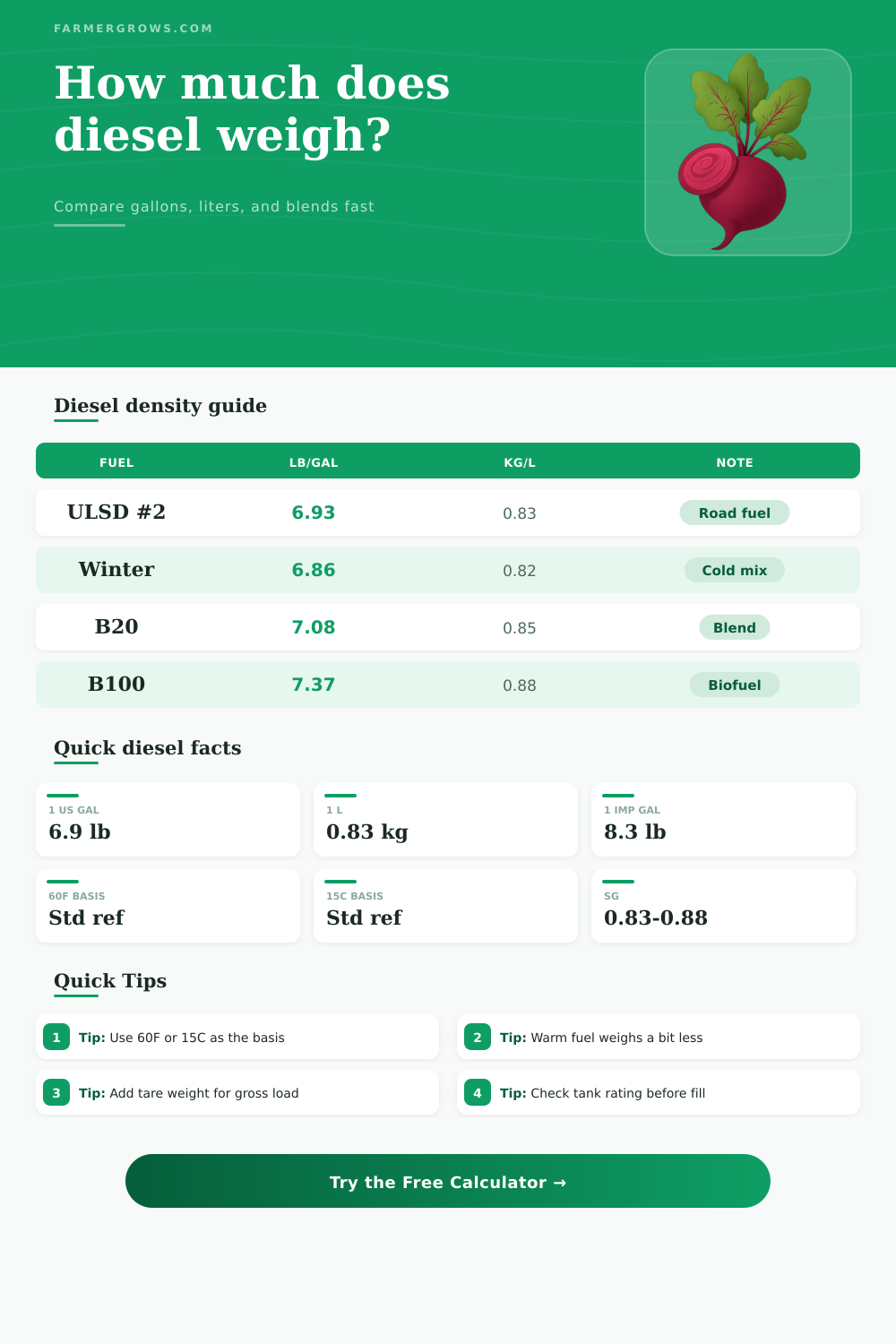
| Fuel | lb/US gal | kg/L | Notes |
|---|---|---|---|
| ULSD #2 | 6.93 | 0.83 | Road diesel base |
| Off-road | 6.92 | 0.83 | Dyed farm fuel |
| Winter blend | 6.86 | 0.82 | Cold flow mix |
| #1 diesel | 6.79 | 0.81 | Lighter fuel |
| B5 blend | 6.96 | 0.83 | Small bio share |
| B20 blend | 7.08 | 0.85 | Fleet blend |
| B100 biodiesel | 7.37 | 0.88 | Heavier biofuel |
| Custom mix | Manual | Manual | Enter your own |
| Container | Capacity | Tare | Use case |
|---|---|---|---|
| 55 gal drum | 55 gal | 48 lb | Shop storage |
| 275 gal tote | 275 gal | 135 lb | IBC tote |
| 100 gal slip tank | 100 gal | 150 lb | Pickup bed |
| 500 gal farm tank | 500 gal | 420 lb | Small site |
| 330 gal IBC | 330 gal | 140 lb | Cube tote |
| 1000 gal skid tank | 1000 gal | 800 lb | Bulk skid |
| 8000 gal tanker | 8000 gal | 14000 lb | Road haul |
| Custom tank | Manual | Manual | Enter values |
| Unit | Metric | Mass | Note |
|---|---|---|---|
| 1 US gal | 3.785 L | 6.9 lb | Diesel ref |
| 1 L | 0.264 gal | 0.83 kg | Metric ref |
| 1 m3 | 264.2 gal | 832 kg | Bulk fuel |
| 1000 L | 264.2 gal | 832 kg | IBC scale |
| 1 imp gal | 4.546 L | 8.3 lb | UK gallon |
| 55 gal drum | 208.2 L | 381 lb | Full drum |
| 275 gal tote | 1040.8 L | 1905 lb | Full tote |
| 500 gal tank | 1892.7 L | 3465 lb | Half ton+ |
| Scenario | Fill | Fuel wt | Gross wt |
|---|---|---|---|
| 55 gal drum | 100% | 381 lb | 429 lb |
| 275 gal tote | 50% | 953 lb | 1088 lb |
| 500 gal tank | 75% | 2599 lb | 3019 lb |
| 8000 gal tanker | 95% | 5260 lb | 19260 lb |
Use the blend that is actually in the tank, not the name on the invoice.
Warm fuel weighs slightly less, so temperature matters on long hauls.
Add tare weight before checking truck, trailer, or lift limits.
Round up for planning if you are near a capacity or gross limit.
To calculate the weight of diesel fuel, a person must take into account that the weight of diesel fuel depend upon several different factors. The weight of diesel fuel isnt a constant number, but rather depends upon the density of the diesel fuel. The blend of diesel fuel that your using, as well as the temperature at which a person measures the diesel fuel, can change the density of diesel fuel.
The density of diesel fuel can be measured in relation to how many pound of diesel fuel are contained within a specific number of gallons of that diesel fuel. The density of standard ultra low sulfur diesel #2 fuel is 6.9 pounds per gallon of fuel. A person took this measurement at a reference temperature for diesel fuel, which is 60 degrees F (or 15 degrees C). If the temperature of the fuel is increased relative to this reference temperature, the density of the diesel fuel will decrease due to the expansion of the fuel.
How to Calculate Diesel Fuel Weight
If the temperature of the fuel is decreased relative to this reference temperature, the density of the diesel fuel will increase due to the contraction of the fuel. Thus, one must monitor the temperature of the diesel fuel to ensure that changes to the weight of the diesel fuel is accounted for. In addition to the temperature of the fuel, the blend of the diesel fuel can also alter the weight of that fuel.
Standard road diesel fuel is the baseline blend for diesel fuel, but other blends exists. For instance, blends of biodiesel, such as B20 and B100, contain plant oils that are more dens than petroleum-based diesel fuel. As a result, diesel fuel blends that contains a percentage of biodiesel will be heavier than standard road diesel fuel.
Thus, diesel fuel that is measured at a percentage of biodiesel, such as B20, will weigh 7 pounds per gallon of fuel rather then 6.9 pounds per gallon. You must first identify the specific blend of diesel fuel that is being transported, as the blend of the diesel fuel will determine the actual weight of the diesel fuel that is to be transported. The weight of the container in which the diesel fuel will be transported, also known as the tare weight of that container, must be added to the weight of the diesel fuel to determine the gross weight of the load that will be transported.
For instance, a 55-gallon steel drum has a tare weight of approximately 48 pounds, while a 275-gallon IBC tote have a tare weight of approximately 135 pounds. It is necessary to add the tare weight of the container to the weight of the diesel fuel within that container to achieve the gross weight of the load. Failure to calculate the weight of the container will result in the failure to calculate the gross weight of the load, which is the weight that is important to consider based off the payload limits of the truck or the forklift that will move that load.
It is also necessary to ensure that there is a safety buffer established for the gross weight of the load that is to be transported. A safety buffer is extra weight that is added to the gross weight of the load to account for variable in the transport of that load, such as the drag that the fuel hoses may create when dragging the load. For example, adding 5% to the gross weight of the load can help to ensure that the gross weight of the load will not exceed the weight limits of the hauling vehicle.
Failure to establish a safety buffer could of result in overloading the truck or trailer that is to transport such a load. Overall, in order to calculate the weight of the diesel fuel that is to be transported, it is first necessary to calculate the density of that fuel. The blend of the diesel fuel, the temperature of the diesel fuel, and the tare weight of the container in which the diesel fuel is contained can influence the density of the diesel fuel.
Thus, to determine the total weight of the load, it is necessary to calculate each of these factors, as the total weight of the load is the sum of the weight of the diesel fuel and the tare weight of the container. By accounting for each of these factors, one can accurately weigh the diesel fuel, as well as the total weight of the load.