🌾 Gramoxone Dosage Per Litre Calculator
Set the spray area, tank size, and mix rate to calculate total concentrate, total spray volume, and refill counts before you mix.
Calibrated sprayer
Use a sprayer that matches the target volume so the litre math stays accurate.
Measuring jug
A clear jug or syringe helps you measure millilitres without guesswork.
Clean water
Start with clean water so the mix stays consistent from tank to tank.
Label and PPE
Keep the product label nearby and follow required protective gear every time.
| Rate | 5 L | 10 L | 20 L |
|---|---|---|---|
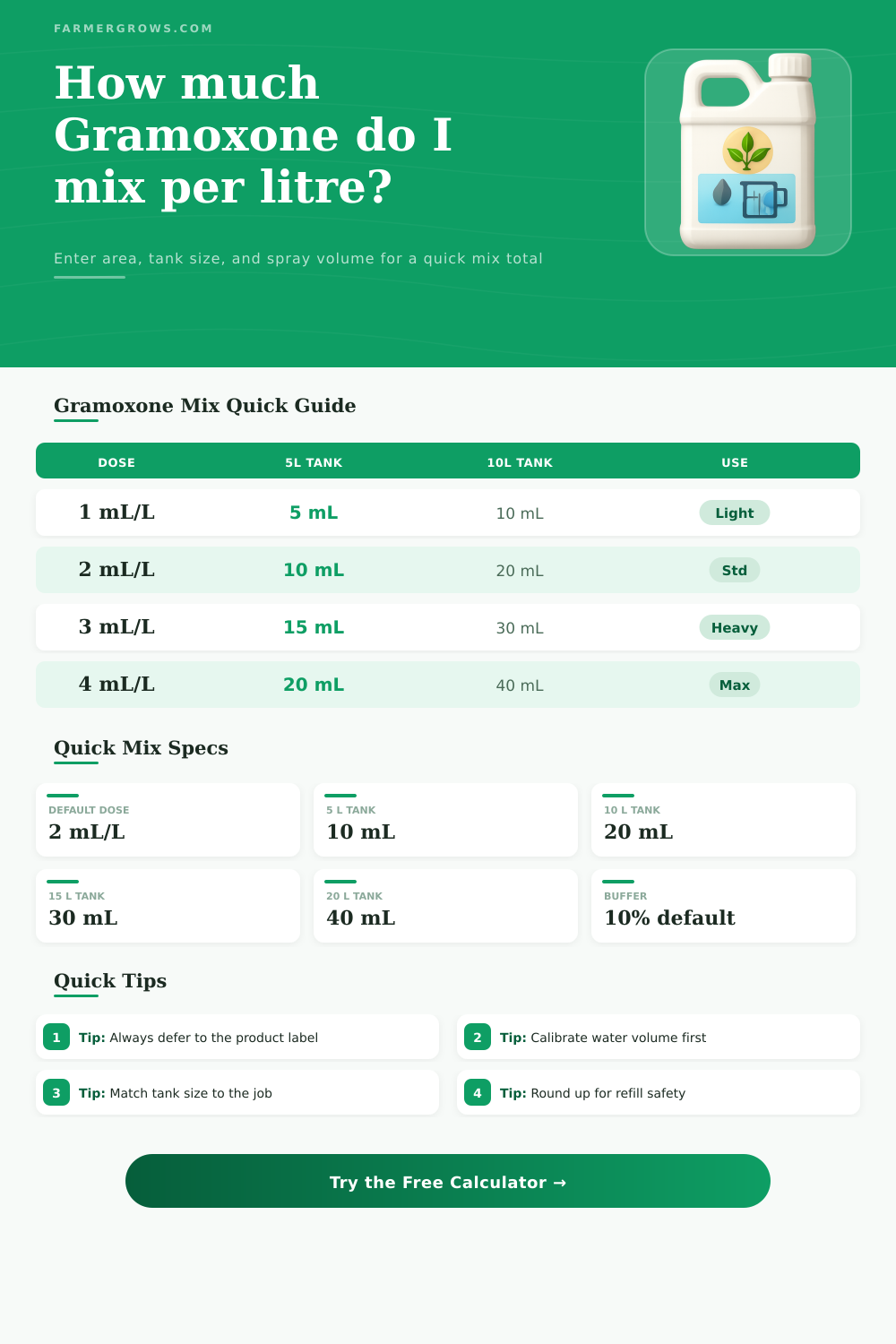
| 1 mL/L | 5 mL | 10 mL | 20 mL |
| 2 mL/L | 10 mL | 20 mL | 40 mL |
| 2.5 mL/L | 12.5 mL | 25 mL | 50 mL |
| 3 mL/L | 15 mL | 30 mL | 60 mL |
| 4 mL/L | 20 mL | 40 mL | 80 mL |
| L/ha | L/m2 | 1 ha mix | 1000 m2 mix |
|---|---|---|---|
| 80 | 0.008 | 80 L | 8 L |
| 100 | 0.010 | 100 L | 10 L |
| 150 | 0.015 | 150 L | 15 L |
| 200 | 0.020 | 200 L | 20 L |
| Job | Area | Mix @100 L/ha | Product @2 mL/L |
|---|---|---|---|
| Small patch | 250 m2 | 25 L | 50 mL |
| Fence line | 600 m2 | 60 L | 120 mL |
| Yard edge | 0.05 ha | 5 L | 10 mL |
| One hectare | 1.00 ha | 100 L | 200 mL |
To use Gramoxone effectivey, you must calculate the correct dosage of Gramoxone per liters of water. Gramoxone contain the active ingredient paraquat, which is a contact herbicide that kill the weeds that it comes in contact with. To ensure that the Gramoxone work correctly, you must ensure that the Herbicide reaches the weeds.
If you dont follow the instructions to mix the Gramoxone at a correct dosage, you may end up wasting the product or not killing the weeds that you desired to eliminate. The first step to mixing Gramoxone is to determine your spray volume. The spray volume will determine the amount of water that you use to spray the area that contains the weeds.
How to Mix Gramoxone per Litre of Water
The spray volume you use will depend on the nozzle type and the sprayer’s pressure. If you use a low spray volume, each droplet of the Gramoxone will be more concentratedly. However, you may not be able to spray the area even.
Alternatively, using a high spray volume will mean that the Gramoxone is more spread out. However, it will ensure that your Gramoxone reaches all weed. Another factor that determines your spray volume is the height of the weeds.
If the weeds are tall, you will require a high spray volume to ensure that the Gramoxone reaches all the weeds. The second step is to select the correct tank size for your sprayer. If the area that you plan to spray is small, use a 10-litre sprayer.
If the area is larger, use a 20-litre backpack sprayer. Use a calculator to calculate the amount of full tank of Gramoxone you will need for your treatment area. Add 10% buffer to these calculations.
The 10% buffer will ensure that you do not run out of Gramoxone before you finish treat the treatment area. The third step is to calculate the area of the weeds. It is imperative that you calculate the area correctly because you will not be able to calculate the correct dosage if you are incorrect in the area that the Gramoxone will be applied.
To calculate the area, if your treatment area is rectangular in shape, multiply the length by the width. If the area is a circle, multiply the diameter of the area by pi. For a triangle area, multiply the base of the triangle by the height divided by 2.
Calculate the area of the treatment zone precisely because any error in measuring the area will mean an error in the amount of Gramoxone that you will have to mix. The fourth step in mixing Gramoxone is to apply the correct dose rate of Gramoxone per litre of water. Use a light dose rate of 1 ml of Gramoxone per litre of water for young weeds.
Use a normal dose rate of 2 ml of Gramoxone per litre of water for most weeds. For perennial weeds, use a heavy dose of 4 ml of Gramoxone per litre of water. Make sure to follow the instructions on the Gramoxone label as to the amount of Gramoxone that you must add per litre of water.
Safety is a requirement when mixing and using Gramoxone. Always wear Personal Protective Equipment (PPE). Wear the PPE to avoid contact with the Gramoxone and to breathe it in.
Use clean water when mixing the Gramoxone and use measured jugs to measure the amount of Gramoxone concentrate. Ensure that you rinse your equipment three times with clean water after mixing the Gramoxone. Avoid the following common mistake when you mix Gramoxone.
One of the most common mistake when mixing Gramoxone is to forget to convert the units of measure. For instance, if you do not convert feet to meters, you can end up with an incorrect dosage of Gramoxone. Another mistake is to fail to calibrate the sprayer when you mix the Gramoxone.
If you do not calibrate the sprayer, the amount of water that comes out of the nozzle will not match what you calculated when mixing the Gramoxone. Finally, another mistake is to use the maximum dose rate of Gramoxone every time you mix the product. Using Gramoxone at a precise dosage is the most effective way to treat the weeds as opposed to using too much of the product.
To mix Gramoxone effective, calculate the area that contain the weeds, choose a spray volume, choose the correct tank size, and apply the correct dose rate. By following these four steps, you will ensure that you mix Gramoxone at the correct dosage per litre of water. By mixing the product at the correct dosage per litre of water, Gramoxone will kill the weeds effective.