Weed Killer to Grass Seed Wait Calculator
Estimate the earliest reseeding date from the label interval, herbicide class, recent rain or irrigation, soil buffer, seed type, and the date you hope to sow grass seed.
📋Realistic herbicide presets
Presets fill common label planning intervals. Always keep the number from your own product label in the label interval field if it differs.
🌱Reseeding wait inputs
Enter the application date and the reseeding interval printed on the label. The calculator then adds planning buffers for site conditions rather than giving application directions.
This planner is not a pesticide label substitute. If the label gives a longer interval than the preset, enter the label number and follow the label.
Reseeding calendar result
Calculated from the label interval plus site buffers.
Planning breakdown
📅Seed window planning
These cards translate the wait date into a practical calendar plan for germination and first mowing.
Based on herbicide interval and site buffers.
Varies with grass type, soil temperature, and moisture after seeding.
Useful for avoiding herbicide follow-up too soon after seedlings emerge.
📚Reference tables
| Product class | Typical label wait | Planning note |
|---|---|---|
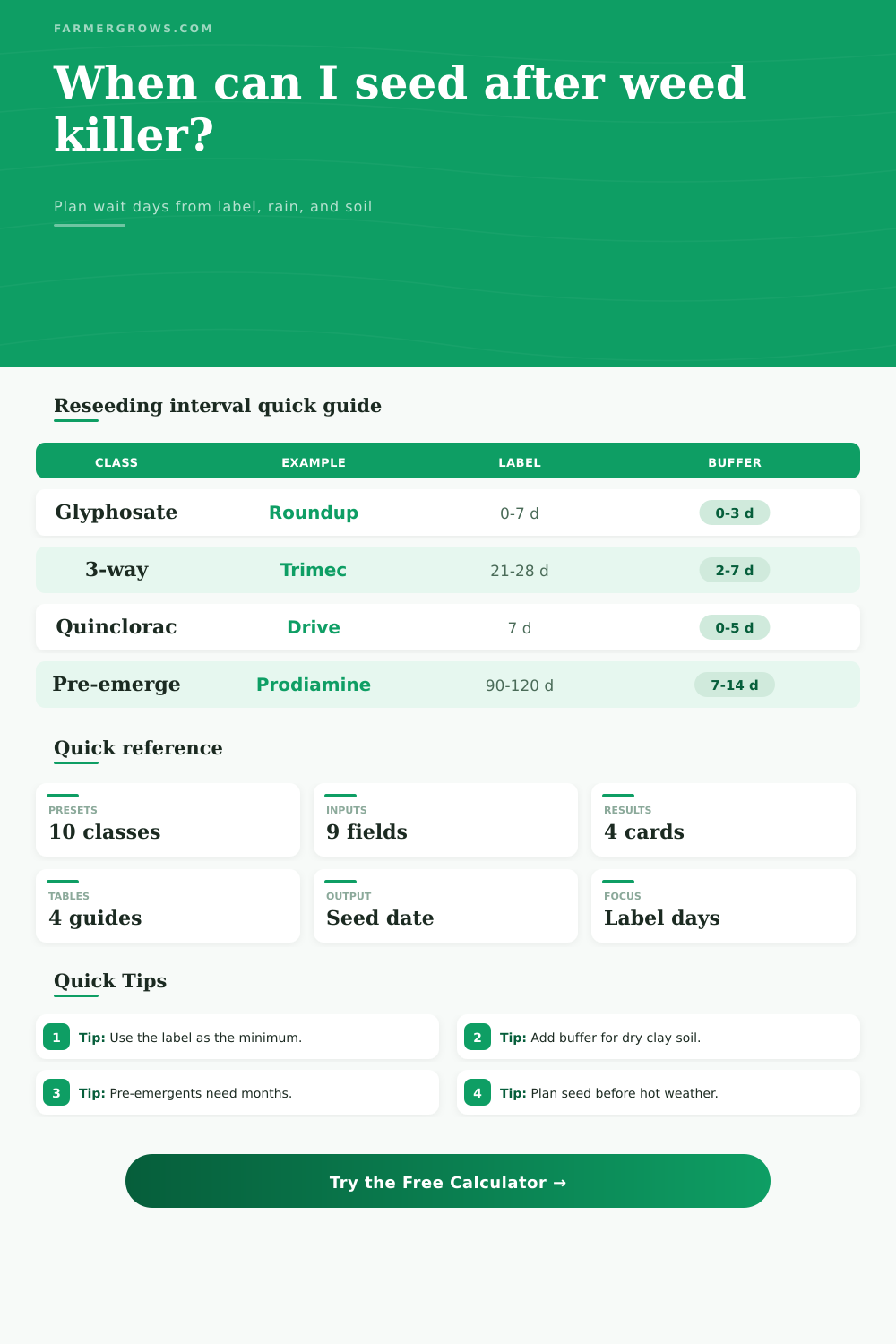
| Glyphosate nonselective | 0 to 7 days | Little soil activity; many renovations wait for visible control. |
| 3-way broadleaf herbicide | 21 to 28 days | Common lawn labels often point to three or four weeks. |
| Triclopyr broadleaf control | About 21 days | Often used before overseeding clover, violet, or brushy weeds. |
| Quinclorac crabgrass control | About 7 days | Many turf labels allow short intervals for tolerant grass species. |
| Mesotrione seed-compatible use | 0 days on label uses | Often chosen because some labels allow use at seeding. |
| Traditional pre-emergents | 6 to 16 weeks or more | Dithiopyr, prodiamine, and pendimethalin can inhibit grass seedlings. |
| Condition | Low residual | High residual |
|---|---|---|
| Under 0.25 in rain | 0 to 2 days | 5 to 10 days |
| Normal moisture | 0 days | 0 to 3 days |
| Saturated seedbed | 2 to 3 days | 3 to 5 days |
| Sandy soil | 0 days | 0 to 2 days |
| Clay or compacted soil | 2 to 5 days | 5 to 10 days |
| Thatchy lawn surface | 3 days | 7 days |
| Grass seed | Germination | First mow estimate |
|---|---|---|
| Perennial ryegrass | 5 to 10 days | 21 to 28 days |
| Tall fescue | 7 to 14 days | 28 to 35 days |
| Kentucky bluegrass | 14 to 30 days | 35 to 50 days |
| Fine fescue | 10 to 21 days | 30 to 45 days |
| Bermudagrass | 7 to 21 days | 28 to 42 days |
| Zoysia | 14 to 28 days | 42 to 60 days |
| Scenario | Label wait | Common plan |
|---|---|---|
| Full kill lawn renovation | 7 days | Seed the following weekend if soil is ready. |
| Broadleaf cleanup before overseed | 28 days | Spray about one month before fall seed day. |
| Crabgrass spot treatment | 7 days | Patch seed after the short label interval. |
| Spring pre-emergent barrier | 90 to 120 days | Often delays cool-season seeding until fall. |
| At-seeding mesotrione use | 0 days | Check turf species and label restrictions first. |
| Clay soil after drought | Label plus buffer | Add time before an expensive overseeding. |
The label wait is the minimum for the exact product and turf use. Presets are only planning shortcuts.
Dry clay, compacted soil, or a high-residual class can justify waiting beyond the printed minimum.
Dithiopyr, prodiamine, and pendimethalin are designed to stop seedlings, so the date may move by months.
Use the germination and first-mow dates to keep follow-up lawn work away from tender seedlings.
SURE: “I spread sprays one Saturday morning, because I’m hoping for a clean lawn by Sunday night.” You’ve got no more twitchy-looking clover, but now the grass is dead, and you can’t wait to sow new seed! More folks lose their lawns this way then due to bad soil.
When the weed stops twitching, the herbicide doesn’t just dissapears. It lingers in the soil as chemical remains, binding to the thatch layer or other organic matter, waiting to ambush any tender little grass seedling you rush to introduce. Plug in the label interval and class of your product into the calculator, above, and it’ll do the math for you. Knowing why the numbers came out like they did will influence all your renovation planning.
How Long to Wait Before Seeding
Glyphosate is easiest to deal with because it bonds strongly to the soil and becomes ineffective rapidly. This can happen as soon as a week, or sometimes you can even seed that day. You might be able to seed the same day or within a week.
These are not the only things on the garden center shelf: Three-way formulas including 2,4-D, or broadleaf killers such as triclopyr, for instance, will persist longer; intended to reach down and kill a deeply rooted dandelion, not just those top leaves. So they’ll sit there waiting to stunt a patch of young fescue growth too. The label tells you what’s considered the minimum safe wait period for that tougher chemistry, sometimes three weeks or more. Not necessarily comfortabley, but the floor.
From here on out, recent weather conditions and soil factors begins to be more important than what’s printed on the label. Dry clay will hold residue like a vise; rain dilutes it or carries some down below. No rain for you since spraying? Heavy clay soil where you live? Add a couple of days’ buffer before sowing; better late than two times over with that seed investment. Waiting another week is preferable to replacing it.
Look in the table on the page for an illustration of how compacted soils retain chemicals closer to the surface, compared to sandy ones that leach off more quickly. Those trapped spots are especially risky for germinating roots. You also need to be careful with pre-emergent herbicides, such as dithiopyr or prodiamine.
These products is intended to stop seed from ever emerging from the ground. Apply them in spring (as for example against crabgrass), and guess what? You have essentially shut out any cool-season grasses from getting in the ground until fall. This means you skip ahead several months, not just a few days, in your wait time. Don’t attempt to shortcut it. Three weeks won’t help; no amount of watering will break through a pre-emergent barrier. Remember: It’s supposed to last at least 90 days.
Thinking about when you plan to plant seeds also shapes this choice. Plan to lay down seed on a certain Saturday, and count back to today. Will the herbicide application match the needed interval? No? Tweak the date of spraying, or wait and get the seed later. You’ll be glad you didn’t rush things and end up staring at spots where no seed took hold.
Some seed is slower to get going than others, Kentucky bluegrass, for instance… But even with quick-starters like rye, you really want a clean slate before they begins to establish. All this means: Trust the science, but don’t trust yourself to be optimistic until you’ve been respectful of the chemistry involved.
Don’t expect an instant fix, because the chemicals don’t work that way. They have their own rates of decay, and they interact in the soil. Adding a little extra margin based off the label’s recommended amount allows for some leeway for things like whether you are on clay or suffered through a drought. The label just can’t factor that into its calculations for your yard.
And patience is the most affordable of all inputs in any lawn-renovation effort. If you’re putting down new grass starting from scratch (as in having sprayed the weeds), then let nature take its time to release what you put down there. You should of waited until it’s clear before asking the new grass to fight against something unseen underground.