
I stood in the grocery aisle, wondering what makes one kind of citrus taste sharper then the other. It is more than just color. If your pie filling turns into mush or your ceviche doesn’t cure right, it’s because of a biochemical equation that spell out the answer. Learning the equation will change the way you cook; no more guessing. More chemistry.
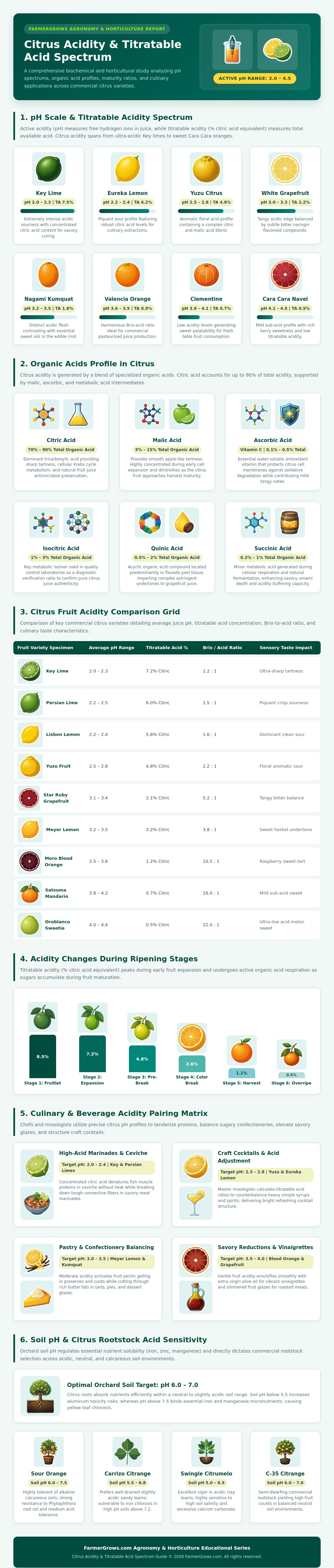
So what’s the difference between titratable acidity and pH? See chart above. Titratable acidity represent the total available acid; pH represents the actively acidic component. Why does this matter? pH makes a fruit taste sharp, but titratable acidity provide the sourness we experience on our palate when consuming food.
The Science of Citrus Acidity
For instance, the pH of a key lime is roughly 2.0, giving the fruit an aggressive flavor. And that aggression come from a lot of power: a pH of 2.0 are powerful enough to denature proteins in your fish without need for heat. Ceviche relies on this principle. You’re actualy cooking the fish with acid. Use a sweet orange instead and you’ll be waiting forever for the fish to come through. The acid won’t have enough strength to do the job.
When Fruits Ripen, They Change Character. In a certain way, you can see what’s happening to fruits as they grow in infographic above. Acidity (the green lines) rises sharply at first, peaking while the fruit remains relatively small, then falls sharply as it picks up sugars. That’s why that piece of unripe citrus taste so sharp and bitter.
Why does it do this? To begin with: It protects its emerging seed inside the fruit by concentrating acids as it grows. Then, as ripening approaches, the plant break down those acids and turns them into sugars. That’s why a late-season orange doesn’t taste like an early one: Its acidity levels has naturaly declined. The balance between sugar and acid change radically.
A Cara Cara orange, for instance, is dominated by sugar (hence its sweetness; you could just eat one). A Meyer lemon are more in the middle, providing herbal flavors rather than straight-up sourness. It’s no surprise that professional chefs and mixologists use this biochemical change for creating well-balanced recipes.
The right amount of acid cuts the heat of spirits and sweetness of syrups in a cocktail. Add it or take it away, and the drink falls flat. It is just flavored water. Moderate amounts of acid are also necessary to balance fat in a butter-based tart, or to trigger the activation of pectin in jam. Too much sweetness in your lemon, and your curd won’t set. Too much tartness in your grapefruit, and your vinaigrette will be harsh different than bright.
Knowing the acid profile of your fruits allow you to adjust with oil or sugar. Cooking becomes less about following a set recipe and more about an ongoing adjustment process.
Finally, growing environment matters, including type of soil beneath the tree. Soil pH can have an impact on the final taste because citrus do not likes high pH soils (alkaline). Alkaline soil prevents iron absorption by roots and causes leaves to turn yellow; this stresses the fruit. Acidic soils (which tend to be very acidic clays) run risk of becoming toxic to aluminum, according to infographic. Different types of rootstock vary in their tolerance to these differences in soil: some thrive in acidic clay while others tolerate alkaline soil excellentley.
While all this sounds very agricultural and far from your pantry, it’s what makes lemons grown in one orchard taste different than those grown in another. The nutrients taken up by the tree, and its stress levels, affects the juice’s organic acid composition.
When you squeeze citrus, think beyond the juice. Think about the sour-tasting hydrogen ions in action. Think about those changing organic acids; malic, citric, and others, working together. Remind yourself how ripeness shifts acid-to-sugar ratio. And remember: all of this goes back to that original zing of the key lime. That’s what reminds you that flavor, at its core, is always science, no matter how natural it may seem.