Firewood BTU Calculator
Estimate gross cord heat, moisture-adjusted heat, and delivered BTUs from real firewood species values, stacked volume, seasoning level, and appliance efficiency.
●Firewood stack presets
Choose a realistic starting point, then edit the species, cord measure, moisture, and stove efficiency for your woodpile.
●Firewood BTU inputs
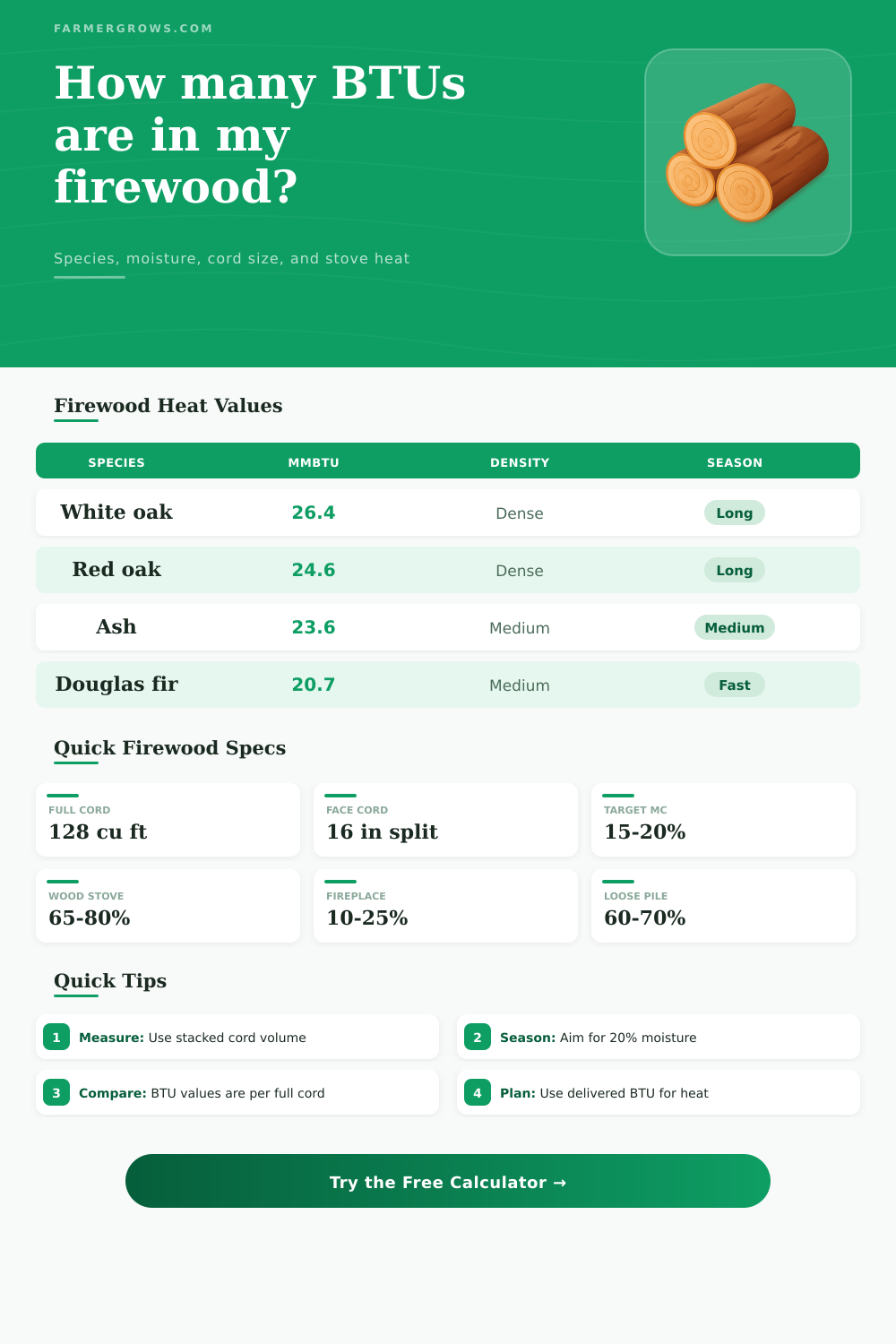
Heat values are million BTU per full cord at about 20% moisture content.
Enter cords, face cords, cubic feet, cubic meters, bundles, or loose cubic feet depending on the next field.
A standard full cord is 128 stacked cubic feet: 4 ft x 4 ft x 8 ft.
Face cord conversion is 4 ft x 8 ft x split length divided by 128 cubic feet.
Use about 60% to 70% for tossed firewood that has not been stacked tightly.
Split-face meter readings near 15% to 20% usually indicate seasoned stove wood.
Modern wood stoves are often 65% to 80%; open fireplaces can be much lower.
Use the delivered BTU load for the room, house zone, boiler loop, or shop.
●Selected stack quick numbers
●Species heat value reference
| Firewood species | Million BTU per full cord | Approx weight at 20% MC | Practical burn character |
|---|---|---|---|
| Osage orange / hedge | 32.9 MMBTU | 4,700 lb | Very dense, extremely hot, best for controlled stove fires. |
| White oak | 26.4 MMBTU | 3,710 lb | Long coaling hardwood, excellent overnight heat after proper seasoning. |
| Red oak | 24.6 MMBTU | 3,520 lb | Strong heat but often needs a long drying period after splitting. |
| Sugar maple | 24.0 MMBTU | 3,550 lb | Dense hardwood with steady heat and good coals. |
| White ash | 23.6 MMBTU | 3,440 lb | Reliable stove wood, splits well, and seasons faster than oak. |
| Black cherry | 20.4 MMBTU | 2,920 lb | Medium heat, pleasant flame, often used in mixed hardwood stacks. |
| Douglas fir | 20.7 MMBTU | 2,970 lb | Good softwood heat, fast ignition, and useful shoulder-season fuel. |
| Eastern white pine | 14.3 MMBTU | 2,250 lb | Lights easily and burns quickly; best for kindling or short fires. |
Values are typical full-cord heating values for seasoned firewood near 20% moisture; local growing conditions and stack tightness can shift real results.
●Moisture adjustment reference
| Moisture content | Net heat multiplier | What it means in the calculator | Burning note |
|---|---|---|---|
| 10% MC | About 1.10x | Dryer than the 20% cord baseline, so more net heat is available. | Very dry wood may burn faster and needs careful air control. |
| 15% MC | About 1.05x | Excellent seasoned firewood with slightly higher usable heat. | Common target for efficient modern stove operation. |
| 20% MC | 1.00x | Baseline used by the species BTU values in this calculator. | Good split-face reading for most residential firewood. |
| 30% MC | About 0.90x | Some heat is spent warming and evaporating extra water. | Expect weaker heat, smoke, and poorer draft. |
| 40% MC | About 0.78x | Green or poorly seasoned wood loses a major share of net heat. | Not ideal for clean stove burning. |
●Cord and stack conversion table
| Firewood measure | Stacked volume used | Full-cord equivalent | Calculator detail |
|---|---|---|---|
| Full cord | 128 cubic feet | 1.000 cord | Standard legal measure: 4 ft x 4 ft x 8 ft stacked. |
| Face cord, 16 inch splits | 42.7 cubic feet | 0.333 cord | Face cord volume changes when split length is not 16 inches. |
| Stacked cubic meter | 35.31 cubic feet | 0.276 cord | Metric stack volume converted to cubic feet, then cords. |
| Loose tossed cubic feet | Entered volume x loose factor | Varies | Loose piles have more air; use 60% to 70% unless measured locally. |
| Retail bundle, 0.75 cu ft | 0.75 cubic feet | 0.0059 cord | Useful for camping firewood comparisons, not winter heating supply. |
●Appliance efficiency reference
| Appliance type | Typical delivered efficiency | Best calculator setting | Result impact |
|---|---|---|---|
| Open masonry fireplace | 10% to 25% | 15% to 20% | Most heat leaves with flue gas; delivered BTU is far below cord BTU. |
| Older airtight stove | 40% to 60% | 50% | Better than open fireplaces but still sensitive to draft and wood moisture. |
| EPA non-catalytic stove | 65% to 75% | 70% to 72% | Good baseline for seasoned cordwood in a modern home stove. |
| Catalytic stove or gasification boiler | 75% to 85% | 78% to 82% | High delivered heat when wood is dry and firing technique is steady. |
●Firewood comparison grid
Dense overnight fuel
Osage orange, oak, beech, and hard maple give the highest BTU per cord and longest coal bed when fully seasoned.
Fast-seasoning hardwood
Ash, cherry, and birch are useful when you need steady heat but cannot wait as long as dense oak often requires.
Shoulder-season softwood
Douglas fir, pine, and cedar light quickly, heat fast, and work well for short burns when the house does not need all-night coals.
Moisture penalty
A high-BTU species can underperform if wet. A dry medium-density stack often delivers more useful heat than green oak.
●Firewood calculation tips
Even though the buyer of a cord of firewood knows the volume of the firewood, that same volume dont indicate the amount of heat that the firewood will release when burned. A person may know the volume of the firewood that he or she purchases, but the person may not know the heat output of that firewood. To aid the individual in calculating the heat output of their firewood, an individual can utilize a calculator.
Such a calculator require that the individual enters four data points: the species of the firewood, the volume of the firewood, the moisture content of the firewood, and the efficiency of an appliance that will burn the firewood. Each of these four characteristics can be used to calculate the heat output of the firewood. The species of the firewood will have the most impact upon the heat output of the firewood if that firewood is burned completly.
How to Use a Firewood Heat Calculator
Each species of wood contains a different amount of energy density than the other species due to the way the cells of the wood is constructed. For instance, white oak contains more mass within the same volume as white pine. Thus, if the same volume of white oak is burned compared to white pine, the white oak will provide more potential heat energy than the white pine.
The moisture content of the firewood can also impact the amount of heat that the firewood releases. Freshly split firewood can contain as much as forty percent moisture. Because the moisture content of the wood can range to above twenty percent, the firewood will release less heat then if the moisture content was lower to that percentage.
Due to the high moisture content in the logs, the firewood must first work to convert that moisture into steam prior to releasing heat into the surrounding area. Therefore, the heat output of the firewood will be less with such a highly moisture content. Calculators adjust for this moisture content in determining the amount of heat that will be released by the firewood.
An additional data point that the firewood calculator will require is the measurement unit of the firewood. Firewood is often purchased in quantities that are not equal to a full cord of firewood. For instance, firewood can be purchased in “face cords” or “loose piles” quantities, each of which contain a different volume of firewood than a full cord.
The calculator will convert this measurement unit to stacked cubic foot, after which the calculator will divide the number of cubic feet by 128 to determine the volume of firewood in full cords. For example, if an individual purchase three face cords of sixteen-inch splits, the individual might believe he or she purchased a full cord of firewood. However, the calculator will reveal that such a purchase is actualy only one-third of a full cord.
The efficiency of the appliance in which the firewood will be burned is the last variable within the firewood heat output calculator. For instance, an open fireplace will release more heat into the chimney than a catalytic stove. Thus, the efficiency rate of the appliance in which it will be burned will multiply the heat output of the firewood.
This multiplication will provide you with a total of delivered-BTU, which is the amount of heat that the room will feel. Comparing this to the heating load of your home will allow you to determine how many cord of firewood you should order. The page provides reference tables to allow you to understand the calculations behind the firewood calculator.
These reference tables provide information about how moisture content can change the heat of firewood, how various appliance can provide heat at different rates, and how large a full cord of firewood can be. The calculator calculates the same information as the reference tables, but applies that calculation to the specific firewood that you input. In comparing the reference tables to your firewood, it is possible that your firewood may not contain the same amount of heat as the reference tables indicate.
For instance, firewood that is cut from the north side of the hill may not season in the same manner as firewood that is cut from an open field. Additionally, firewood that is measured in the rain may weigh more than firewood that is measured in the sun. While the calculator does not account for these specific factors, they can be accounted for in determining whether the heat output of your firewood is lower than expected.
To determine how much firewood to order for the winter, begin with the heating load for your home. Determine the number of BTUs per hour that your home need to reach the desired temperature, and multiply that figure by the amount of hours that you plan to burn wood and the length of the heating season in your area. This will allow the calculator to determine how many cords of firewood of each species and moisture level are required to heat your home during the winter months.
Because firewood requirements are rarely a whole number, it is recommended that you dont order the amount of firewood that you used the previous winter to burn in your fireplace. To ensure that the firewood that you order will meet the heat levels that you require, it is recommended that you measure a sample of firewood before it is delivered to your home. By measuring the length, the height, and the depth of the firewood stack, you can multiply those three dimensions to determine the volume of the firewood.
Divide that volume by 128 to determine if the firewood is a true cord. Once you know the volume of the firewood, you can use the calculator to determine how many BTUs of heat that the firewood will provide. Thus, using the calculator removes the guesswork involved in purchasing firewood.
In comparing firewood costs from different sellers, it is possible that a cheaper cord of light firewood will provide less heat than a more expensive cord of dense firewood. You can enter each of these different brands of firewood into the calculator to compare the heat output that each type of firewood will provide. Understanding the heat output of each type of firewood helps to reveal the true cost of each brand of firewood.
The firewood calculator helps to remove the difficulty of estimating the amount of heat that a cord of firewood will provide. All that is required to use the calculator is the measurement of the firewood being considered, the species of firewood, the moisture content of the firewood, and the efficiency of the appliance in which the firewood will be burned. The calculator will provide you with the figure that you need to plan for the winter months.