Fermentation Brine Calculator
Calculate salt by weight for lacto-fermented vegetables, cover brines, equilibrium brines, and dry-salted batches.
Use trimmed edible weight after washing, peeling, coring, or slicing.
For cover brine, measure the water that will go into the jar.
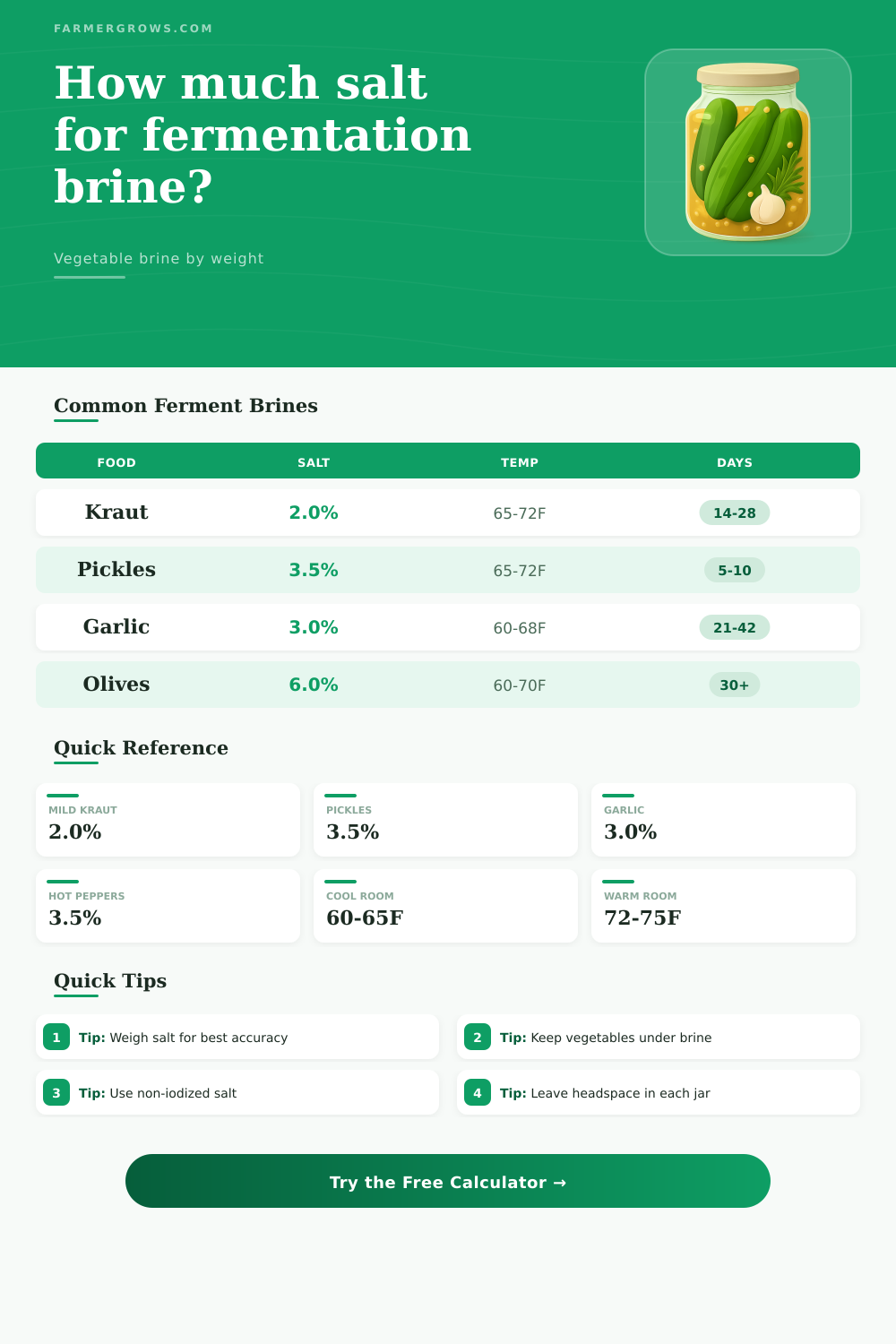
Most vegetable ferments land between 2% and 5%; olives often use more.
The gram result is primary; spoon estimates vary by crystal shape.
Used to estimate fill level and remaining headspace.
Ferments foam and bubble; many jars work best with 10% to 15% open space.
Temperature shifts speed, texture, and sourness more than jar size does.
Use this to compare your plan with a typical temperature-based window.
A starter is optional; it does not replace the calculated salt.
Extra brine helps when weights, airlocks, or wide-mouth jars displace liquid.
Fermentation Brine Results
Use weight-based salt as the controlling number, then taste and refrigerate when acidity and texture fit the crop.
| Ferment | Typical Salt | Best Method | Common Active Time |
|---|---|---|---|
| Shredded cabbage sauerkraut | 1.8% to 2.2% of cabbage weight | Dry salt; massage until brine forms | 14 to 28 days at 65–72°F |
| Napa kimchi base | 2.0% to 2.5% finished salt basis | Dry salt or equilibrium brine | 2 to 5 days active, then cold storage |
| Cucumber pickles | 3.0% to 4.0% water brine | Cover brine by water weight | 5 to 10 days at 65–72°F |
| Carrot sticks and beans | 2.5% to 3.0% water brine | Cover brine by water weight | 7 to 14 days at 64–70°F |
| Garlic cloves | 3.0% to 3.5% water brine | Cover brine by water weight | 21 to 42 days at 60–68°F |
| Hot peppers for sauce | 3.0% to 4.0% total mash weight | Equilibrium or dry salt | 14 to 30 days at 65–72°F |
| Green tomatoes | 3.5% to 5.0% water brine | Cover brine by water weight | 10 to 21 days at 62–70°F |
| Fresh olives | 6.0% to 8.0% water brine | Cover brine, changed as needed | 30 or more days after bitterness treatment |
| Salt Type | Approx g per tsp | Approx g per tbsp | Fermentation Note |
|---|---|---|---|
| Fine sea salt | 6 g | 18 g | Dissolves quickly; good all-purpose choice |
| Diamond Crystal kosher | 3.3 g | 10 g | Large flakes; volume spoons weigh much less |
| Morton kosher | 5 g | 15 g | Denser kosher crystal; still best weighed |
| Pickling salt | 6.3 g | 19 g | Fine and additive-free; easy to dissolve |
| Fine mineral salt | 6 g | 18 g | Works when non-iodized and free of anti-caking extras |
| Room Range | Fermentation Pace | Texture Effect | Timing Adjustment |
|---|---|---|---|
| 55–59°F | Very slow start | Crisp, mild, less bubbling | Add 50% to 100% more active time |
| 60–64°F | Slow and steady | Good crunch, gradual acidity | Add about 25% more active time |
| 65–72°F | Classic vegetable range | Balanced sourness and texture | Use normal recipe timing |
| 73–78°F | Fast acid development | Softer vegetables, more foam | Check 25% to 40% sooner |
| 79–82°F | Very fast | Higher softening risk | Use short ferments or move cooler |
| Jar or Crock | Usable Fill at 12% Headspace | Typical Vegetable Load | Brine Planning Use |
|---|---|---|---|
| 1 pint / 0.47 L | 415 ml | 250 to 350 g | Small test batch, garlic, pepper rings |
| 1 quart / 0.95 L | 835 ml | 500 to 750 g | Cucumber spears, carrots, green beans |
| Half gallon / 1.9 L | 1.67 L | 1.0 to 1.5 kg | Kraut, kimchi base, mixed vegetables |
| 1 gallon / 3.8 L | 3.34 L | 2.0 to 3.0 kg | Large pickle or farm stand batch |
| 2 gallon crock / 7.6 L | 6.69 L | 4.0 to 6.0 kg | Bulk cabbage or pepper mash |
Cover Brine
Salt is calculated from added water. It is practical for cucumbers, beans, carrots, garlic, green tomatoes, and other pieces that stay submerged in brine.
Equilibrium Brine
Salt is calculated from vegetables plus water. It is useful for pepper mashes, chopped relishes, and recipes where everything shares one final salt level.
Dry Salt
Salt is calculated from vegetable weight alone. It fits shredded cabbage, grated roots, and kimchi bases that release enough liquid after mixing.
Salt is essential to the fermentation process due to salt’s ability to create an environment suitable for the beneficial lactic acid bacteria that ferment vegetables. Salt prevents undesirable microbe from growing inside the ferment. Using too little salt will cause the vegetables to become too soft and have unpleasant flavors.
Using too much salt will stop the fermentation process or make the salt flavor too strong for the vegetables. The salt measurement must be based off weight because salt measurements in tablespoons will not provide the proper amount of salt. Different type of salt will weigh differently.
Salt and How to Use the Ferment Calculator
For example, a tablespoon of fine sea salt will weigh more than a tablespoon of large-flake kosher salt. The amount of salt to use will depend on the type of vegetable to ferment and the fermentation process you would like to use. Fermenting shredded cabbage will require a lower percentage of salt because the cabbage cells will release the liquid necessary to even distribute the salt throughout the cabbage.
In contrast, using salt brine will be stronger for vegetables like cucumbers or carrot sticks because the salt has to travel from the outside of the vegetable to the inside of the vegetable. You can choose between dry salt, cover brine, and equilibrium modes on the calculator to account for the different types of vegetable you may use in your ferment. Equilibrium mode treat the vegetables and the water as one system allowing the salt to be consistent throughout the jar.
The calculator includes several different field for fermentation because the actual batch you will make may not be the same as the theory behind fermentation. Using the water field will allow you to add water to the jar to cover the vegetables. Using the headspace field allows you to ensure that there is enough space for the foam and gas created during the fermentation process.
If there isnt enough headspace, the ferment will overflow the jar. If there is too much headspace, the mold may grow on the ferment. Using the temperature field will allow you to account for the different temperature in your kitchen.
For example, a jar of ferment at seventy degrees will ferment more faster than a jar at sixty degrees. The temperature at which you will ferment your vegetables will also affect the texture of the vegetables. Fermenting vegetables in cooler temperatures will ferment at a slower rate allowing the vegetables to remain crispy.
For example, fermenting garlic or olives at temperatures between 60 and 65 degrees will allow the vegetable to ferment at a slower rate and remain crisp. Fermenting in warmer temperatures will speed up the acid development in the vegetable but will also lead to the vegetables losing their crunch before the flavor has had time to develop. Using the planned days field will allow you to compare the number of days you plan to ferment your vegetables to the room temperature you have entered into the calculator.
However, you cant rely on the ferment calculator for the fermentation time for your vegetables. You will have to taste your vegetables to find the proper amount of acidity and crunchiness. It is also possible to prepare an extra brine to account for the vegetables taking up some of the liquid in the brine.
Using an extra brine will allow for more time to prepare the extra brine and account for the volume of the vegetables. If there is not enough extra brine, the vegetables will not be covered in the ferment. Vegetables that are not covered in the fermentation process could lead to a compromised fermentation process.
Using an extra brine will allow for the vegetables to be covered in the ferment and account for any variable during the first week of fermentation when the fermentation process is the strongest. People often make mistake when fermenting vegetables. For instance, a salt percentage of 2% may work well for a batch of vegetables fermented at 65 degrees.
However, using 2% salt for vegetables fermented at 78 degrees will require more attention from the fermenter. Using a 3.5% brine may taste perfect for the vegetables in your kitchen but may be too salty for another kitchen. The ferment calculator will help you account for the variables like room temperature, type of vegetables, and the amount of headspace the ferment will have in your jar.
By accounting for these variables in advance with the calculator will help you find out if the amount of vegetables and water will fit in the jar and if the salt is the correct amount for the room temperature.