Ground Cover Calculator
Estimate how many plugs, flats, pots, mulch, and weekly establishment water you need for a ground-cover planting based on bed shape, plant spacing, mature spread, and starter size.
Use this calculator for planting plans, nursery orders, and bed preparation. It estimates plant count from spacing geometry, then adds optional overage for edges, curves, bare corners, and replacement plants.
Ground-Cover Estimate
Plant counts are rounded up to full plants and full nursery packs so the order is practical in the field.
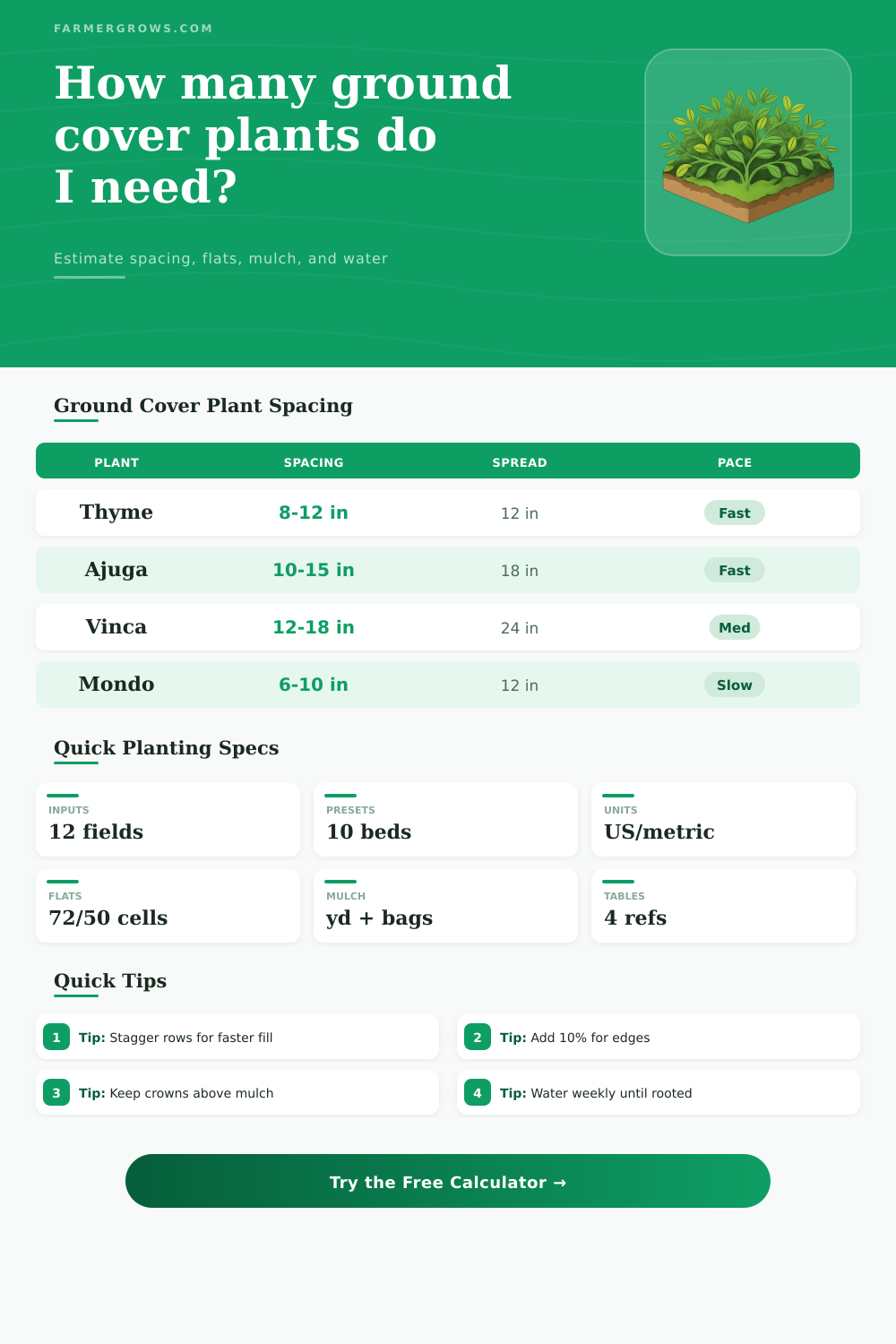
| Ground cover | Typical spacing | Mature spread | Fill pace | Best exposure |
|---|---|---|---|---|
| Creeping thyme | 8 to 12 in | 12 to 18 in | Fast in warm sun | Full sun, lean soil, low water |
| Ajuga | 10 to 15 in | 12 to 18 in | Fast by runners | Part sun to shade, even moisture |
| Pachysandra | 6 to 10 in | 12 in | Moderate to slow | Shade, woodland soil, root competition tolerant |
| Vinca minor | 12 to 18 in | 18 to 24 in | Moderate | Part sun to shade, banks and broad beds |
| Liriope | 12 to 18 in | 12 to 24 in | Moderate clump fill | Sun to part shade, edging and slopes |
| Mondo grass | 6 to 10 in | 8 to 12 in | Slow | Part shade, courtyards, formal plantings |
| Sedum stonecrop | 10 to 15 in | 12 to 18 in | Fast in heat | Full sun, dry berms, rock garden edges |
| Creeping cotoneaster | 30 to 48 in | 48 to 72 in | Slow woody spread | Sun to part sun, erosion banks |
| On-center spacing | Square rows per 100 sq ft | Staggered rows per 100 sq ft | One 72 flat covers | Use when |
|---|---|---|---|---|
| 6 in | 400 plants | 462 plants | 18 sq ft square | Very small plugs, slow covers, formal dense fill |
| 8 in | 225 plants | 260 plants | 32 sq ft square | Pachysandra, mondo, tight shade plantings |
| 10 in | 144 plants | 166 plants | 50 sq ft square | Woodruff, thyme, ajuga with faster closure |
| 12 in | 100 plants | 116 plants | 72 sq ft square | Most 4 in ground covers and mixed beds |
| 15 in | 64 plants | 74 plants | 112 sq ft square | Vigorous runners and larger starter pots |
| 18 in | 45 plants | 52 plants | 162 sq ft square | Vinca, liriope, sedum, quart starts |
| 36 in | 12 plants | 15 plants | 648 sq ft square | Woody ground covers and erosion banks |
| Starter size | Plants per unit | Good spacing range | Best use | Field note |
|---|---|---|---|---|
| 72-cell plug flat | 72 plants per flat | 6 to 12 in | Large dense plantings with small starts | Needs careful watering while roots expand |
| 50-cell landscape flat | 50 plants per flat | 8 to 15 in | Most perennial ground covers | Easier handling than tiny plugs |
| 4 in pots | 18 pots per tray | 10 to 18 in | Retail beds, slopes, faster visual fill | Set crowns level with finished soil |
| Quart pots | 12 pots per tray | 12 to 24 in | Vigorous runners and ornamental edges | Useful where weeds pressure new plugs |
| 1 gal pots | 6 pots per case | 18 to 48 in | Liriope, cotoneaster, woody covers | Backfill well so root balls do not dry out |
| Bare-root bundles | 25 plants per bundle | 8 to 18 in | Pachysandra and some large installs | Plant quickly and keep roots damp |
| Establishment item | Typical rate | Coverage or volume | When to use | Important caution |
|---|---|---|---|---|
| Fine mulch, 1 in deep | 1 cu yd per 324 sq ft | 14 bags at 2 cu ft each | Plug flats and small crowns | Keep mulch off crowns and stems |
| Mulch, 2 in deep | 1 cu yd per 162 sq ft | 14 bags at 2 cu ft each | Weed suppression between larger pots | Leave breathing room around each plant |
| Mulch, 3 in deep | 1 cu yd per 108 sq ft | 14 bags at 2 cu ft each | Shrub-like ground covers on slopes | Too deep can bury low ground covers |
| Water week 1 to 2 | 1 to 1.5 in per week | 0.62 gal per sq ft per inch | Right after planting | Split watering on clay or slopes |
| Water week 3 to 8 | 0.75 to 1 in per week | Adjust for rain and heat | While roots knit into bed soil | Check below mulch, not just the surface |
| After establishment | Deep water as needed | Usually less often | Once new growth is steady | Drought-tolerant plants still need first-season care |
For faster closure: Use staggered rows on slopes and broad beds. The calculator adds about 15.5% more plants because triangular spacing uses bed area more tightly.
For healthier starts: Keep mulch thin around low crowns, water by root-zone moisture, and reduce spacing only when the variety tolerates crowding and airflow remains good.
On a diagram it looks like you’re just counting how many plant to fit, but we’re not looking at that; we’re thinking about how each one fills out its space over time, and how quickly the bed closes up (and how much mulch must be applied to smother the weeds), or what the root system will require as it settles into soil, how far apart should the crowns be?
In general: With a fast spreader planted at eighteen inches, expect an empty-looking bed for a season. On the other hand, if you crowd a less speedy thing because you want faster results, you’ll have trouble getting air flow inviting disease.
Why Good Planning Is Important
Before any digging starts comes the pre-planning part: What combination of space and plant type makes sense? It’s more complicated than I thought: How a bed shapes up affect how it performs. A fast-draining slope after a rain isn’t the same as a broad rectangle or a long narrow strip alongside a walkway.
When you input your bed dimensions, the calculator take care of all that math (no mistakes about curves and triangles), no worries about triangular rows. It also factors in size of starter plants. Does a gallon pot cost and handle different than a seventy-two-cell flat does?
The same logic apply to mulch: Is there too little, which leaves the stem surface exposed to weeds and drying out? Or is there too much, which traps water against the stem at its crown? When you enter the volume of water per week, it will tell tool the amount needed in those first few weeks where roots are still tiny.
That number depends on understanding your climate. You need more in dry areas. Use less for rainy spots. Use less on a steep slope than on a flat one because slopes sheds water, though heavy rain can also saturate clay and flood rootzones. The calculator gives the raw number. But you allocate that volume to zones and/or spread over days yourself.
Don’t make common mistake that all plants are created equal! Perhaps you ordered just enough for your space, no extra, and then discovered an empty spot here or there due to missing something in a curve, or because some plant didn’t take root where intended, or because they were spaced too wide apart. Or maybe you spaced them as far apart as possible (saving money right now), not realizing this mean it will take a couple of seasons to cover that area instead of just one.
Look at the table of reference: It shows approximate size when mature and what is considered a normal range of spacing for each variety, whether they require breathing room or could stand to have a neighbor closer in. I’m not aiming at mathematical perfection on the drawing board. I want an intentional-looking planting by the end of the first summer that doesn’t need to be watered or weeded all the time.
You should of planned for it. A bed comes together evenly when you estimate water needs, mulch requirements and space between things based off the conditions on site, so everything settles in place instead of fighting against it. That’s what separates a workable groundcover from one that will have to be adjusted for years.