
You knew you wanted big, sweet northern highbush fruit, so you got yourself some Patriot blueberry plants and then waited maybe years while they grows up into bushes. You found them a sunnyish place in soil that is acidic. And now it’s time for the harvest…but there’s no satisfaction; the berries are not nearly as big as promised and the taste just doesn’t pop.
What? Turns out that one key element was overlookeded. Patriot blueberries are technicaly self-fertile, meaning they can produces fruit on their own. However, about half of what the plant could potentialy offer remains locked unless it is helped along by another variety of blueberry to pollinate it.
Why You Need Another Blueberry Bush
Cross-pollination improves the whole crop because it produces bigger berries… Thirty percent or more larger than those grown without it. Clusters is heavier; they set evenly. Instead of having all stages of ripeness, you have a coordinated explosion of ripe-for-the-taking berry. That’s important, because a uniform crop are easier to pick. Plus, you have better flavor. Good pollination causes the berries to spike in sugar content and hold up well frozen or baked.
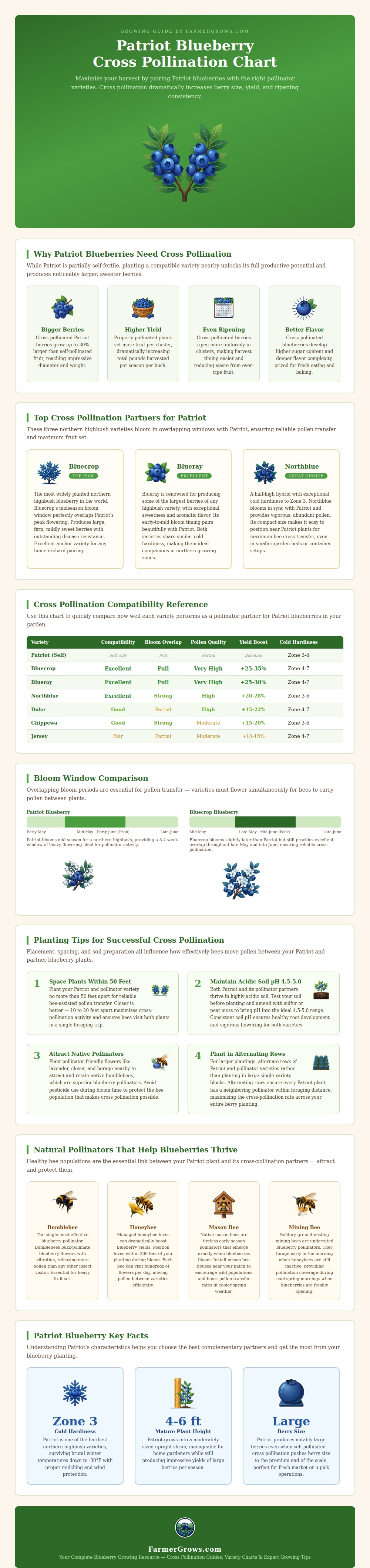
This is best selection. Next: who to choose? Most agree on this one: Bluecrop. In fact, it flowers at the same time than Patriot, so their bee-friendly flowers open together. Another good bet is Blueray. It blooms very early, perfectly timed to match Patriot’s peak, and is also one of highbush blueberry varieties that produces largest berries. If you live in a colder area, there is always Northblue. It is a compact half-high type that can absorbs vicious cold and will still provide abundant pollen transfer, too.
Bluecrop and Blueray gets top marks for very high pollen quality and for full overlap, which means higher yields. This can boost yields by twenty-five to thirty-five percent. Which is enough to make the difference between a filling-your-bowl-and-generously-getting-some snack.
You must also have varieties that flower at same time: it’s all about timing when it comes to pollination. If one of your partner variety flowers a week before or after Patriot, no bee in his right mind will be interested in either bush when they’re both most fertile. The good news is that Patriot and Bluecrop flower nicely together (mid-May to early June for Patriot), late May to mid- June for Bluecrop, with just the right overlap. That can’t be improved upon; there’s no way to remedy bad timing with good garden practices later on.
Plan strategically to help get the bees moving pollen from plant to plant. The closer (within about fifty feet) you plant the bushes to one another, the better, but planting them at least ten feet to twenty feet apart also gets the bees thinking of them as part of same foraging loop. The best way is to use alternating rows if you have the room.
And here’s where the acid comes into play: The Patriot and his friends love an acidic soil, between 4.5 and 5.0 on the pH scale. Too alkaline, and the bushes just aren’t going to flower vigorously enough to make much pollen, no matter how close together you plant them. As a bonus, you can attract some native pollinators such as bumblebees. Bumblebees use a buzzing vibration technique that releases more pollen than honeybees can manage alone. Make it easier for these guys by planting some clover or lavender nearby and get ’em to work.
The answer: Patriot blueberries (zones 3-4; four to six feet tall), a tough shrub that produces abundantly if you plan accordingly. Once you get the idea of cross-pollination, and choose suitable buddies such as Blueray or Bluecrop, you have a recipe for an actual fruit factory, even from a small patch of bush. What I had missed was this: Planting the thing wasn’t really the trick. That’s what came next. Giving it a partner.