Fertilizer Ratio Calculator
Match a fertilizer grade to a target nutrient rate, field or garden area, bag size, crop phase, and soil-test need before spreading N-P-K.
Use guaranteed analysis values from the fertilizer label. Nitrogen is N, phosphorus is reported as phosphate P2O5, and potassium is reported as potash K2O.
Efficient nitrogen source for sidedress or topdress programs. Incorporate or irrigate to reduce volatilization loss.
Strong phosphate source with useful nitrogen. Good near seeding when salt placement and seed safety are managed.
Simple garden blend when N, P2O5, and K2O needs are similar. Can overapply phosphorus on high-P soil.
Concentrated potassium source for legumes, hay, soybeans, potatoes, and low-K fields without adding nitrogen.
Ammonium sulfate supplies nitrogen plus sulfur. Useful for pasture, brassicas, and soils with sulfur deficiency.
Lower analysis means more pounds per acre, but release is slower and may support soil biology in gardens.
Fertilizer Ratio Results
Results use label grade percentages, selected area, target nutrient rate, and the N-P-K needs you entered.
| Common NPK grade | Material example | Primary nutrient | Typical crop use | Planning note |
|---|---|---|---|---|
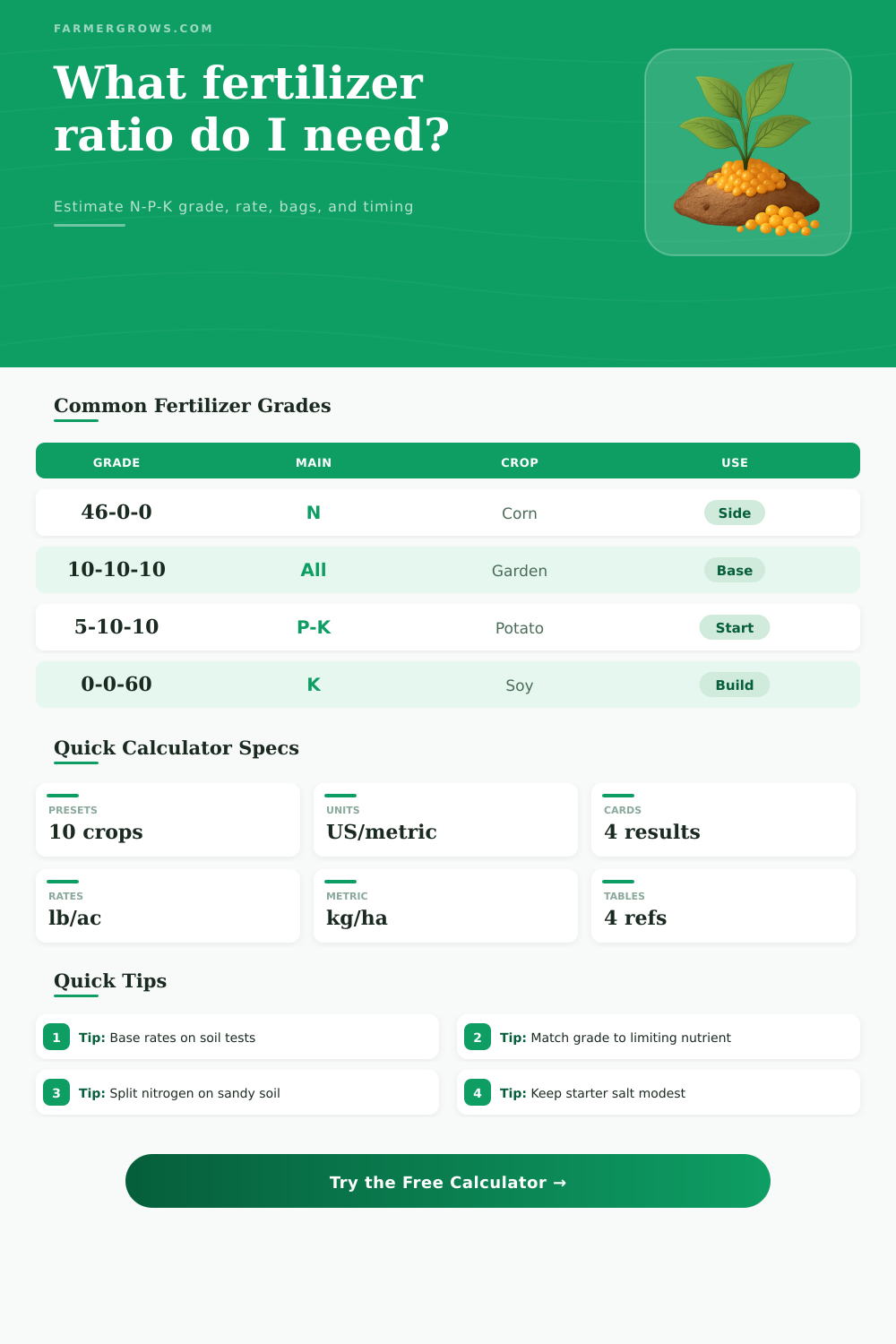
| 46-0-0 | Urea | Nitrogen | Corn, wheat, pasture, lawns | High analysis; protect from volatilization with incorporation, rain, or stabilizer. |
| 21-0-0 | Ammonium sulfate | Nitrogen plus sulfur | Pasture, brassicas, sulfur-deficient fields | Acidifying material; useful where sulfur is part of the recommendation. |
| 18-46-0 | Diammonium phosphate | Phosphate plus N | Starter grain, rice, vegetable establishment | Strong P source; watch seed placement and high-pH ammonia risk. |
| 11-52-0 | Monoammonium phosphate | Phosphate plus N | Starter bands and low-P soils | Lower pH reaction near granule than DAP, often preferred in starter blends. |
| 10-10-10 | Balanced garden blend | Even N-P-K | Mixed vegetable gardens and beds | Convenient, but may not match soils already high in phosphorus. |
| 5-10-10 | Low-N garden starter | Phosphate and potash | Potatoes, tomatoes, transplant beds | Useful when early root and fruiting support matters more than leafy growth. |
| 0-0-60 | Muriate of potash | Potash | Soybeans, hay, alfalfa, potatoes | Concentrated K source; chloride sensitivity matters for some specialty crops. |
| 0-20-20 | P-K maintenance blend | Phosphate and potash | Legume hay, established perennial plots | No nitrogen, helpful when legumes supply their own N. |
| Nutrient conversion | Formula | Use when | Example |
|---|---|---|---|
| Elemental P to P2O5 | P x 2.291 = P2O5 | Lab reports phosphorus as elemental P | 20 lb P equals 45.8 lb P2O5 |
| P2O5 to elemental P | P2O5 x 0.436 = P | Comparing bag label to elemental crop removal | 40 lb P2O5 equals 17.4 lb P |
| Elemental K to K2O | K x 1.205 = K2O | Lab reports potassium as elemental K | 80 lb K equals 96.4 lb K2O |
| K2O to elemental K | K2O x 0.830 = K | Comparing label potash to crop K removal | 60 lb K2O equals 49.8 lb K |
| lb/ac to kg/ha | lb/ac x 1.12085 = kg/ha | Switching to metric fertilizer plans | 100 lb/ac equals 112.1 kg/ha |
| kg/ha to lb/ac | kg/ha x 0.89218 = lb/ac | Converting metric recommendations | 120 kg/ha equals 107.1 lb/ac |
| Crop group | Typical N need | Typical P2O5 need | Typical K2O need | Ratio planning note |
|---|---|---|---|---|
| Corn grain | 120 to 220 lb/ac | 30 to 80 lb/ac | 40 to 120 lb/ac | N drives most rate decisions; P and K depend heavily on soil test. |
| Wheat | 60 to 140 lb/ac | 20 to 60 lb/ac | 20 to 80 lb/ac | Split N between fall starter and spring topdress when conditions fit. |
| Soybean | 0 to 30 lb/ac | 30 to 70 lb/ac | 60 to 140 lb/ac | K removal is often the main replacement target. |
| Vegetable garden | 40 to 160 lb/ac | 40 to 120 lb/ac | 60 to 180 lb/ac | Crop family matters; fruiting crops usually need strong K support. |
| Potato | 120 to 220 lb/ac | 80 to 180 lb/ac | 150 to 300 lb/ac | High K demand; chloride source choice can affect tuber quality. |
| Alfalfa or hay | 0 to 70 lb/ac | 40 to 120 lb/ac | 120 to 300 lb/ac | Legumes usually need P and K maintenance more than N. |
| Application timing | Best-fit nutrients | Common crops | Rate caution | Field note |
|---|---|---|---|---|
| Preplant broadcast | P2O5, K2O, base N | Corn, vegetables, forage seedings | Avoid excess N too early on leaching-prone soil. | Incorporation improves placement for immobile P and K. |
| Starter band | Small N plus P2O5 | Corn, rice, vegetables, potatoes | Keep salt and ammonia away from seed. | Useful in cool soils where early root access is limited. |
| Sidedress | Nitrogen | Corn, tomatoes, peppers, brassicas | Apply before peak uptake and rainfall risk. | Split applications often improve N use efficiency. |
| Topdress | Nitrogen and sulfur | Wheat, pasture, lawn | Surface urea needs rain, irrigation, or stabilizer. | Match timing to active growth and canopy demand. |
| Post-harvest maintenance | P2O5 and K2O | Hay, alfalfa, orchards, berries | Replace removal without pushing late soft growth. | Good window for perennial nutrient rebuilds. |
Use the limiting nutrient: When one fertilizer supplies all three nutrients, calculate from the nutrient you cannot underapply, then check whether the other two are over the soil-test recommendation.
Split mobile nutrients: Nitrogen moves and can be lost. Phosphate and potash move slowly, so they usually fit better in preplant, starter, or maintenance applications.
The right fertilizer for each crop come in the right bag with the proper content; match it. That’s where the numbers on the bag come in, but they don’t tell the whole story. Knowing the number is just one factor among several. You also need to know how much ground you have and what exactly you are trying to add (nitrogen?). Phosphorus? Is it something else, and which crop stage or test result are the priority?
Knowing that will get you toward the correct bag count and rate. It all adds up to this: a fertilizer ratio calculator. No more guesswork on the math side.
Why You Need a Fertilizer Calculator
That said: What are the grades themselves? That’s where it begins; the key inputs. Each has some percentage of N (nitrogen), P (phosphate) and K (potash), the big three nutrients.
Next, what do you want to create. A certain soil-test blend, for instance, or just one nutrient? Then decide on the square footage of the area, and finally choose if it is preplant, sidedress, or another phase. These all affect things, because timing matter. Applying a lot of nitrogen at sidedress on corn typically doesn’t work the same way as applying that same grade in a small starter band around seed row.
Enter the data and let the calculator convert. Now you can compare your options without re-creating the math. Textbook ratios aren’t usually what real fields is like. Often one nutrient will limit the rate; the rest just come along for the ride. Limiting-nutrient thinking prevents you from shorting an element the crop can’t live without. Then you can see if the other ones falls into reasonable bounds.
Reference tables containing common grades with their usual applications show you this same sort of reasoning: Why does 0-0-60 (nearly pure potash) work well on ground deficient in potassium? For example, it’s not such a great fit when you’re also looking for some nitrogen.
There’s also one more wrinkle: units. You may plan in kilograms per hectare or pounds per acre. If you change systems halfway through the plan, look out for math errors. If you select metric or imperial units on the calculator, it’ll maintain consistency throughout. Then the per-acre rate converts to total number of bags/totes and material.
This is important when you’re filling a spreader or ordering product. An extra half bag can mean an extra trip or an unplanned partial pallet.
The last test is the soil-test fit. Enter your required level of each nutrient, and the tool computes the match between your soil and nutrients in the grade you select for each crop phase. If the scores are high, it means the grade should provide the proper balance with minimal excesses. Low scores alert you to potential under- or over-application of an element, and help point you toward choosing a different grade or even splitting up the routine.
The errors typically arise from failing to think of the grade as variable, and not a set recipe. For instance, some people use a standard 10-10-10 mix each year just because it seems like an even blend. They sometimes do this even when a soil test shows that phosphorus levels is already adequate. Or some go for one big number on the bag, with no thought given to when or where they are applying it. That may be pushing salty stuff too close to tender seedlings; it may fall off fast if applied in sandy soil.
The calculator helps surface those mismatches, the nutrients being delivered vs. This refers to what you entered regarding your needs. But it’s up to the user to put in reasonable targets.
That’s where the real-world payoff occurs: transitioning directly from your soil-test results to a shopping list without getting lost in the weeds. Add the phase, the area, the grade, the limiting nutrient or blend fit. The math calculates the rate, the amount of material needed and the coverage per bag. Adjust accordingly (or plan for a split application). Swap grades if the fit score is low.
All that doesn’t stop you from using your local know-how regarding rainfall patterns or soil texture. But it eliminates the friction of having to do all those conversions by hand each time. You should of checked everything first. It’s naturaly important for avoid mistakes when dealing with luxurius amounts of chemicals.