Durum Seeding Rate Calculator
Estimate durum wheat seed rate from target plants per square foot, seed size, germination, field mortality, row spacing, planting timing, soil moisture, and acres.
Use the seed tag when possible. The calculator converts TKW to seeds per pound when needed, adjusts the target stand for planting timing, and turns field emergence into drill-ready pounds per acre.
Durum Seeding Rate Result
Your seed rate and drill row load will appear here.
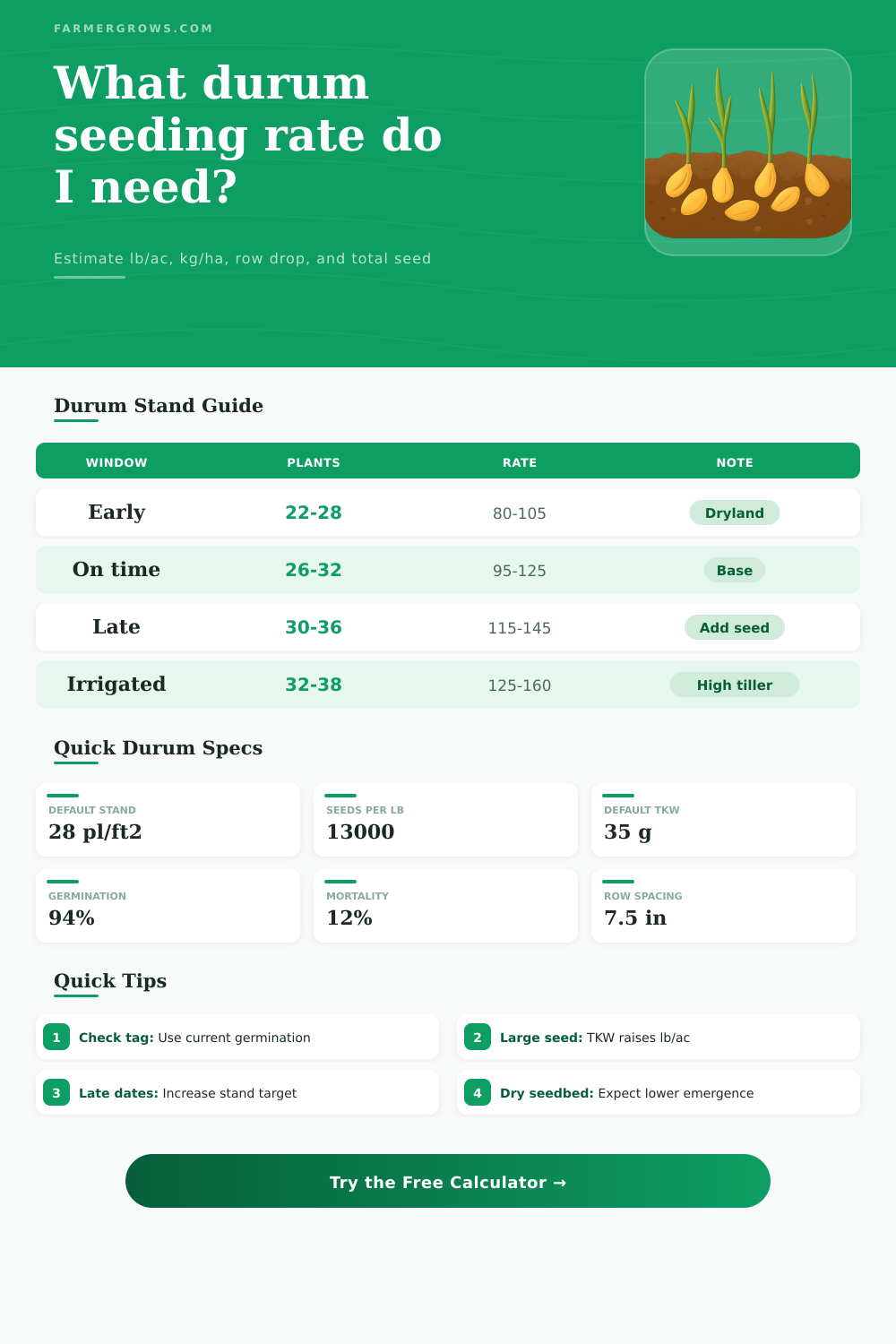
| Scenario | Target plants/sq ft | Typical adjustment | Use when |
|---|---|---|---|
| Conservative dryland | 22 to 26 | Lower rate | Stored moisture is limited and tillering window is normal. |
| Balanced durum stand | 26 to 32 | Base rate | On-time planting with good seedbed conditions. |
| Late planting | 30 to 36 | Add 8% to 15% | Reduced tillering or shortened season. |
| Irrigated or high yield | 32 to 38 | Add 10% to 20% | Moisture and fertility support a denser canopy. |
| TKW (g) | Seeds per lb | Seed size | Rate effect |
|---|---|---|---|
| 28 | 16,200 | Small | Fewer pounds for the same seed count. |
| 34 | 13,340 | Medium | Common planning value for durum lots. |
| 40 | 11,340 | Large | More pounds needed for equal plants. |
| 48 | 9,450 | Very large | Watch drill capacity and calibration. |
| Row spacing | 30 seeds/sq ft | 36 seeds/sq ft | Calibration note |
|---|---|---|---|
| 6 in | 15.0 seeds/ft | 18.0 seeds/ft | Narrow rows spread seed load. |
| 7.5 in | 18.8 seeds/ft | 22.5 seeds/ft | Common small grain spacing. |
| 10 in | 25.0 seeds/ft | 30.0 seeds/ft | Check in-row crowding. |
| 12 in | 30.0 seeds/ft | 36.0 seeds/ft | Useful for wide opener systems. |
| Field acres | 90 lb/ac | 120 lb/ac | 150 lb/ac |
|---|---|---|---|
| 40 acres | 3,600 lb | 4,800 lb | 6,000 lb |
| 80 acres | 7,200 lb | 9,600 lb | 12,000 lb |
| 160 acres | 14,400 lb | 19,200 lb | 24,000 lb |
| 320 acres | 28,800 lb | 38,400 lb | 48,000 lb |
Calibrate by seed count: Durum kernel size changes pounds per acre quickly, so a scale-only drill setting can miss the intended plant population.
Separate seedbed risk: Put known germination in the germination field, then use mortality and soil moisture for field emergence losses.
Determining the correct seeding rates is a necessary step in establishing a durum wheat crop. The seeding rate will determine the density of the crop. If the seeding rate is too low, there will be too much space between the plant and weeds will grow in those gaps.
Conversely, if the rate is too high, there will be too much competition between the individual plants for resources like nutrient and light, and money will be wasted on purchasing extra seed. Therefore, a farmer must find a balanced rate to ensure that the durum wheat crop grows correct. The size of the seed is one of the variable that will change the amount of seed that is required to establish the crop.
How to Choose the Right Seeding Rate for Durum Wheat
If the kernels of the seed are large, then fewer seeds is contained within a pound of seed than if the kernels of the seed are small. Thus, large kernels will require more pound of seed per acre to achieve the same rate of plants per acre as small kernels. The rate of seeds per pound can be calculated from the thousand-kernel weight listed on the seed tag for the seed.
The specific weight of the specific seed variety will provide the most accurately rate of seeds per acre to plant. The dates on which the seed is to be planted and the conditions of the soil in which the seed is to be planted will change the seeding rate. If the durum wheat is to be planted early in the season, the plants will have more time to tiller before the growing season end.
Thus, a lower seeding rate can be used if the crop is to be planted early in the season. Conversely, if the planting date is later in the season, there will not be as much time for the tillering process to occur. Therefore, a higher seeding rate may have to be used to ensure that there is enough plants to achieve the crop yield goals for that season.
Additionally, if the soil conditions are dry, cold, or wet, these factors will impact the rate at which the seeds will germinate. Therefore, the target number of emerged plants will have to be adjusted according to soil condition. The germination potential of the seed and the rate at which the emerged plants will die in the field will impact the seeding rate.
If the seed tag indicates a germination rate of 94%, for example, it is likely that the emerged plants will not have a 94% survival rate in the field. Seeds may die in the field if they are planted too deep, if they are planted in dry pockets within the field, or if insects eat the seed. Therefore, the farmer will have to adjust the germination rate to account for these potential deaths in the field.
By adding a mortality rate to the germination rate, an accurate seeding rate can be created that account for any potential deaths in the field of emerged plants. The rows in which the durum wheat is to be planted will impact the seeding rate. If the rows are wider than others, then more of the plant will be forced to compete with each other for resources within each row.
Narrow rows will allow for more even distribution of the emerged plants. Therefore, the rate of seed to be planted per acre can be translated to the number of seeds per row foot to ensure that the drill used to plant the field is correctly set up. Different drills has different spacings of their openers to plant the seeds in the field.
The total quantity of seed to be planted can be calculated by multiplying the rate to be planted per acre by the total number of acres to be planted with the durum wheat. The total quantity of seed that should be planted can be calculated early in the planting process. By calculating the total quantity of seed that will be planted, a farmer can determine how many seed tote are required to transport the seed to the fields.
Additionally, the total quantity of seed can be used to determine if the farmer has enough seed inventory to fulfill the planting request. The seeding rate will impact how the established durum wheat crop responds to the weather in which the crop is grown. If the crop is not evenly established, weeds will emerge in the areas in which the durum wheat plants did not germinate or emerge.
Additionally, if the rate at which the seed is planted is too high, the emerged plants will grow into a thick canopy that may lead to lodging of the plant. Thus, the seeding rate will impact the crop according to the environment in which the plants are grown. Much of the time, farmers will use the same rate each season to determine the number of seed to be planted.
However, this rate may not reflect the variables that impact the germination and emergence of the plant. For instance, the old seeding rate may not reflect the changing size of the seeds, the changing dates for planting the fields, or the changing conditions in which the fields are planted. Thus, recalculating the seeding rate will ensure that each season’s fields contain the correct number of emerged plant.
Finally, the fields can be walked once the durum wheat has emerged from the ground. By counting the number of emerged plants, the farmer can determine if the established seeding rate was accurate. If the number of emerged plants is different than the target number of emerged plants, the reason for the differences can be noted; this will help to adjust the seeding rate for the following season.