🌱 Cover Crop Mix Calculator
Size seed blends by area, PLS, method, and component rates. Compare real mix recipes, total seed weight, and bag counts in one layout.
Mix ready
Pick a preset or adjust the rates to see the field totals.
Drill
Best for cleaner placement, lower loss, and tighter seed count estimates.
Air seeder
Good when you want solid placement but a little more allowance than a drill.
Broadcast
Use for faster field work, then raise the buffer to cover uneven seed contact.
Overseed
Best for frost-seeding or cover-over-stand work where establishment is less certain.
| Mix | Rates | Use | Note |
|---|---|---|---|
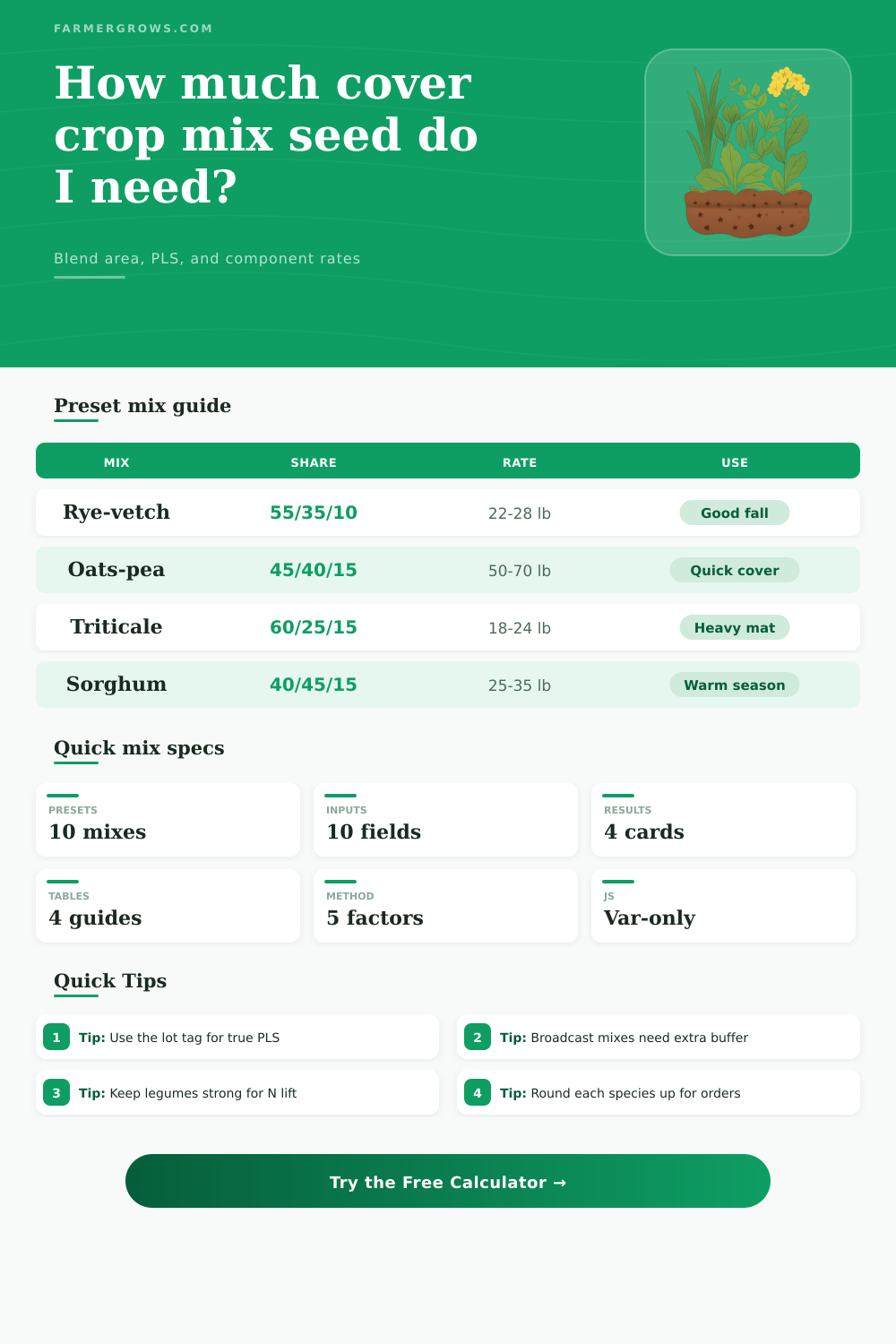
| Rye + vetch + radish | 44 / 18 / 8 / 4 | Fall cover | Fast canopy |
| Oats + peas + radish | 32 / 28 / 10 / 6 | Spring cover | Quick lift |
| Triticale + clover | 38 / 22 / 10 / 4 | Grazing | Balanced mix |
| Sorghum + cowpea | 26 / 22 / 0 / 12 | Summer biomass | Warm window |
| Component | Common species | Imperial rate | Metric rate |
|---|---|---|---|
| Cereal | Rye, oats | 18-55 lb/ac | 20-62 kg/ha |
| Legume | Vetch, pea | 10-35 lb/ac | 11-39 kg/ha |
| Brassica | Radish, turnip | 4-12 lb/ac | 4-13 kg/ha |
| Broadleaf | Flax, chicory | 2-15 lb/ac | 2-17 kg/ha |
| Method | Factor | Best when | Tradeoff |
|---|---|---|---|
| Drill | 1.00x | Firm seedbed | Least waste |
| Air seeder | 1.05x | Even spread | Small cushion |
| Broadcast | 1.15x | Fast work | More buffer |
| Overseed | 1.20x | Frost seed | Most loss risk |
| Pack | Weight | Count | Note |
|---|---|---|---|
| 50-lb bag | 50 lb | 1.00 | Imperial pack |
| 25-kg bag | 55.1 lb | 1.10 | Metric pack |
| Bulk tote | 1000 lb | 20.00 | Large order |
| Mini lot | 25 lb | 0.50 | Sample seed |
Plan multi-species cover crop blends by area, seed rate, PLS, and establishment method. Compare preset mixes, review component totals, and size bags before you order seed.
A cover crop mix calculator is a tool that will help a person to determine the amount of seed that is required for a specific number of acres. Calculating the amount of seed that is required can be dificult for a grower due to the different species of cover crops, the different methods that may be used to seed the fields, and the different conditions of the fields in which the cover crops will be planted. A cover crop mix calculator can make it easier for a grower to determine how much seed to purchase by automatically performing the mathematical calculations necessary to determine that value.
Cover crops are planted within the soil in the years between the growth of cash crops. Cover crops help to create organic matter within the soil, they remove the excess nitrogen from the soil, and they help to break pest cycles within that soil. The cover crops contain several different species, so the grower must ensure that each species is included in the proper amount.
How to Use a Cover Crop Mix Calculator
For instance, if there is too much of a cereal grain species within the cover crop mixture, that species may smother the legume species. Similarly, if there are no broadleaf plant species within the mixture, the fields may not provide enough opportunities for pollinators to gain their forage. Some of the types of plants that may be included in a cover crop mixture include cereals, legumes, brassicas, and broadleaf plants.
Cereal grains, such as wheat, triticale, and rye, are used due to their rapid rate of establishment within the soil, as well as their deep roots that hold the soil from eroding from either wind or rain. Legumes, such as vetch or peas, is included to the mixture for their ability to fix nitrogen within the soil, reducing the amount of fertilizer that is required of the fields in the spring. Brassica species, like radish or turnip, are included into the mixture both for their abilities to break up compacted soils, as well as to die within the winter in such a way that the fields may be easily tilled.
Finally, broadleaf plants, like flax or chicory, help to remove different nutrients from the soil, increasing the diversity of plant within the fields. The method in which the seeds are to be seeded has an impact upon the amount of seed that is required to cover the acres that are to be treated with the cover crop mixture. Methods like drilling allow for the seeds to be placed directly into the soil, allowing for the use of less seed.
Methods like broadcasting scatter the seeds throughout the fields, but lead to the potential loss of some of those seeds due to birds or poor contact with the soil. Thus, more seed must be used in this method. Finally, overseeding methods involve planting into established crops, like corn.
More seed is required for overseeding due to the competition between the cover crop seeds and the established crops. Another factor that must be considered is the Pure Live Seed (PLS) rate of the seeds that are to be planted. PLS is a measurement of the amount of live seed within a batch of seed.
Most seed recommendations indicate the amount of seed to use if the seeds germinates perfectly. No batch of seed can germinate at such a perfect rate. Thus, the grower can use the PLS percentage to adjust the rate at which the grower plans to seed the acres.
Additionally, some extra seed may be purchased to account for the headlands within each field, as well as in case of any mishaps or issues with the seeding process. For instance, if the base rate for a specific mixture of cover crops is 20 pounds of seed per acre, an additional 5 pounds of seed may be purchased to ensure that there is enough seed to successfully establish the cover crops. A cover crop mix calculator considers different factors to determine how many pounds of cover crop seed is required for a field, as well as how many bags of that seed the grower is required to purchase.
These factors may include the rate at which the fields are to be seeded, the amount of soil residue within the fields, and the PLS rate for the seed mixture. For instance, an equation to calculate the amount of seed that is to be planted may include multiplying the base rate by a factor that reflects the seeding method, the soil residue, and the PLS rate for the seeds. The calculator will provide the total pounds of seed that is required, as well as the total number of bags of seed that the grower should purchase.
Many of these calculators consider different “presets” that are pre-determined recommendations for specific mixtures of cover crops. For instance, one of the presets may be a mixture of oats, peas, and radish. In addition to the factors that the calculators consider, there are additional factors that are important to consider when planning to plant a cover crop mixture.
For instance, the time in which the cover crops are to be planted can have an impact upon how successful the cover crops are with performing their various functions of the soil. If the cover crops are planted too late in the season, they may not have time to perform their necessary processes. Soil tests are another factor that should of been considered prior to seeding.
For instance, if the soil tests indicates that the soil within the fields contain too much nitrogen, additional legume cover crops will need to be planted. Finally, the cover crop mixture should be considered in relation to the crops that will be planted into those fields. For instance, if brassica crops were just planted into the fields, a mixture that contains more of those species may be used for the fields to break up any compaction created by the brassica crops.
Conversely, if soybean crops were just planted into those fields, a mixture that contains more cereal grains will be beneficial for covering the fields quickly with organic material. Some common mistakes made by farmers when planting cover crops include reliance upon only a single species of cover crop, and ignoring the PLS measurements for the seeds. In each of these cases, the farmers will not gain the benefits that they require of the cover crops.
Additionally, the farmers will waste their money by purchasing the seeds by weight rather than live seed weight. Thus, to avoid these common mistakes by farmers, using a calculator to determine the amount of each species of cover crop that should be planted will ensure that the farmers do not make these mistakes when preparing their fields.