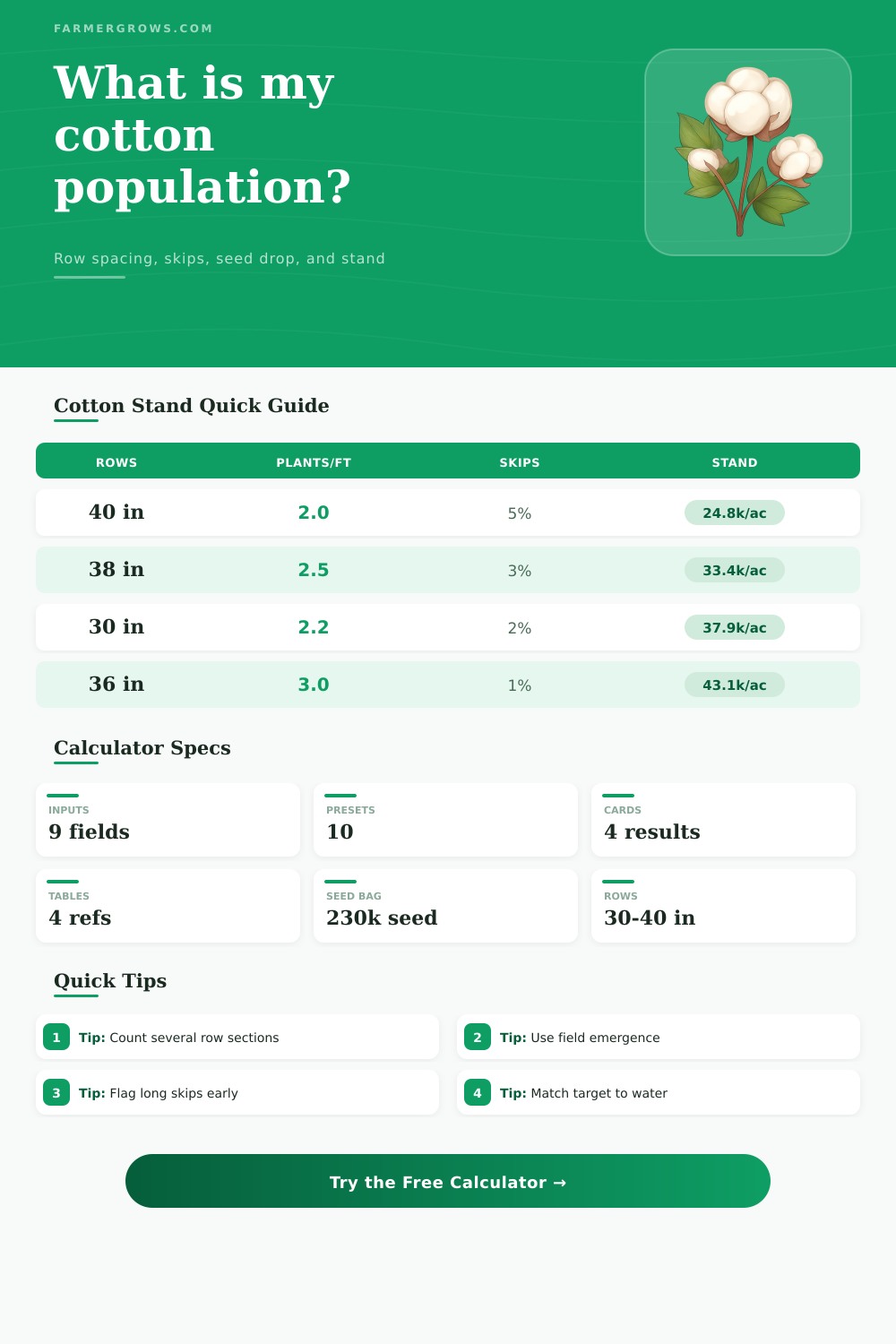
Cotton Plant Population Calculator
Estimate cotton plants per acre from row spacing, plants per row foot, skip percentage, emergence, seed drop, variety type, irrigation zone, target stand, and planted acres.
Count live cotton plants in multiple row sections after emergence is stable. This tool converts plants per row foot into a field-average stand, adjusts for skipped rows, compares the result with your target, and scales seed needs by acres.
Cotton Stand Results
Your cotton stand estimate will appear here.
| Row spacing | Row feet per acre | 2 plants/ft | 3 plants/ft |
|---|---|---|---|
| 30 inches | 17,424 ft/ac | 34,848 plants/ac | 52,272 plants/ac |
| 36 inches | 14,520 ft/ac | 29,040 plants/ac | 43,560 plants/ac |
| 38 inches | 13,755 ft/ac | 27,511 plants/ac | 41,266 plants/ac |
| 40 inches | 13,068 ft/ac | 26,136 plants/ac | 39,204 plants/ac |
| Seed drop | 75% emergence | 85% emergence | Use case |
|---|---|---|---|
| 2.5 seeds/ft | 1.9 plants/ft | 2.1 plants/ft | Dryland conservative stand |
| 3.0 seeds/ft | 2.3 plants/ft | 2.6 plants/ft | Common balanced setting |
| 3.5 seeds/ft | 2.6 plants/ft | 3.0 plants/ft | High target or cool soil |
| 4.0 seeds/ft | 3.0 plants/ft | 3.4 plants/ft | Narrow row or replant window |
| Water zone | Typical target | Stand note | Calculator use |
|---|---|---|---|
| Dryland | 20,000-32,000/ac | Conserve soil moisture | Use lower seed drop when uniform |
| Limited irrigation | 28,000-40,000/ac | Balance fruiting and water | Watch skips and late emergence |
| Full irrigation | 32,000-48,000/ac | Supports stronger canopy | Keep row closure in range |
| Drip or precision | 36,000-52,000/ac | High management system | Use variety-specific limits |
| Final stand | Uniformity | Risk level | Field action |
|---|---|---|---|
| Under 18,000/ac | Patchy or long skips | High | Scout plants, calendar, and replant cost |
| 18,000-28,000/ac | Mostly even | Moderate | Often manageable with good weather |
| 28,000-45,000/ac | Even rows | Low | Common target band for many systems |
| Over 50,000/ac | Dense canopy | Management | Review growth regulator and water plan |
Tip: Count at least three representative zones, then count weak areas separately. Cotton can compensate for a thin stand better when gaps are short and plants are healthy.
Tip: Do not use seed tag germination alone as emergence. Cold soil, crusting, seedling disease, insect pressure, and planter depth can make field emergence much lower.
Determining the correct number of cotton plant per acre is an important task. The number of cotton plants per acre can impact the growth of the cotton crops throughout the season. If there are too few cotton plant per acre, then the cotton plants will not fill the acre.
If there are too many cotton plant per acre, the cotton plants will compete for the available light and water resources for the acre. When cotton plants compete for light and water, it is essential to spend more time managing the height of the cotton plants and the setting of the boll. A person must align the inputs to the cotton crop to the conditions in the acre to ensure that the cotton plant grow correctly in that specific acre.
How to Calculate Cotton Plants per Acre
Another important factor to consider when planting cotton is the row spacing. The row spacing determines the number of linear feet of row that will exist in each acre. If the rows are wider than desired, there will be fewer linear feet of row per acre.
Furthermore, if there are skip in planting rows, there will be fewer rows that is actually planted into the acre. The skip percentage determine how many fractions of rows are actually planted. Using this percentage will allow a person to calculate the effective row feet that will contain the cotton plants.
The final population of cotton plants per acre will change based on the effective row feet. The plants per row foot is a measurement that many people will take when they are in the field. However, this measurement might be misleading if it is obtained only from a few spots in the field.
Cotton plants will compensate for a few space in the row. However, long stretches of the field without cotton plants will result in a loss of the cotton crop yield. A person should count the number of cotton plants in several different zones of the field to find the field average for cotton plants.
Furthermore, any areas that contain fewer cotton plant should be planted separately so that the calculator can determine the correct number of cotton plants for those areas. Seed drop is another important process that will determine the number of cotton plants in the acre. Furthermore, emergence will also impact the number of cotton plants.
The number of cotton seeds that are dropped into the field is referred to as the seed drop. However, the emergence is the number of cotton plants that emerge from the ground based on the soil temperature, moisture, and any disease that may have impacted the planted seeds. The calculator will use the emergence percentage to calculate how many live cotton plant will emerge based on the number of cotton seeds that were dropped into the field.
Furthermore, the calculator will allow a person to set the number of cotton plants that is desired in each acre. Based on the number of cotton plants that is desired in each acre, the calculator will provide the number of seeds that must be dropped into the field. This allows people to decide whether to change the settings of the planter or if they will accept the lighter stand of cotton plants that may grow.
The type of cotton variety that will be grown in the acre and the type of irrigation will also impact the number of cotton plants per acre that is desired. For instance, if an individual intends to grow a compact upland cotton plant, then the population of cotton plants per acre can be higher because the drip irrigation system will assist in the growth of the cotton plants and the cotton bolls. In contrast, if the variety of cotton that is to be grown is a dryland variety, it may require more space for the cotton plants to branch out and perform its photosynthesis if the stored moisture in the soil is all that will be used to grow the cotton plants.
The calculator will use the ranges of population for each type of cotton plant to determine whether the actual population of cotton plants matches the target for that acre. The tables that are included in the calculator can help a person to quickly determine the different factor for the cotton farm. These tables will include the number of row feet that will be created by each type of row spacing.
Furthermore, these tables will include the number of plants that will emerge from the ground based on the number of cotton seeds that are dropped into the ground. Additionally, these tables can show how various zones within the field will impact the target number of cotton plant that will grow in that field. These tables are not a replacement for the person going into the field to inspect the cotton plants.
However, they can provide a person with a quick understanding of whether or not the number of cotton plants per acre is within normal limit for the acre before taking any further action. Another important factor in determining the number of cotton plants that will grow in each acre is the skip rate. Skips occur when a planter intentionally skip some of the rows or when the rows are skipped due to an issue with the planter.
The calculator allows a person to enter a percentage that represents the number of skip that there will be in the field. This is an essential part of determining the number of cotton plants that will grow per acre because skipping some of the rows will reduce the amount of rows that contain cotton plants. The calculator calculates the total number of cotton seeds that will be required for the acres that are to be planted.
The total number of cotton seeds is calculated based on the number of seeds that will drop into the field and the fraction of the planter that will actually plant the seeds. This number can be compared with the number of cotton seeds that are required to reach the target number of cotton plants per acre. This will allow a person to understand the number of bag of cotton plants that will be used for the acres.
Furthermore, this calculation will allow a person to compare the number of bags of cotton plants to the number of bags of seed that would of been required if there were changes in the target number of cotton plants per acre or the number of cotton plants that emerge from the ground. Because the cost of bags of cotton plants is a fixed cost, these changes will impact the total cost of cotton plants for that person. The final test of a stand calculator is whether the calculations that the calculator performs are accurately reflected in the field after two week of planting.
Cotton plants will compensate for some skipped area in the field. However, the compensation only works well if the plants in those areas are of similar varieties with the remaining cotton plants in the field. Furthermore, if the weather condition have been good during this two week period, the compensation will be more effective.
A stand of cotton plants that is below the target that is calculated with the calculator may result in a good yield of cotton after harvesting the crop. However, planting the same number of cotton plants in a different field with fewer plant and with long skips may result in a loss of money for the cotton farmer. Thus, the calculator may provide accurate estimates and calculations of cotton plants that are to grow in each acre.
However, the decision of whether or not to plant cotton in certain areas of the field belongs to that individual who goes into the field to plant and care for the cotton plant.