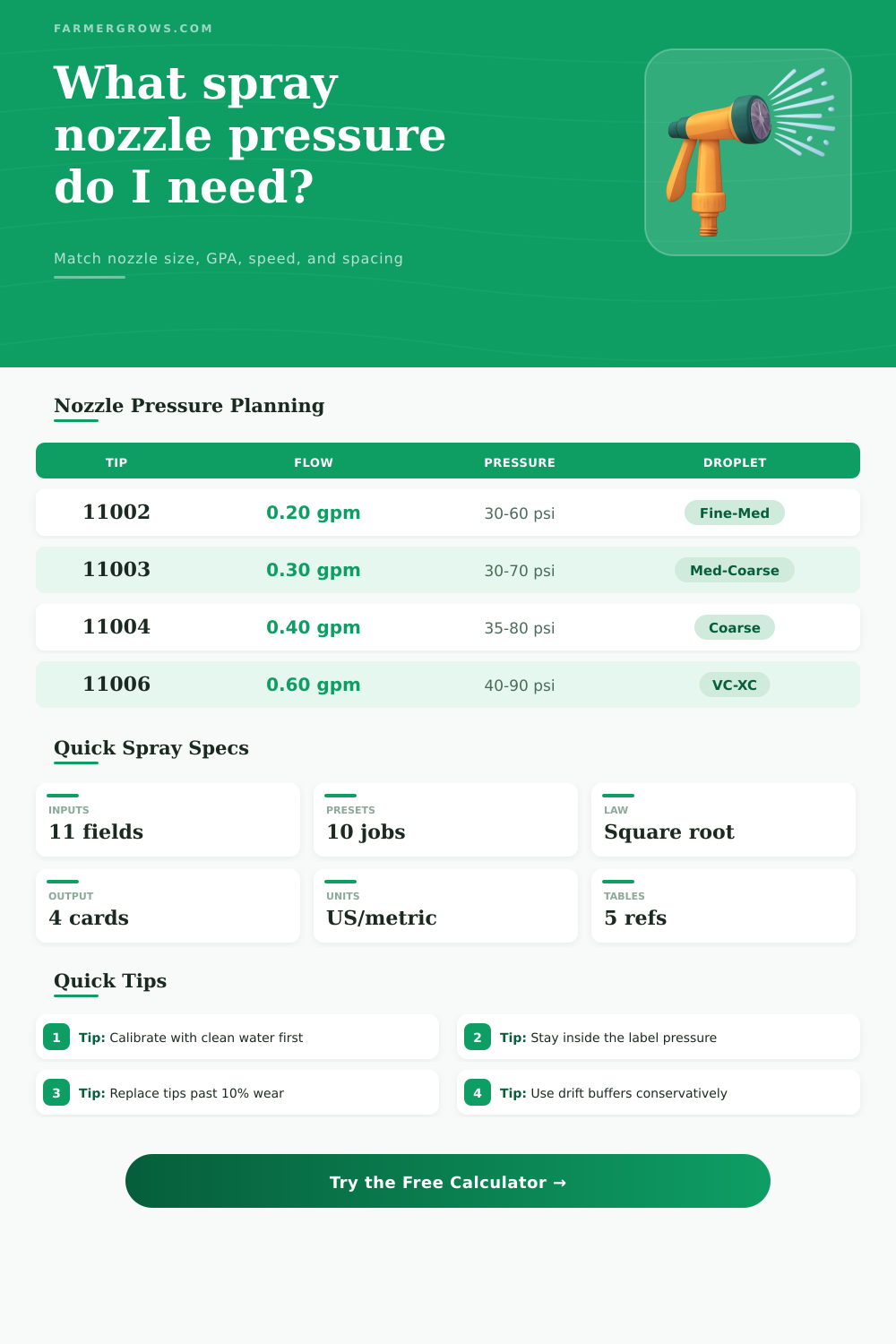
Spray Nozzle Pressure Calculator
Estimate required nozzle pressure from target GPA, ground speed, nozzle spacing, and ISO tip size, then compare actual output, boom flow, tank coverage, and droplet class.
Use this calculator for boom sprayer arithmetic with water-like spray mixes. Flow through an orifice follows the square-root pressure law, so doubling pressure does not double nozzle flow.
Spray Pressure Results
Your nozzle pressure, flow, and application rate will appear here.
| Pressure Change | Flow Multiplier | Example from 0.30 GPM | Practical Meaning |
|---|---|---|---|
| 20 psi from 40 psi | 0.707x | 0.212 gpm | Half pressure gives about 71% of rated flow. |
| 30 psi from 40 psi | 0.866x | 0.260 gpm | Useful when lowering drift risk, but pattern may weaken. |
| 40 psi rating point | 1.000x | 0.300 gpm | ISO color size flow is normally stated at this pressure. |
| 60 psi from 40 psi | 1.225x | 0.367 gpm | Higher pressure increases flow and usually makes finer droplets. |
| 80 psi from 40 psi | 1.414x | 0.424 gpm | Double pressure gives only 41% more flow, not double. |
| ISO Size | Common Color | Rated Flow at 40 psi | Typical Broad-Acre Use |
|---|---|---|---|
| 01 | Orange | 0.10 gpm / 0.38 L/min | Very low volume, slower speeds, specialty work. |
| 015 | Green | 0.15 gpm / 0.57 L/min | Low GPA or narrow spacing applications. |
| 02 | Yellow | 0.20 gpm / 0.76 L/min | 10 GPA near 6 mph on 20 in spacing. |
| 025 | Lilac | 0.25 gpm / 0.95 L/min | 12 to 15 GPA at moderate field speeds. |
| 03 | Blue | 0.30 gpm / 1.14 L/min | Common 15 GPA herbicide setup. |
| 04 | Red | 0.40 gpm / 1.51 L/min | Higher volume herbicide or drift-reduction tips. |
| 05 | Brown | 0.50 gpm / 1.89 L/min | 20 GPA coverage or faster travel speeds. |
| 06 | Gray | 0.60 gpm / 2.27 L/min | High-volume carrier or liquid fertilizer work. |
| 08 | White | 0.80 gpm / 3.03 L/min | Very high carrier volume or wide spacing. |
| 10 | Light blue | 1.00 gpm / 3.79 L/min | Large-orifice fertilizer and specialty broadcast jobs. |
| Target Setup | Required Flow Formula | Needed GPM per Nozzle | Closest ISO Size at 40 psi |
|---|---|---|---|
| 10 GPA, 6 mph, 20 in spacing | 10 x 6 x 20 / 5940 | 0.202 gpm | 02 yellow |
| 12 GPA, 6.5 mph, 20 in spacing | 12 x 6.5 x 20 / 5940 | 0.263 gpm | 025 lilac to 03 blue |
| 15 GPA, 6 mph, 20 in spacing | 15 x 6 x 20 / 5940 | 0.303 gpm | 03 blue |
| 15 GPA, 8 mph, 20 in spacing | 15 x 8 x 20 / 5940 | 0.404 gpm | 04 red |
| 20 GPA, 6 mph, 20 in spacing | 20 x 6 x 20 / 5940 | 0.404 gpm | 04 red |
| 20 GPA, 7 mph, 20 in spacing | 20 x 7 x 20 / 5940 | 0.471 gpm | 05 brown |
| 25 GPA, 6 mph, 20 in spacing | 25 x 6 x 20 / 5940 | 0.505 gpm | 05 brown |
| Nozzle Class | Typical Pressure Range | Likely Droplet Trend | Use Carefully For |
|---|---|---|---|
| Standard flat fan / XR | 20 to 60 psi | Fine to medium; finer as pressure rises | Contact products needing coverage when drift risk is low. |
| Turbo flat fan / TT | 30 to 90 psi | Medium to coarse across common field pressures | General herbicide work needing a broad pressure window. |
| Air induction / AI | 40 to 100 psi | Coarse to very coarse with air-filled drops | Systemic products and drift reduction when label permits. |
| Turbo air induction / TTI | 30 to 100 psi | Very coarse to extremely coarse | Drift-sensitive sites where coverage tradeoffs are acceptable. |
| Twin flat fan | 30 to 70 psi | Fine to medium, depending on style | Canopy penetration, fungicides, and dense leaf surfaces. |
| Flood or fertilizer fan | 10 to 40 psi | Coarse to extremely coarse | Liquid fertilizer and low-clog broadcast work. |
| Check Item | Field Method | Pass Range | What to Do If Off |
|---|---|---|---|
| Nozzle output | Catch each tip for the same seconds at target pressure | Within 10% of chart or average | Clean, replace, or verify pressure at boom. |
| Tip-to-tip uniformity | Compare left, center, and right boom sections | Most tips within 5% of boom average | Look for worn tips, plugged strainers, hose restrictions. |
| Ground speed | Time a measured course with tank partly loaded | Actual speed used in GPA math | Recalculate pressure or adjust controller calibration. |
| Pattern overlap | Check boom height and fan angle with water | Even overlap across boom | Set height by nozzle angle and spacing. |
Pressure tip: Use pressure mainly for fine adjustment. If required pressure falls outside the nozzle's recommended range, change tip size, speed, spacing, or target GPA instead of forcing the pressure.
Calibration tip: A worn nozzle often applies more carrier than expected while still looking normal. Catch-test several nozzles, compare to chart flow, and replace the set when wear is past about 10%.
Set your nozzle pressure correctly to keep droplets in range specified on the label while maintaining proper spray direction. The wrong nozzle pressure lead to a collapsed spray pattern (too low) or drift fines exceeding buffer zone limits (too high). This one variable link carrier rate, spacing, travel speed and nozzle size. Right means saving time and product.
With four or five field numbers of input, the calculator do the math. You’ll see instantly how much pressure is needed to produce your desired gallons per acre, based off the square-root relationship controlling flow out of any orifice. Then it tells you what actual output of that nozzle will be at intended pressure. If charts and your controller say one thing and it says something else, use this to know exactly what’s coming from nozzle.
How to Set Nozzle Pressure Correctly
After testing the tank with clear water for comparison, you’re ready to go load up. That way you catch pressure loss or wear before you get streaks in field. We all know doubling the pressure doesn’t double the flow. But what we don’t see as easy is how rapidly range of droplets shifts under such increased pressure. At 40 pounds a typical flat-fan tip rests snugly in middle of road and begins to shift into finer droplets as you hit sixty pounds. The increase in flow here are just twenty percent at this tipping point. When the calculator identify a required pressure that lies beyond the typical operating range for nozzle family, it typically means that a pressure increase is not worth it compared than changing tips and/or speeds.
Speed and spacing do matter; each nozzle will have to puts out more liquid for narrower spacing or faster travel speeds. Six miles per hour with 20-inch spacing needs noticeably less flow per tip compared to eight miles per hour with that same spacing. Written out it’s easy math, but having the calculator eliminate any possible decimal-place mistake while racing against fading light. It also converts the resulting acres per tank into minutes of run time (which can be helpful when deciding if you want to switch tanks or just top them off at next headland).
Other factors also affect results, such as material choice and wear life. An abrasive carrier with ceramic tips lasts longer but costs more initially. Most broad-acre work stainless tips is forgiving down to the tenth-percent wear point. Beyond that point, the pattern opens wider and output begin to drift upwards. The calculator does not measure wear. But the catch-test field it offers will demonstrate the wear difference before you load up again.
Finally, the goal with the pressure number is to ensure it stay within the range accepted by both the label and the nozzle. That’s what the calculator gives you in one place. But then again, there is still the ultimate field test which is whether or not the ground show a pattern and does it cover the entire boom evenly?
Make sure those strainers are kept open and tips are kept clean. Hold the pressure at what the label and math say. Do not spray the neighbor’s fence row. On the crop.