Sprayer Speed Calculator
Find target ground speed, calibration-pass time, actual GPA from a timed run, boom output, tank coverage, and drift-risk notes for field sprayers.
Use this as a calibration worksheet before spraying. Confirm nozzle output with a catch test, drive the timed course with the sprayer loaded, and follow the pesticide label, PPE, buffer, weather, and drift rules for the actual product.
Sprayer Speed Results
Speed is calculated from pressure-adjusted nozzle flow, target rate, and nozzle spacing, then compared with the timed calibration pass.
| Speed | Time for 100 ft | Time for 200 ft | Time for 300 ft | Metric equivalent |
|---|---|---|---|---|
| 4 mph | 17.0 sec | 34.1 sec | 51.1 sec | 6.4 km/h |
| 5 mph | 13.6 sec | 27.3 sec | 40.9 sec | 8.0 km/h |
| 6 mph | 11.4 sec | 22.7 sec | 34.1 sec | 9.7 km/h |
| 8 mph | 8.5 sec | 17.0 sec | 25.6 sec | 12.9 km/h |
| 10 mph | 6.8 sec | 13.6 sec | 20.5 sec | 16.1 km/h |
| 12 mph | 5.7 sec | 11.4 sec | 17.0 sec | 19.3 km/h |
| Target rate | Nozzle flow | Spacing | Calculated speed | Typical use |
|---|---|---|---|---|
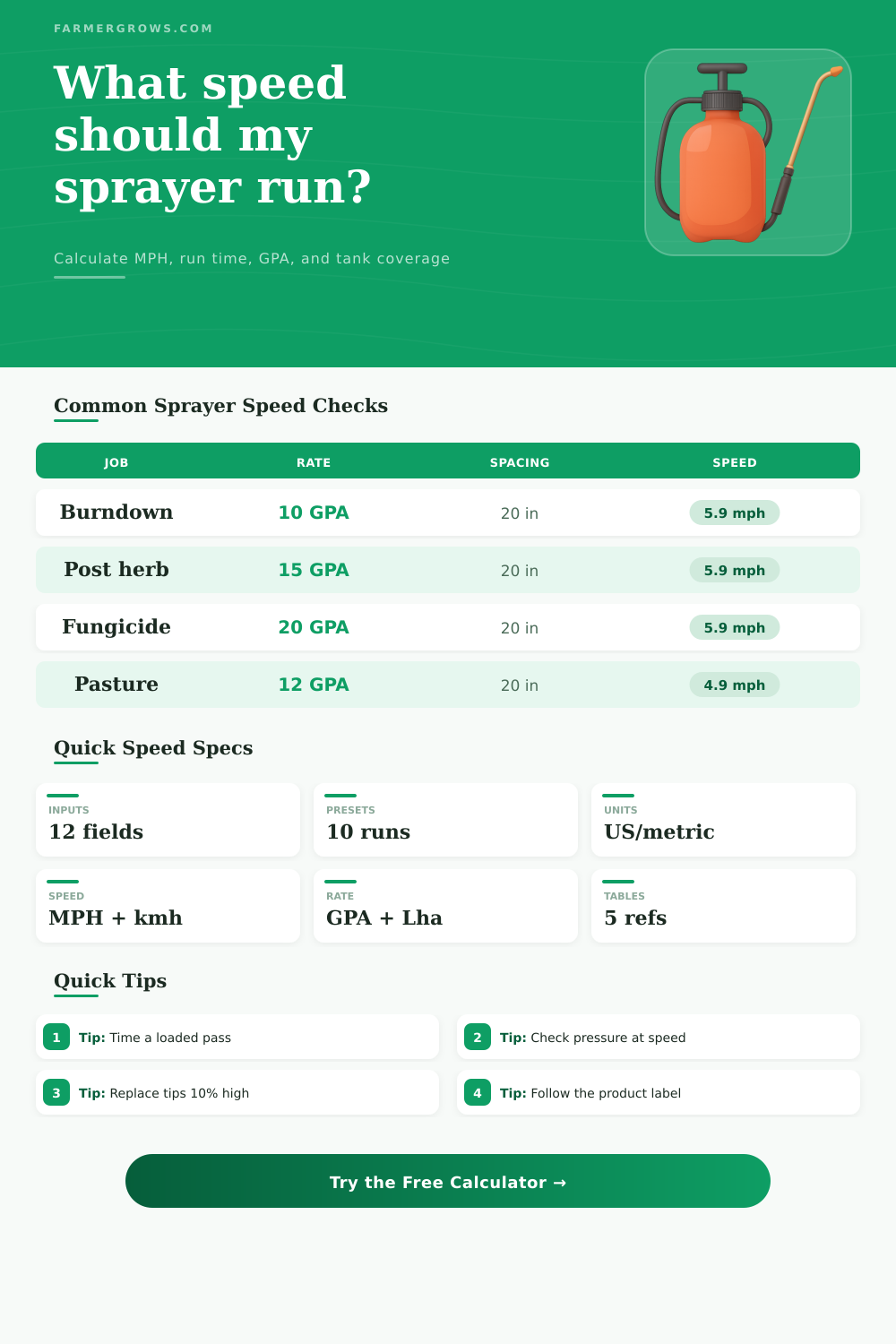
| 10 GPA | 0.20 GPM | 20 in | 5.94 mph | Low-volume systemic herbicide |
| 12 GPA | 0.20 GPM | 20 in | 4.95 mph | Pasture or ATV boom calibration |
| 15 GPA | 0.30 GPM | 20 in | 5.94 mph | Common post-emergence herbicide |
| 20 GPA | 0.40 GPM | 20 in | 5.94 mph | Coverage sprays and fungicide |
| 30 GPA | 0.50 GPM | 20 in | 4.95 mph | Vegetable or dense canopy coverage |
| ISO nozzle size | Color | Flow at 40 psi | Speed at 15 GPA, 20 in | Speed at 20 GPA, 20 in |
|---|---|---|---|---|
| 110015 | Green | 0.15 GPM / 0.57 L/min | 2.97 mph | 2.23 mph |
| 11002 | Yellow | 0.20 GPM / 0.76 L/min | 3.96 mph | 2.97 mph |
| 11003 | Blue | 0.30 GPM / 1.14 L/min | 5.94 mph | 4.46 mph |
| 11004 | Red | 0.40 GPM / 1.51 L/min | 7.92 mph | 5.94 mph |
| 11005 | Brown | 0.50 GPM / 1.89 L/min | 9.90 mph | 7.43 mph |
| 11006 | Gray | 0.60 GPM / 2.27 L/min | 11.88 mph | 8.91 mph |
| Boom width | Nozzles at 20 in | Ac/hr at 5 mph | Ac/hr at 8 mph | Gear/RPM note |
|---|---|---|---|---|
| 20 ft | 12 | 12.1 theoretical | 19.4 theoretical | Good ATV and utility boom range |
| 30 ft | 18 | 18.2 theoretical | 29.1 theoretical | Keep throttle steady on turns |
| 45 ft | 27 | 27.3 theoretical | 43.6 theoretical | Watch pressure drop across sections |
| 60 ft | 36 | 36.4 theoretical | 58.2 theoretical | Common gear lock near 5 to 8 mph |
| 90 ft | 54 | 54.5 theoretical | 87.3 theoretical | Needs stable boom and smooth terrain |
| Field condition | Efficiency guide | Drift risk | Speed note | Calibration action |
|---|---|---|---|---|
| Large square fields | 75% to 85% | Low to moderate | Target speed is easier to hold | Time a long loaded pass |
| Short irregular fields | 55% to 70% | Moderate | Turns reduce effective acres per hour | Use field efficiency input |
| Rough pasture | 50% to 65% | Moderate | Slow enough to control boom bounce | Calibrate on similar ground |
| Wind 10 to 15 mph | 65% to 80% | High | Speed can increase wake and drift | Check label wind limit first |
| Fine droplets | 65% to 80% | High | Avoid extra pressure just to go faster | Consider nozzle or weather change |
Calibration tip: Mark a 100 to 300 ft course, fill the sprayer at least half full, reach field RPM before the start mark, and average two passes in opposite directions.
Safety caveat: Speed math never overrides the label. Stop if wind, inversions, sensitive areas, PPE, nozzle class, buffer zones, or local rules do not fit the product.
The right spray setup matter, set your sprayer at the right speed so that it apply properly.
If you drive too slowly, you waste time refilling and risk applying to much product. If you drive too fast, coverage will be thin, especially with heavy crops. It’s simple in theory, the math between target rate, spacing, pressure, and nozzle flow. But out there in the field, flow is affected by pressure changes, making it complicatedly.
How to Set the Right Spray Speed
Gallons per acre are how most operator learn their target rate. When you start combining spacing, pressure and nozzles, it’s figuring out what speed holds that constant rate of application. And pressure does not move in a straight line with speed. It can varies by just a pound or two per square inch, but that is enough to change the output significant and throw your whole pass off.
The other factor? Nozzle spacing also matters because with banded apps, you’re only using treated width. Get all this wrong, and the rate you calculated on paper won’t be the rate that lands on ground.
Theory becomes practice on a timed calibration run. Run tank at least half full. Pick a course and make a mark. Drive it out at working speed. Time how many seconds it takes to cover distance. The number of seconds will let you know if your throttle and gear provide the speed the nozzles are designed for.
Are you several percent too slow or fast? Adjust the pressure, change tips, select a new gear then load tank up for real work. And then there’s tank coverage and good field capacity that add to the equation. A larger tank sounds better until you remember that turns, overlaps, and refill time all reduces the acres you finish per hour.
You never cover 100 percent of an acre all the time. Short, odd-shaped fields and rough ground lower your efficiency far below what your flat sheet of paper say. The wind may not seem bad back at the farm but get up in the air with the boom going and fine spray gets blown sideways. Reducing drift by adjusting droplet sizes can change your coverage rate, which means you will need more carrier.
After plugging in the operating pressure, nozzle flow, spacing and distance and time from your calibration pass, calculator above does all the work for you. It displays the target speed, timed run measured rate, tank acres and an estimated field capacity based off your efficiency setting. That way you can see all this info in one place and judge if your terrain and tractor will work well with what nozzles are supposed to do.
Once a boom is upright and the rate controller catches up, common sprayer speeds varies from five to ten mph. Going slower results in greater coverage on contact products; however, it reduce acres per tank. Going faster makes the tank last longer, but it also increases boom bounce and the chance that parts of field will recieve less than desired rate. Optimal speed is the one you can repeat throughout the field with the nozzles operating within their designed pressure range.
But just because it’s calibrated doesn’t mean you don’t read the label. There are still limits to what you’ll be able to do each day due to wind, personal protective equipment guidelines and buffer zone around waterways. It simply validates that the mechanical part of your job matches the agronomic objective. If your calculated speed align closely with the timed pass, you would of a far higher likelihood that the rest of your spray day will go as intended.