Companion Planting Calculator
Compare a main crop and companion crop by spacing, bed size, interplant ratio, maturity overlap, shade tolerance, family pressure, and pest-benefit score.
Use this as a garden planning estimator before seeding or transplanting. The score combines known companion relationships with spacing pressure, maturity timing, shade fit, and your expected pest-control benefit.
Companion Planting Results
Run the calculator to compare this crop pair.
| Crop | Typical spacing | Days | Shade fit | Common role |
|---|---|---|---|---|
| Tomato | 18-30 in | 70-85 | Low | Main crop, tall canopy |
| Basil | 8-12 in | 60-75 | Medium | Aromatic companion |
| Carrot | 2-4 in | 60-80 | Medium | Root crop filler |
| Onion | 4-6 in | 90-110 | Low | Aroma and border crop |
| Cabbage | 18-24 in | 70-100 | Low | Main brassica crop |
| Dill | 8-12 in | 40-70 | Medium | Beneficial insect flower |
| Main crop | Companion | Expected score | Best layout | Why it works |
|---|---|---|---|---|
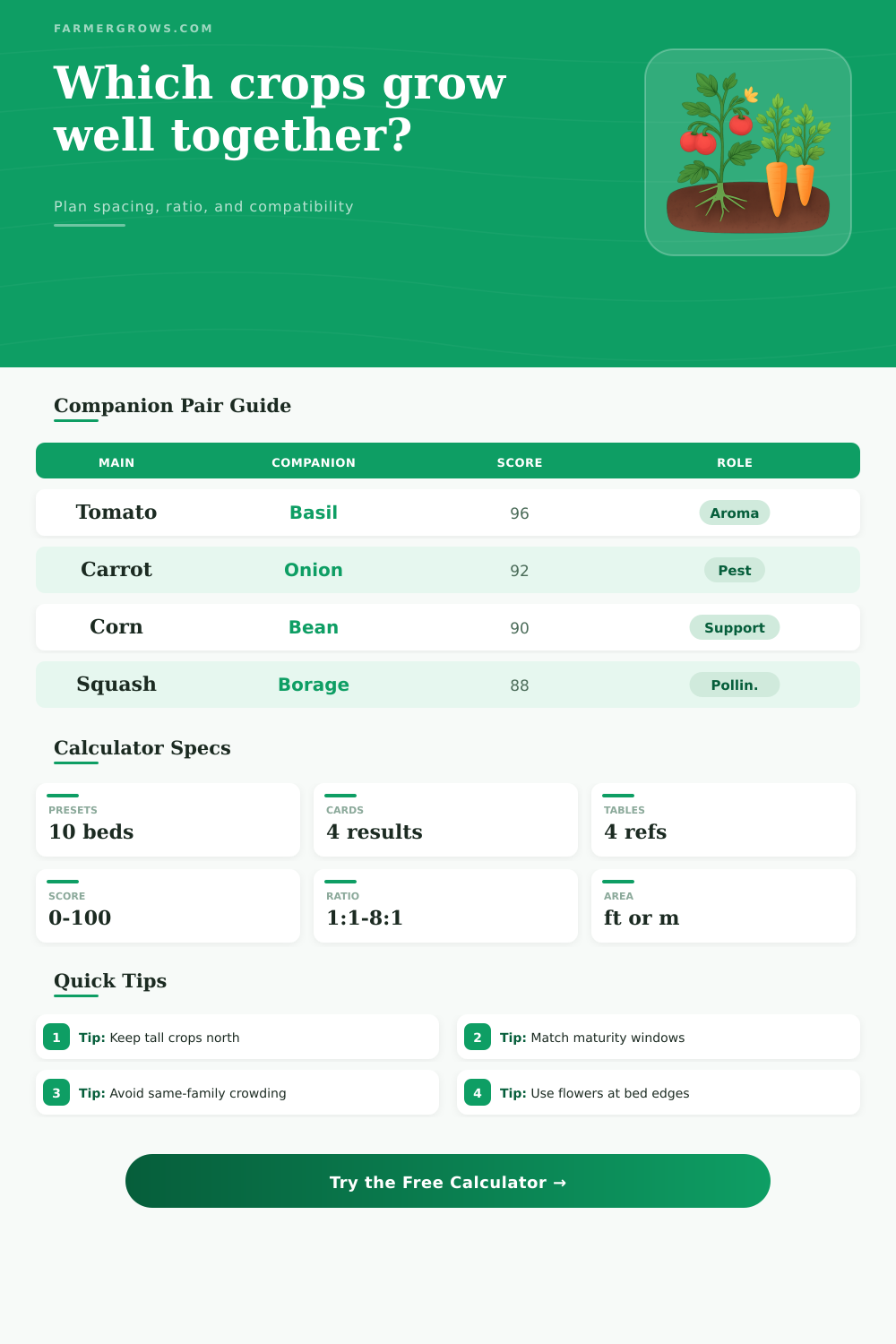
| Tomato | Basil | Very strong | Between plants | Aromatic foliage, compatible canopy, close harvest window. |
| Carrot | Onion | Very strong | Alternating rows | Different root profile and scent masking for fly pressure. |
| Cabbage | Dill | Strong | Scattered edge | Flowering umbels attract beneficial insects near brassicas. |
| Cucumber | Nasturtium | Strong | Bed edge | Flowering edge and aphid trap-crop function. |
| Corn | Bean | Strong | Block or row | Vertical support plus legume association when spacing is generous. |
| Squash | Borage | Strong | Outer hill | Pollinator draw without heavy root crowding. |
| Ratio | Use case | Spacing pressure | Good examples | Planning note |
|---|---|---|---|---|
| 1:1 | Equal crop value | High | Carrot and onion | Use only with narrow, compatible crops. |
| 2:1 | Primary crop focus | Medium | Tomato and basil | Good default for beds with one main harvest crop. |
| 3:1 | Flower support | Low | Pepper and marigold | Keeps companion visible without taking bed over. |
| 4:1 | Edge or trap crop | Low | Cucumber and nasturtium | Best when the companion runs along the border. |
| 6:1+ | Large crop spacing | Very low | Squash and borage | Place companion outside the hill or mound. |
| Factor | Strong range | Caution range | Score effect | Field adjustment |
|---|---|---|---|---|
| Days to maturity overlap | 0-20 days apart | 35+ days apart | Closer overlap lifts planning score | Use relay crops for wider timing gaps. |
| Shade tolerance | Medium to high below tall crop | Low below tall crop | Shade mismatch reduces compatibility | Move low-shade herbs to the south edge. |
| Pest-benefit score | 7-10 entered score | 0-3 entered score | Higher score adds up to 18 points | Use local pest history, not wishful thinking. |
| Bed fit | 70-95 percent use | 110+ percent use | Crowding subtracts sharply | Thin, widen spacing, or lower companion ratio. |
| Family pressure | Different crop families | Same family | Same-family pairs lose points | Rotate families between beds where possible. |
Protect the main crop: When a companion is mainly for pest or pollinator value, start with a lighter ratio and place it along the edge before moving it into the crop row.
Check shade and harvest timing: Tall crops can make good umbrellas for shade-tolerant greens, but low-shade herbs usually need open sun on the south or west side.
Companion planting is a method of planting different types of crops into the same garden beds. Companion planting is used for a variety of reasons. For instance, some companion planting arrangement may work because certain crops will protect other crops from pests, other crops will attract fewer pests to the garden, or some plants will do just fine sharing the same space in the garden bed as the other plants without competing with them for the same resource.
A companion planting calculator is a tool that can assist a person in determining the plan for their garden bed. Such a calculator asks a person to select several variable for the companion planting arrangement that they wish to create. These variables can include the spacing for the main crop and companion crop, the ratio of main to companion plants, the days to maturity for each type of crop, the shade tolerance for the companion plants, and the benefit that the companion plants will provide to the main crops in the garden.
How to Use a Companion Planting Calculator
The dimensions of the garden bed, specifically the length and width of the bed, are two variable that the calculator will require a person to select. These dimensions will determine the total area of the garden bed. The total area that is available in the garden bed will determine how many plant will be able to grow in that garden bed.
The main crop spacing and companion crop spacing will determine the distance that each plant needs from each other once the plants are mature. These variables will adjust automatic if a person decides to change either of the main crop spacing or companion crop spacing. The interplant ratio is another variable that a person will need to set in their garden bed.
For example, a ratio of 2:1 will require that a person plants twice as many main crops as companion crops. A person may decide on a 2:1 ratio if they wish to focus mainly upon the main crop for harvesting, and the companion crop will only be planted for scent, flowers, or border/edge protection. In addition to these variables, a person can select the days to maturity for each type of plant that is to be grown in the garden bed.
The days to maturity for each crop will help to determine how many days the crops will be growing simultaneously in the garden bed. If there are too many days between the maturity of each crop, there may be an issue with the shared resource among those plants. Another variable to select is the shade tolerance for the companion plants.
For instance, a person may decide to place companion plants that have a low tolerance for shade into a location that will be shaded by the main crop growing in that garden bed. These companion plants will struggle to grow due to the shade. However, if a person selects a shade tolerant green crop to be planted in the garden bed in this manner, the plants will do just fine in the shade that the main crop creates.
The pest-benefit score is one last variable to select. This number will weigh the benefit of the companion plants in the garden bed. For instance, if a person sets a high pest-benefit score for their companion plants, this means that those companion plants are to mask the scent of the main crop to attract beneficial insects, or to act as a trap crop for certain pests.
This variable will be incorporated into the final compatibility number between the main and companion crops. Finally, there are a few different layout option to select for the companion plants within the garden bed. The mixed planting layout will spread out the companion plants throughout the garden bed.
Another layout option is to select the edge placement for the companion plants. This will ensure that the companion plants are located on the border of the garden bed. This border could be used for trapping certain pests, or for acting as a border to exclude other type of plants from entering the garden bed.
Lastly, the alternate rows layout option is used for companion and main crops that have narrow roots. This will allow the plants to all share the same garden bed, without any issue with shading of the companion plants. Understory is another layout for companion planting, but only for those who can handle the reduced light level that such a layout imposes upon the companion plant.
The layout choice changes how the calculator estimates the use of space within the garden bed, so changing the layout will change the percent of the bed that will be fitted to the companion plants. It is possible for an individual to make the mistake of thinking companion planting is as simple as the addition of two good plant to an area that is to be planted with only one type of plant. In some instances, two plants will not make a good pair if they are from the same plant family, or if they require the same type of nutrient from the soil at the same depth within the soil.
The compatibility calculator accounts for these factor in its calculation of the compatibility score for each of the plant selections. For instance, plants with similar root zone receive a reduced compatibility score. Conversely, plants that have been proven to benefit from being planted together receive an increased compatibility score.
The individual can use these reference tables to ensure that the companion plants have a high compatibility score, because these tables list the known good companion plant pair. Beyond calculating the compatibility of each of the selected plants, the calculator also determine what is referred to as the bed pressure for the companion plants. If the total number of estimated plants for the bed creates space use that is above 100%, the compatibility score for the selected plants will decrease.
This is due to the fact that overcrowding of the plants increases the risk of disease for those plants. If, however, the percentage of the bed that is calculated to be used by the plants is significantly below 70%, then the bed is wasting space that could be used to grow either a second wave of one of the companion plants, or a relay crop. While the calculator incorporates many of the variables that may impact the success of a bed of companion plants, there are still other variables that is outside the scope of the calculator.
For instance, the calculator does not factor in the impact of soil temperature or rainfall on the growth of the plants. Additionally, the score for the pest-benefit for the companion plant is based upon the assumption that the companion plant will grow enough leaves or flowers to provide its benefit to the main crop. However, if the growing season is too short for the companion to perform its job, then the score for compatibility will also be affected.
Thus, while the companion plant calculator provides a score that indicates the compatibility of the companion plants, the individual must still personally monitor the companion plants to ensure that they are performing as calculated by the calculator. These reference tables also include information about each of the recommended companion plant pairs and the specific ways in which the plants should be arranged within the garden bed for the best growth for each of the plants. For instance, beans are recommended to be planted within or alongside corn plants, but only if the beans will be allowed to climb the corn plants without the beans plants shading the leaves of the corn plants.
Similarly, borage plants are recommended to be planted alongside squash plants, but only if the borage plants are positioned on the outer hill of the planting area to avoid competing with the squash plants for the use of the soil within the mound created by the squash plants. The benefit of using the companion plant compatibility calculator is that it forces the individual to make decision about the garden bed prior to actualy planting the garden. For instance, an individual can use the calculator to determine if adding more companion plants will provide benefit to the main crop, or if adding those companion plants will crowd the main crop.
An individual can also determine whether adding a relay crop that matures at a faster rate will enable those companion plants to be harvested prior to the main crop needing the space that those plants will occupy. These types of decisions are essential for the companion planting success, as the goal is to create a garden bed that produces more crops that are usable by the individual, with fewer problems with the plants in the bed, than if those same plants were grown in a monoculture. Thus, the calculator allows individuals to test the outcome of their proposed garden bed before actually beginning to plant the garden bed.