🏗 Cattle Panel Arch Calculator
Plan hoop barns and panel arch structures — panels, height, arches, and footprint
Quick Presets:
📐 Arch Structure Results
🚧 Material Summary
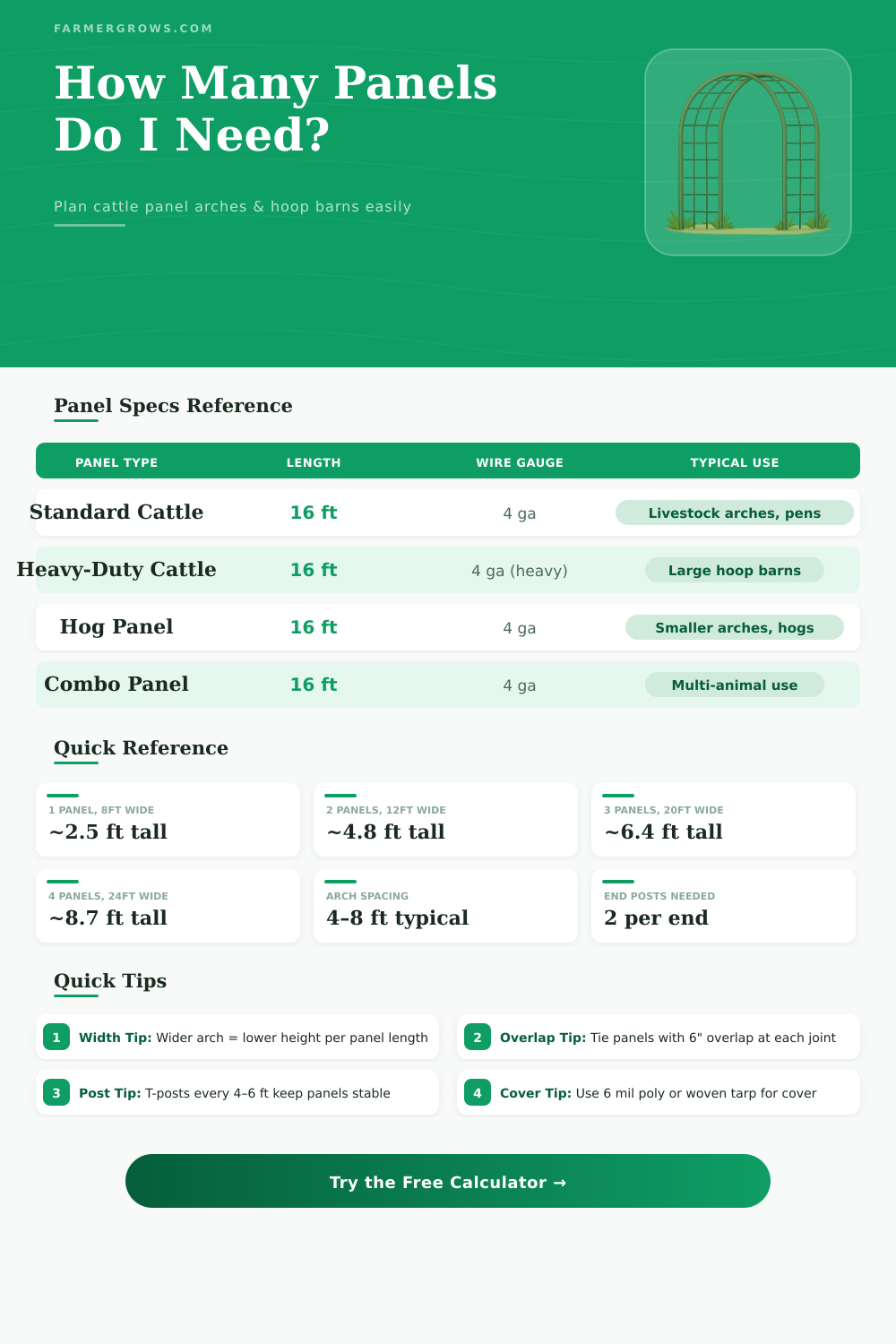
Panel Specifications
| Panel Type | Length | Wire Gauge | Typical Use |
|---|---|---|---|
| Standard Cattle Panel | 16 ft | 4 gauge | General livestock arches, garden arches |
| Heavy-Duty Cattle Panel | 16 ft | 4 gauge heavy | Large hoop barns, heavy livestock |
| Hog Panel | 16 ft | 4 gauge | Smaller arches, hogs, chickens |
| Combo Panel | 16 ft | 4 gauge | Multi-species, flexible spacing |
Arch Dimensions by Panel Count
| Panels Used | Arch Width (ft) | Est. Height (ft) | Sq Ft per 10 ft Length |
|---|---|---|---|
| 1 panel (16 ft) | 8 | ~2.5 | 80 |
| 1 panel (16 ft) | 10 | ~1.8 | 100 |
| 2 panels (32 ft) | 12 | ~4.8 | 120 |
| 2 panels (32 ft) | 16 | ~3.8 | 160 |
| 3 panels (48 ft) | 18 | ~6.4 | 180 |
| 3 panels (48 ft) | 20 | ~5.7 | 200 |
| 4 panels (64 ft) | 24 | ~8.7 | 240 |
| 4 panels (64 ft) | 30 | ~6.5 | 300 |
| 5 panels (80 ft) | 30 | ~10.2 | 300 |
Material Needs by Arch Count
| Arch Count | Panels (2 per arch) | Side T-Posts | End Posts | Ground Anchors |
|---|---|---|---|---|
| 3 | 6 | 8–12 | 4–6 | 6 |
| 5 | 10 | 12–18 | 4–6 | 10 |
| 8 | 16 | 18–28 | 4–6 | 16 |
| 10 | 20 | 22–34 | 4–6 | 20 |
| 15 | 30 | 32–50 | 4–6 | 30 |
A cattle panel arch is simply a 16-foot panel for livestock that you bend into an arch shape. Rather than rolled fencing, all panels stay flat until you curve them. You find them in almost every good store for garden materials.
The way it works is surprisingly easy: set one end down, then anchor the other end a bit farther and right away you have a homemade wire arch. Those 16 feet give enough height so you can go underneath without bending.
How to Make a Cattle Panel Garden Arch
Bring the panels to where you need them can be genuinely annoying, honestly. They are so long that without a truck you almost want to have bolt cutters to cut them in half. Or simply ask something bigger of a friend or neighbor if they have one.
Another trick is bend them right here in arch form, which means fit them in a small space for the trip home. If you do not have access by truck, remesh is a lighter solution, easier to drag around, although cattle panels with their 4×4-inch grid is definitely tougher. Hog panels have a 6×8-inch grid and weigh less, but actually they still give good strength for a good trellis.
Build such an arch goes much better with two folks helping. You take the end of the panel and fix it against the inside of your T-posts to the left, while the other person holds the other end, and you both slowly push it inward, bending as you go. It is simpler than it sounds.
Both must keep a grip like rock, if someone lets go, you risk flying over the panel. Ratchet straps help well for keeping everything in shape while you set it safely.
For a standard 50-inch 16-foot cattle panel, set your T-posts outside in a rectangle. You need about 5 feet wide and 50 inches deep. One T-post each side does the job.
The arch looks nicest when the base spacing is exactly 5 feet. If your garden beds are 6 feet or less apart, the arch climbs above 6 feet at the peak, sometimes almost 8 feet when the base is only 4 feet wide.
All arches work for heavy climbers, pole beans, melons, cucumbers or squash all like them. They work well between two raised beds sitting parallel to each other. Beans and cucumbers especially like the structure.
Sugar pie pumpkins climb right up. You can also train hummingbird vines, climbing roses or clematis over them. Set the panels east-west if you want more shade below when the plants cover it.
Plants climb over the top and stand below to harvest easy. Pick beans inside and outside of the arch reduce the reaching around. Cattle panel trellis forces growth upward and use the most of the strength of the structure.
It frames a nice gate or shady, private way through the garden. Garden arches no simply work, cattle panel is the stronger choice.