Manure Value Calculator
Estimate manure nutrient content, availability-adjusted credits, application load, and equivalent fertilizer value from one clean set of inputs.
Pick a real manure scenario to seed the calculator. Each preset loads source type, shape, application rate, moisture, dry-basis nutrients, availability factors, and fertilizer price assumptions.
Manure Value Output
Calculated from the area, manure rate, nutrient analysis, moisture, and availability settings above.
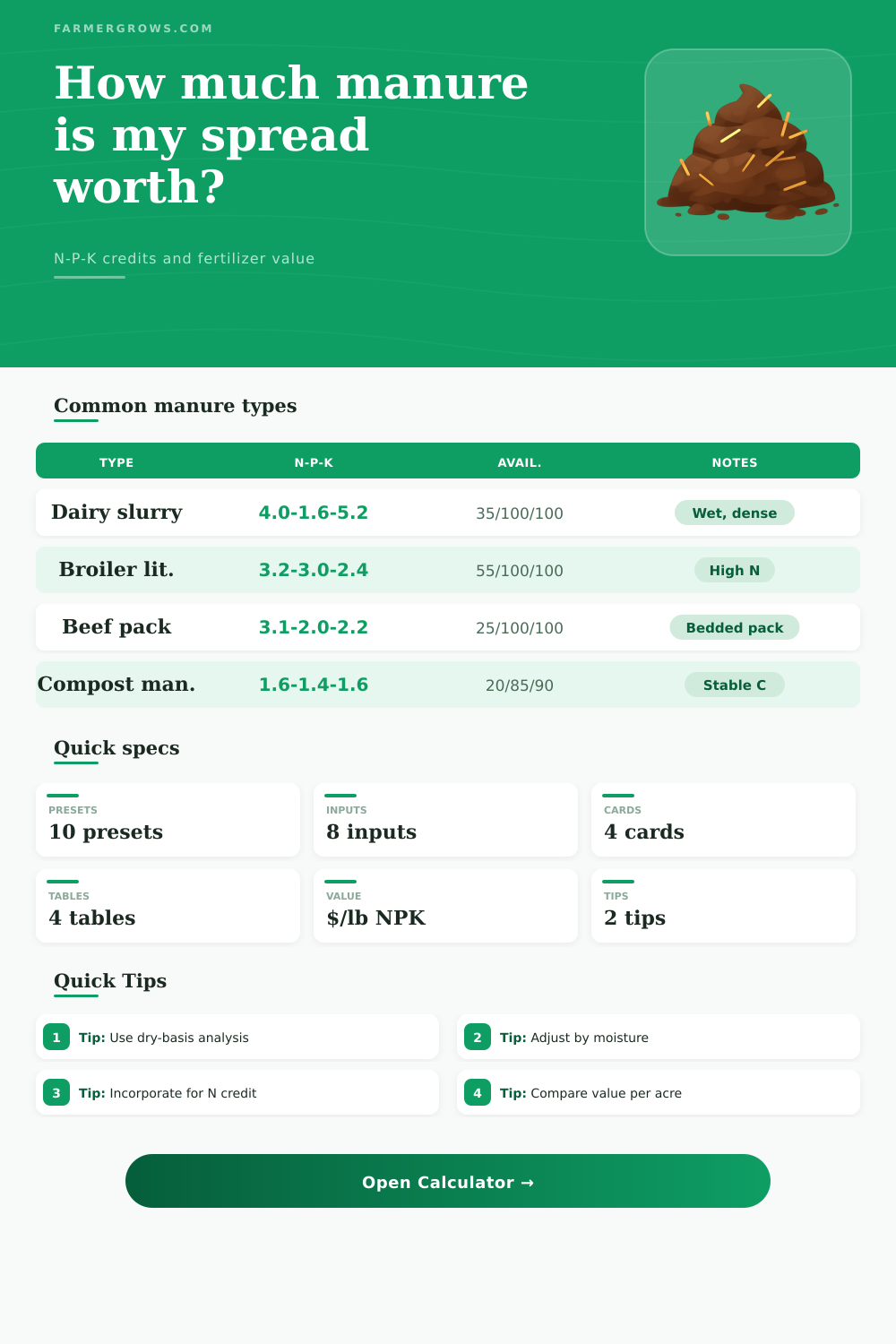
These four cards compare common manure sources on the same nutrient-value assumptions so you can see how moisture, analysis, and availability affect market value.
| Source | Moisture | Dry N-P-K | Use note |
|---|---|---|---|
| Dairy slurry | 88-94% | 3.0-1.5-4.5 | Liquid, dilute |
| Broiler litter | 20-30% | 3.0-3.0-2.5 | Strong N |
| Beef pen pack | 45-60% | 2.8-1.9-2.2 | Bedded mix |
| Composted | 30-40% | 1.6-1.4-1.6 | Stable, lower N |
| Handling method | N % | P2O5 % | K2O % |
|---|---|---|---|
| Surface spread | 25-40% | 90-100% | 95-100% |
| Incorporated | 40-60% | 95-100% | 100% |
| Injected/liquid | 55-70% | 100% | 100% |
| Composted | 15-30% | 80-95% | 85-95% |
| Nutrient | Default | Typical range | Notes |
|---|---|---|---|
| N | $0.95 | $0.70-1.20 | Fast credit |
| P2O5 | $0.68 | $0.50-0.90 | Builds soil P |
| K2O | $0.52 | $0.35-0.70 | Potash value |
| Blend | Auto sum | Manual edit | Change inputs |
| Scenario | Rate | Coverage | Comment |
|---|---|---|---|
| Dairy slurry | 15-25 t/ac | Field wide | Liquid haul |
| Broiler litter | 3-6 t/ac | Band or spread | High value |
| Beef pen pack | 8-15 t/ac | Pasture acres | Lower N |
| Compost manure | 6-12 t/ac | Topdress | Slow release |
Use dry-basis analysis from the lab that matches the manure pile or lagoon sample.
Incorporate quickly after spreading to protect ammonia-N and improve fertilizer credit.
Manure contain nutrients that can be utilized as a fertilizer for crop. However, manure isnt a uniform material. For instance, dairy slurry often contain high amounts of both water and potassium.
Broiler litter, on the other hand, contains less water then dairy slurry, but contains more higher amounts of nitrogen. Furthermore, the varying amount of water present in manure can change the nutrient value of the manure. Thus, prior to determining the value of the manure, you must first calculate the nutrients contained within the manure on a dry basis (excluding the weight of the water in the manure).
How to Find the Value of Manure as Fertilizer
The availability of nutrients within manure can also change depending off the method used to apply the manure to the fields. For instance, nitrogen is one nutrient that may be lost to the air through a process known as volatilization. Volatilization is more common with the use of surface application methods for applying manure to the soil; incorporation or injection method for manure will increase the availability of nitrogen.
Phosphorus and potassium are nutrients that does not volatilize, so there availability is near 100% with any manure application methods. However, if the farmer composts the manure prior to application to the field, the availability of nitrogen will decrease. The calculator that you may utilize can assist in determining the value of the manure.
Specifically, you can select the shape of the field (such as rectangle, circle or triangle) to account for the area of the field. Preset type of manure can be selected, as well as the moisture content (based upon a sample of manure from a recent laboratory analysis). The calculator will calculate the available nutrient credit per acre based upon the dry-basis percentage of nutrients in the manure.
Furthermore, you can enter the current prices of commercial fertilizers into the calculator. Knowing the price of commercial fertilizer allows for the determination of the value of the manure in dollar. For instance, if the price of nitrogen change, you can enter the price of nitrogen into the calculator; the value of the manure will change accordingly.
Another factor to consider is the rate at which the manure is to be applied to the field. Too much dairy slurry may lead to the addition of too much potassium to the field. Applying broiler litter at rates of 4-6 tons per acre will provide the crops with balance nutrition without adding too much phosphorus to the fields.
However, applying too much manure to the fields can lead to nutrient runoff. Regulations exist that place a cap on the rate at which manure can be applied to fields based upon test of the soil. You must follow these regulations when applying manure to fields.
Broiler litter have a high economic value per ton compared to other type of manure. Broiler litter contains low amount of moisture and high amounts of nitrogen. Dairy slurry has a lower value per ton than other manure types because it contain high amounts of water.
Composted manure slowly release nutrients, but does not contain as high an amount of nutrients as broiler litter. These type of calculations can be performed alongside one another. By running these number alongside one another, it is possible to determine the most cost-effective type of manure for a particular farming operation.
Several factor can impact the amount of nitrogen that can be received from manure applied to the fields. For instance, when manure is applied in the spring, the loss of nitrogen may differ from manure applied in the fall. Additionally, sandy soil and clay soils react differently to volatilization of nitrogen.
Therefore, another variable to consider is the crop rotation on the fields. Finally, manure provide organic matter to the soil. Organic matter increase the tilth of the soil over many years; however, commercial fertilizers do not provide organic matter to the soil.
In order to accurately calculate the manure value of the fields, another calculation that you should perform is analyzing the manure in a laboratory. Using the book value of manure analyses is a common error. The manure pile can be sampled for dry-basis analysis.
Furthermore, another factor to consider is the weather. Rainfall after the application of manure can increase the nitrogen that enter the fields. However, rainfall can lead to nutrient runoff.
Thus, another consideration is the weather conditions after application of manure to the fields. By using the calculator to determine the value of the manure, as well as by following these step, manure can be transformed from a waste product into a valuabel fertilizer for crop.